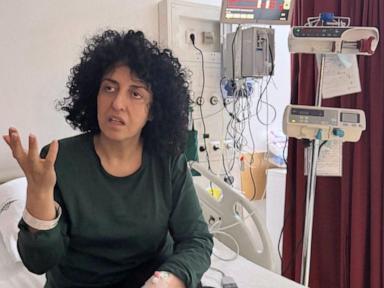
After nine weeks of strategic delays and international outcry, Iranian authorities finally authorized the transfer of Nobel Peace Prize laureate Narges Mohammadi from Evin Prison to a hospital. This move, reported by her family and the Free Narges Coalition on October 28, 2024, is not an act of state-sponsored mercy. It is a desperate reaction to the visibility of a dying woman. Mohammadi, 52, has spent the better part of two decades cycling through interrogation rooms and concrete cells, but her current health crisis represents a more quiet, insidious form of state execution.
The transfer follows a bone marrow biopsy that was delayed for months, despite Mohammadi suffering from chronic heart disease and a series of alarming physical setbacks. In the world of Iranian political detention, the "medical leave" is a well-worn currency. The state uses it to alleviate international pressure just before a breaking point, only to return the prisoner to the same conditions that caused the ailment once the spotlight dims.
The Strategy of Attrition
The Iranian judiciary operates on a principle of slow-motion destruction. When a high-profile activist like Mohammadi cannot be silenced through traditional sentencing, the prison system itself becomes the weapon. This isn't about a lack of resources. Tehran has world-class medical facilities. The bottleneck is the prosecutor’s office and the intelligence apparatus, which must sign off on every "outside" medical visit.
For Mohammadi, this bureaucracy has been lethal. Since winning the Nobel Peace Prize in 2023, her treatment has noticeably soured. She was denied access to a telephone for nearly a year. She was denied hospital transfers because she refused to wear the mandatory hijab during transport. By making medical care conditional on a symbolic act of submission, the state forced a choice between her physical survival and her ideological integrity. Mohammadi chose the latter, and the state responded by letting her health crater.
The current hospitalization covers a litany of issues: multiple lesions on her bone, a suspected heart condition, and the lingering effects of a 2022 surgery where she had a stent placed in a clogged artery. To view this as a standard medical emergency is to ignore the context of the last decade. This is a controlled demolition of a human being.
The Bone Marrow Red Herring
While the immediate focus is on her hospitalization, the underlying investigative trail points to the bone marrow biopsy results. Sources close to the family indicate that the delay in this specific test was not accidental. Bone marrow issues often signal severe underlying conditions, including various forms of cancer or autoimmune failures brought on by prolonged stress and lack of sunlight.
By stalling the biopsy, the Iranian authorities ensured that any diagnosis would be "late-stage." This provides the state with a convenient shield. If Mohammadi’s condition becomes terminal, they can claim it was an unfortunate natural progression rather than the direct result of the 12-year sentence she is currently serving. This is the "death by natural causes" loophole that has claimed several political prisoners in Evin over the last five years.
The Refusal of Hijab as a Medical Barrier
The standoff regarding the headscarf is not a minor detail; it is the crux of the current crisis. In late 2023 and early 2024, several scheduled hospital transfers were canceled at the prison gates. Guards demanded Mohammadi wear the hijab; she refused, citing her "Woman, Life, Freedom" convictions. The state’s insistence on this protocol during a medical emergency is a calculated gamble. They know that for Mohammadi, the hijab represents the very system she is fighting. By tying her heart medication and diagnostic tests to the veil, they are attempting to break the symbol of the Iranian resistance from the inside out.
International Hypocrisy and the Nobel Curse
There is a grim irony in the Nobel Peace Prize. While it provides a temporary shield of global visibility, it often accelerates the "security" measures taken against the recipient. Since the 2023 announcement, Mohammadi has faced additional charges, including "spreading propaganda against the state" while behind bars.
The international community, including the UN and various human rights watchdogs, has issued the standard battery of "grave concern" statements. However, the lack of tangible diplomatic consequences for Iran’s treatment of political prisoners allows the regime to continue its policy of medical neglect with impunity. The Iranian government views these prisoners as assets—human chips to be traded in broader geopolitical negotiations. But a sick asset loses its value. This is likely why the transfer was finally permitted; a dead Narges Mohammadi is a far more powerful martyr than a living, imprisoned activist.
Comparison of Medical Access in Evin Prison
The disparity in care within the prison system reveals the targeted nature of Mohammadi's neglect.
- Standard Criminals: Generally receive basic infirmary care and routine transfers for acute issues without ideological conditions.
- Low-Profile Political Prisoners: Subject to the whims of the warden, but often granted "furlough" if family can pay substantial bail.
- High-Profile Ideologues (Mohammadi): Transfers are handled by the Revolutionary Court. Care is used as a bargaining tool for public retractions or forced confessions.
The Infrastructure of Evin Prison Infirmary
To understand the severity of her situation, one must look at the "medical wing" within Evin. It is notorious for being understaffed and over-encumbered. Doctors there are often under the thumb of the Ministry of Intelligence. When a physician recommends an outside transfer, that recommendation must go through a "Medical Commission." This commission is not a board of doctors; it is a security screening.
In Mohammadi’s case, the Medical Commission repeatedly ignored the warnings of prison doctors who noted her declining heart function. This suggests a top-down directive to keep her within the walls of the prison for as long as physically possible, regardless of the risk of cardiac arrest.
The Psychological Toll of Isolation
Beyond the physical ailments, the state has weaponized isolation. Mohammadi has not heard her children's voices in years. They live in France with her husband, Taghi Rahmani. The denial of phone calls and family visits is a deliberate tactic to induce clinical depression, which further weakens the immune system. When the body is fighting a bone marrow disorder and a heart condition, the psychological weight of total silence from the outside world can be the deciding factor in recovery.
The Logistics of the Transfer
The transfer to the hospital does not mean Mohammadi is free. She remains under heavy guard. Her hospital room is effectively an extension of her prison cell. Windows are blacked out or barred, and the "nursing" she receives is monitored by security personnel. This is "prison-hospitalization," a state of limbo where the patient is treated just enough to keep them alive for the next round of interrogations.
Her family has called for her "unconditional release" on medical grounds, citing Iranian law which theoretically allows for the release of prisoners who are physically unfit to serve their sentences. However, the "unfit" designation is rarely granted to those the regime deems a threat to national security. In the eyes of the Islamic Republic, Mohammadi’s ideas are more dangerous than her physical presence.
The Bone Lesions and the Unknown
The most concerning development in her recent health reports is the mention of bone lesions. In a woman of her age, subjected to the diet and environmental stressors of Evin, this could point to severe osteoporosis or something far more malignant. The fact that it took months to move her for a biopsy is a violation of the most basic medical ethics.
If the biopsy reveals a malignancy, the Iranian state faces a PR nightmare. They will be forced to either release her—which they view as a sign of weakness—or oversee her death in custody, which could spark a second wave of the "Woman, Life, Freedom" protests that shook the country in 2022.
The Path Forward for the Resistance
Narges Mohammadi’s struggle is no longer just about her own life. She has become the physical embodiment of the friction between the Iranian people and the clerical establishment. Every day she spends in a hospital bed under guard is a reminder of the state’s inability to silence her voice, even when they control her breathing.
The "medical transfer" is a tactic to buy time. The regime is waiting for the news cycle to shift, for the Nobel committee to find a new cause, and for the Iranian public to grow weary. But the reality on the ground suggests otherwise. The transparency of her condition, fueled by her family’s refusal to stay quiet, has turned her medical records into a manifesto of state failure.
The only remaining question is whether the international pressure will move beyond rhetoric into the realm of actual diplomatic cost. Until the Iranian judiciary sees a direct link between the health of its political prisoners and its own survival on the global stage, the "slow execution" of activists like Mohammadi will remain standard operating procedure.
The hospital stay will likely be brief. The state will seek to stabilize her, run the bare minimum of tests, and shuffle her back into the shadows of Evin before she can become a rallying point for the doctors and nurses attending to her. They are not treating a patient; they are managing a liability.