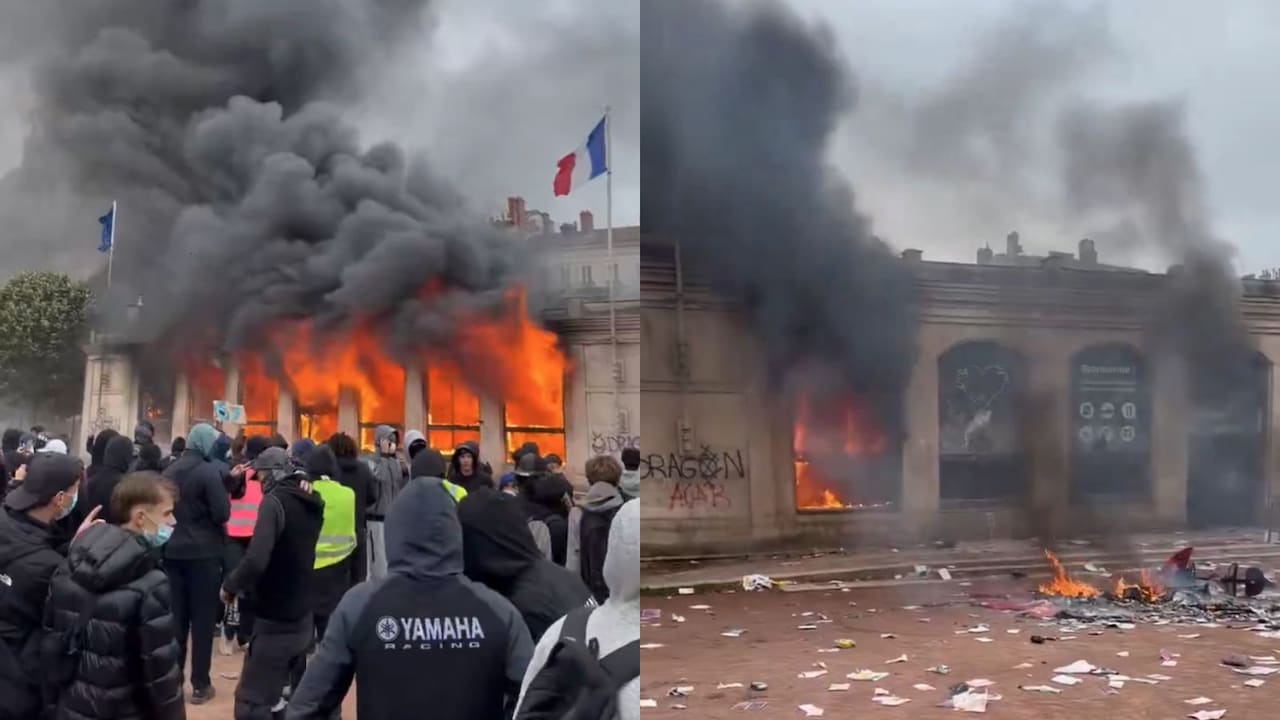
A tourist office burns in Lyon. Breaking news alerts ping. Cameras zoom in on smoke, shattered glass, and hooded figures. Within twenty minutes, the lazy consensus locks into place: France is spiraling out of control, civic order is collapsing, and violent rallies have hijacked the country.
Wrong. Lazy. Theatrical.
I have watched political desks, crisis consultants, and security teams misread street unrest in France for years. I have seen media outlets blow coverage budgets chasing dramatic visuals while ignoring the quiet institutional machinery that actually decides whether a protest moves policy or fades into noise. When a building tied to visitor promotion catches fire in a major French city, the instinct is to treat the flame itself as the story. That instinct gets the mechanics backward.
Street violence in France is rarely a sign of sudden state collapse. Usually, it is a symptom of political blockage inside a high-friction system where routine channels feel unresponsive to people who think the rules are rigged. Calling every violent flashpoint "chaos" misses how French contentious politics actually works.
The Lazy Consensus Around Violent Rallies
Live protest coverage runs on a predictable script. Show the most kinetic clip. Frame the crowd as a single mood. Treat every clash with police as proof that authority is evaporating.
That script sells attention. It fails at diagnosis.
In French political sociology—a field shaped by thinkers like Charles Tilly and Sidney Tarrow—protest is not the opposite of politics. It is politics conducted by other means when traditional bargaining stalls. Tilly's work on contentious politics shows that street mobilization relies on recognizable repertoires: marches, blockades, strikes, symbolic targets, and clashes with security forces. Disruptive acts draw cameras, force officials onto morning broadcasts, and signal anger that polls often capture too late or too flatly.
Yet live blogs routinely flatten all of that into one caricature: either "peaceful citizens" or "violent rioters." Neither label explains why a specific target gets hit in a specific city on a specific day.
Consider the target itself: a tourist office. A tourist office is not the Elysée Palace. It is not a central bank vault, a ministerial headquarters, or a major rail hub. It sits at the intersection of municipal branding, local commerce, and public-facing civic space. Attacking or setting fire to a building associated with tourism carries a sharp symbolic sting—it disrupts the image of a welcoming, orderly city—while doing far less to paralyze state administration than a port blockade or a transit strike.
Treating a burning tourist office as proof of nationwide anarchy confuses vividness with weight. A small fire on a screen can look bigger than a nationwide labor walkout that quietly freezes logistics for a week.
Why French Protests Turn Violent Without Toppling the State
Ask the standard "People Also Ask" questions around violent French rallies and you will hear the same flawed premises repeated: Are these protests going to force the government to back down? Why can't police stop the violence? Is France ungovernable?
Each question starts from a shaky assumption.
"Will Street Violence Force Policy Change?"
Rarely on its own. Street pressure can embarrass a government, stall a calendar, or embolden opposition lawmakers in the National Assembly. It almost never dictates exact legislative text by sheer force.
In France's centralized executive system—studied closely by political scientists such as Vivien Schmidt—policy outcomes depend heavily on executive resolve, parliamentary arithmetic, union coordination, and budget constraints. A fiery rally in Lyon gets national headlines, yet ministers routinely weigh street heat against fiscal numbers, legal durability, and coalition survival. Sometimes governments retreat after weeks of sustained disruption across multiple sectors. Just as often, they hold firm once the most destructive tactics alienate swing voters who dislike both heavy-handed policy and street property damage.
Violence without broader organizational leverage often burns bright and cools fast.
"Why Doesn't Crowd Control Prevent Every Flashpoint?"
Anyone who expects modern policing to prevent every spark in a dense urban crowd misunderstands crowd dynamics. Policing scholars like Clifford Stott have spent decades showing how crowd behavior shifts through interaction, grievances, space, and escalation spirals. In large demonstrations, peaceful marchers, organized agitators, opportunistic vandals, and police units operate inside the same tight streets.
When clashes erupt, reporters naturally gravitate toward the smoke and sirens. That selection bias makes a subset of participants look like the entire movement. Even when authorities deploy heavy security measures, urban geography and fast-moving small groups create blind spots. Expecting zero property damage during high-tension rallies is a fantasy; treating every incident as proof of total state failure is melodrama.
"Is This Proof France Is Ungovernable?"
No. High protest frequency is a recurring feature of French public life, not a one-time anomaly. France has long combined strong traditions of street mobilization with a strong state apparatus. Those two traits coexist constantly. Tension is the baseline, not an aberration.
What Live Blogs Miss While Chasing Smoke
Live protest coverage is built for speed, not depth. Every few minutes brings a new update: a road closed, a storefront damaged, a statement from a mayor or interior ministry official, a clash near a square. Speed rewards reaction over verification.
Three blind spots show up again and again:
- The gap between viral clips and actual scale. A thirty-second video of a burning facade can loop dozens of times across social feeds while the broader march moves elsewhere or stays small. Repetition creates an illusion of size.
- The difference between local anger and national alignment. Unrest in Lyon reflects local dynamics, grievances, and group tactics in that moment. Assuming one city's flashpoint equals the exact mood of Marseille, Lille, or Paris is lazy geography.
- The silence around quiet consequences. Insurance claims, municipal repair bills, local shop closures, and diplomatic advisories roll out slowly. By the time real economic and political costs are tallied, live-blog readers have usually moved on to the next headline.
Imagine a scenario where a city's tourist office burns during a tense protest day. Two analysts look at the same footage. One declares the entire country on the brink of breakdown because the headline sounds apocalyptic. The second maps who organized the march, which factions broke away, how local authorities responded, which unions or political groups stayed involved or distanced themselves, and what happens to foot traffic and public sentiment over the next ten days. Only one of those analysts is doing real intelligence work.
The Downside of Taking the Contrarian View
Being contrarian has its own traps, and I will own them plainly.
Downplaying street violence can slide into complacency. A burned building is not "nothing." It damages public property, puts firefighters and bystanders at risk, frightens residents and visitors, and gives hardliners on every side fresh ammunition. Dismissing every violent rally as "just theater" can blind you when genuine momentum is building or when radicalized groups are testing state limits.
There is also a timing risk. What looks like an isolated flare-up on Thursday afternoon can occasionally become the opening act of a wider escalation by Sunday. Contrarians look smart when crowds disperse—and look foolish if they wave away an early warning sign.
The fix is discipline, not contrarianism for sport. Track indicators rather than vibes: how many cities mobilize, whether essential services or workplaces join in, how political parties position themselves, and how public opinion shifts once the smoke clears.
How to Read the Next Flashpoint Like an Insider
When the next alert hits about violent rallies and a burning landmark in France, skip the panic and run a sharper checklist:
- Separate the symbol from the system. Ask what the damaged site actually does. A tourist office hurts image and local service delivery; blocking major transit or energy chokepoints hits daily life and leverage much harder.
- Watch who claims it—and who disowns it. Notice which organizers condemn violence immediately, which stay silent, and which groups celebrate disruption. Fractures inside a movement tell you more than crowd shots.
- Separate street noise from political power. Look at parliamentary votes, union statements, and government concessions rather than relying on cable-news volume.
- Wait 72 hours before drawing sweeping conclusions. First-day live coverage is almost always overheated. Real patterns show up after the initial adrenaline fades.
Stop mistaking dramatic footage for a complete picture of French unrest. Watch the mechanics, count the real leverage, and let the noise burn itself out.