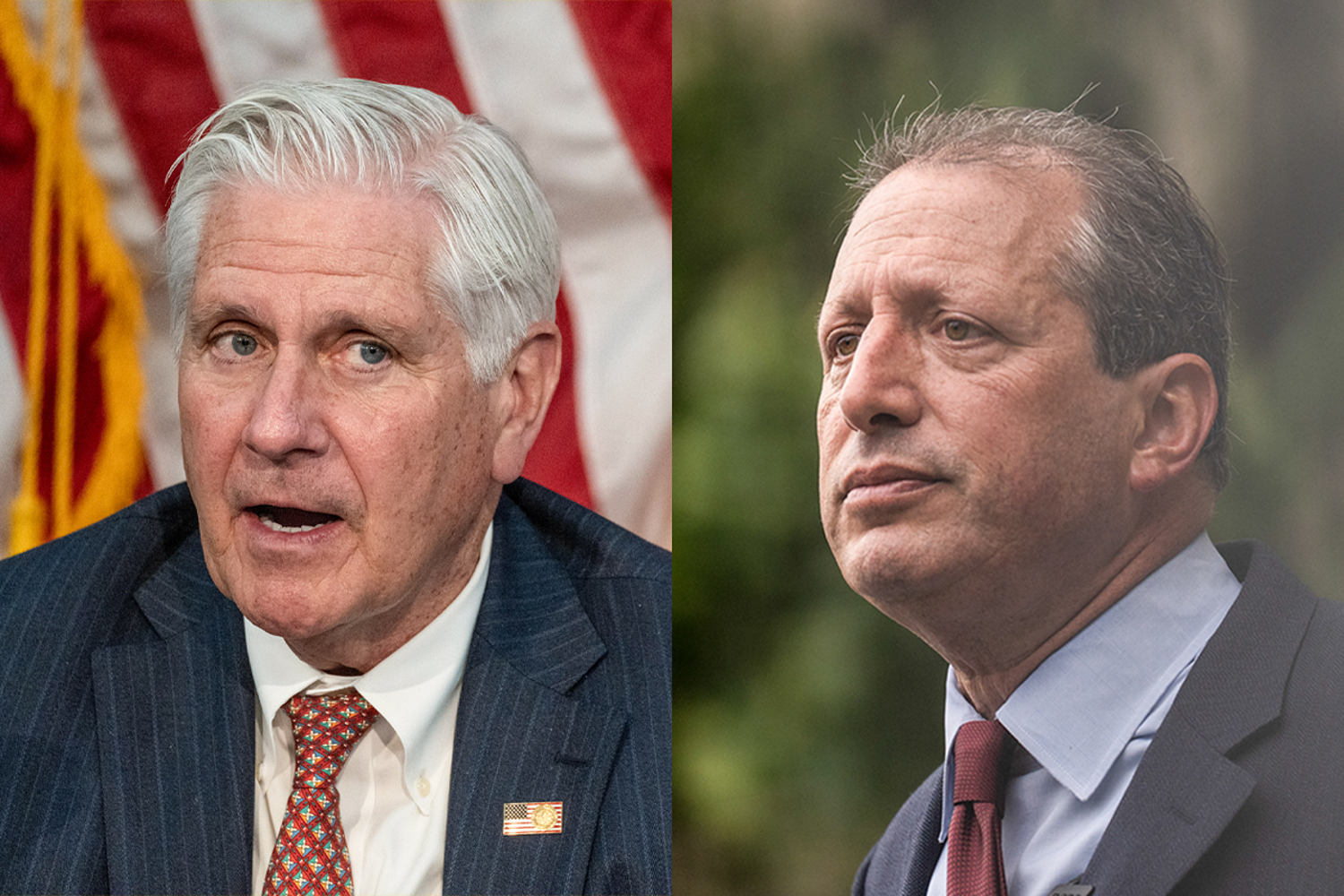
The race for the governor’s mansion in Albany has descended into a dark, historical abyss. Bruce Blakeman, the Republican nominee for Governor of New York, recently declared during a Newsmax interview that Democratic congressional candidate Brad Lander would be “a camp guard in the concentration camp” for the Nazis if he could. This was not a slipped tongue in a late-night town hall. It was a calculated, televised assault directed at a fellow Jewish public official. The remark immediately ignited a firestorm across the state, prompting conditional walkbacks and fierce condemnation that highlights a broader, systemic rot in American political discourse.
Blakeman later attempted to soften the blow, telling reporters that while "camp guard" might have been too strong, he stood by the core sentiment, pivoting instead to the label of "collaborator." This semantic shifting does nothing to erase the gravity of the initial smear. The deployment of Holocaust imagery to litigate modern policy disputes has moved from the radical fringe directly into mainstream party politics.
To understand how New York politics arrived at a point where major-party nominees casually trade accusations of Nazi complicity, one must look closely at the changing electoral map.
The Leftward Surge and the Right Response
The backdrop to this rhetorical escalation is a shifting landscape within New York’s Democratic primaries. Brad Lander, a prominent progressive and former New York City Comptroller, recently secured the Democratic nomination for New York’s 10th Congressional District. He did so by executing a successful primary ouster of the incumbent centrist Representative Dan Goldman.
Lander’s victory was heavily propelled by the endorsement of New York Mayor Zohran Mamdani and a coalition of leftist organizations. The primary contest between Lander and Goldman served as a proxy war for the soul of the party, deeply divided over the Israeli-Palestinian conflict. Goldman ran as an unapologetic supporter of the current Israeli administration, heavily backed by traditional pro-Israel fundraising networks like the American Israel Public Affairs Committee. Lander, positioning himself as a "liberal Zionist," pledged to champion Palestinian human rights while simultaneously vowing to combat domestic antisemitism. He explicitly rejected funds from corporate lobbying groups, a move that energized the city's progressive base.
This victory by the Democratic party’s left wing has sent shockwaves through the state's conservative establishment. Nassau County Executive Bruce Blakeman, having secured the Republican gubernatorial nomination to challenge incumbent Governor Kathy Hochul, is attempting to position himself as the ultimate defense against a rising socialist tide in the state's urban centers.
Weapons of Mass Distortion
The weaponization of historical trauma is a desperate tactic, but it is one that yields high returns in the modern attention economy. By invoking the Holocaust, political actors bypass policy debates entirely, moving directly to total moral excommunication. Representative Jerry Nadler led the institutional backlash against Blakeman, calling the remarks a "grotesque desecration" of the six million Jews murdered by the Nazi regime.
The strategy behind Blakeman's rhetoric is clear.
- Guilt by Association: Linking progressive policy positions on foreign affairs directly to historic atrocities.
- Radical Simplification: Reducing nuanced debates regarding international law and human rights into binary struggles of good versus absolute evil.
- Base Mobilization: Using maximum outrage to drive campaign donations and voter turnout in conservative suburban enclaves like Nassau County.
The long-term danger of this approach lies in the complete destruction of shared civic reality. When political opponents are no longer viewed merely as mistaken, but rather as literal facilitators of genocide, compromise becomes impossible. Governing a diverse state like New York requires a baseline level of mutual recognition.
A Pattern of Escalation
This is not an isolated rhetorical flare-up. It is part of a deliberate pattern of boundary-testing by candidates seeking to break through an increasingly fragmented media ecosystem. Earlier this year, Blakeman sought to build momentum by staging high-profile media appearances on the steps of City Hall, aggressively labeling Governor Hochul and Mayor Mamdani as the "taxing twins" and filing lawsuits against the Campaign Finance Board over matching funds.
As the margins between the major parties tighten in traditional swing areas across Long Island and the outer boroughs, the pressure to deliver viral, high-impact media moments increases. Policy proposals concerning fracking, wind energy, or tax cuts struggle to capture headlines in the way that a shocking, historical smear can.
The collateral damage of this trend is borne by the public. When the language of the state's highest political campaigns borrows from the darkest chapters of twentieth-century history, it desensitizes the electorate to actual bigotry. It reduces genuine historical horrors to mere rhetorical cudgels used to score a fleeting victory on cable news.
The race for the governorship will continue to test these boundaries as November approaches. Whether New York voters will reward this brand of scorched-earth rhetoric remains the defining question of the current electoral cycle. Candidates are betting that outrage will outvote policy, and until that calculation changes at the ballot box, the language will only grow darker.