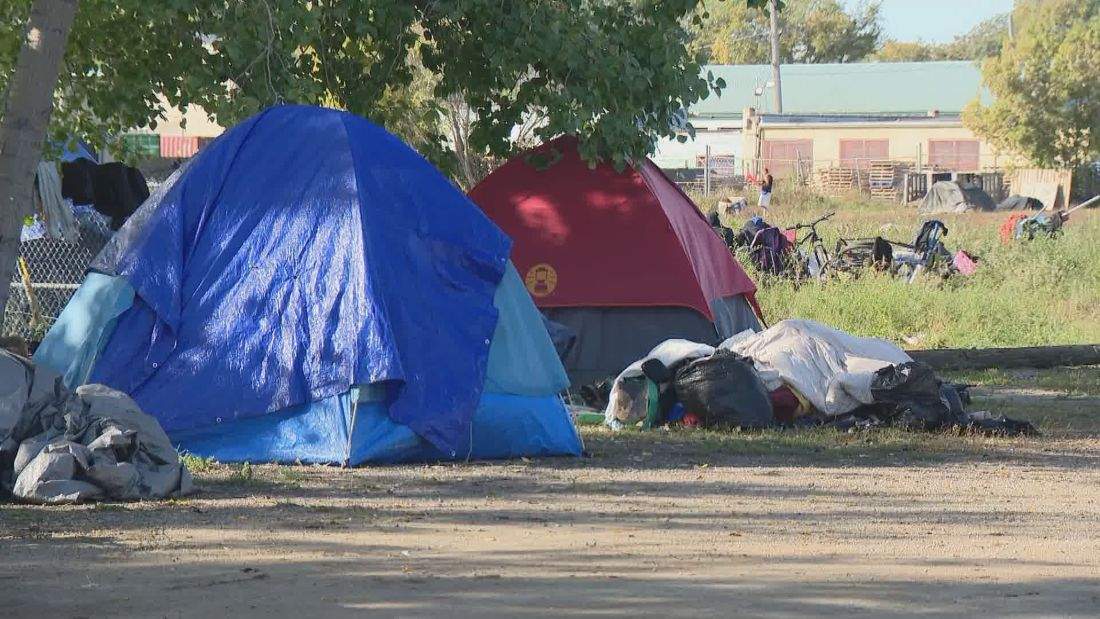
When municipal machinery collides with an unyielding housing crisis, the breaking point rarely arrives quietly. In Saskatoon, the collision materialized on a stretch of Avenue K South, where city crews, police officers, and fire inspectors arrived to dismantle a sprawling tent encampment containing over fifty structures. They expected a routine clearance backed by property maintenance bylaws. Instead, they encountered a human chain, protesters standing atop flatbed trailers, and a wall of community advocates demanding to know where the displaced population was supposed to go.
The operation ground to an abrupt halt. City officials quickly pointed to the hostility of the crowd, citing aggressive language and safety hazards, but framing the standoff as merely a conflict between angry demonstrators and municipal workers misses the entire systemic fracture underneath. Beneath the shouting on 19th Street lies a much deeper municipal failure: a cyclical routine of displacement that solves nothing, costs millions in enforcement, and leaves vulnerable citizens cycling endlessly through the elements. In other news, we also covered: The UAE Air Ban on Iranian Carriers Is Not About Sanctions It Is About Real Estate.
Municipal authorities face a genuine bind. Acting Fire Chief Yvonne Raymer outlined conditions that make urban encampments untenable over the long term, pointing to accumulating human waste, discarded needles, fire hazards, and escalating complaints from nearby St. Mary's School staff and families. Schools should not have to erect temporary fencing to shield children from public hazards, and local residents should not feel unsafe in their own neighborhoods. Public health mandates and municipal bylaws exist to maintain baseline infrastructure, sanitation, and safety for the entire tax-paying public.
Yet enforcing those bylaws without a viable destination for the evicted creates an expensive feedback loop. Critics of the city's approach, including local residents living directly across from the site, have noted that clearing these lots functions as a temporary bandage on a chronic injury. People pack up what little they own, move a few blocks away, and rebuild the exact same structures weeks later because the structural deficit of affordable, low-barrier housing remains unaddressed. Associated Press has also covered this fascinating topic in great detail.
The friction also highlights a widening gulf between municipal enforcement and social advocacy groups. Officials reported that offers of support from the Salvation Army and the fire department were widely declined during pre-eviction visits. From the perspective of municipal administrators, offering shelter spaces that go unfilled reads as refusal of assistance. From the perspective of encampment residents and street-level outreach workers, temporary emergency shelter beds often come with rigid restrictions, curfews, or safety concerns that make them untenable for people dealing with severe trauma, addictions, or medical vulnerabilities like dialysis requirements.
Legal challenges are increasingly altering how Canadian municipalities handle these standoffs. Following court rulings in other jurisdictions—such as decisions in Quebec emphasizing that cities cannot dismantle encampments without offering genuinely safe, secure alternatives—Canadian cities find themselves entangled in constitutional and human rights scrutiny. The King's Bench court filings in Saskatoon forced a legal pause, transforming what used to be a simple municipal cleanup into a high-stakes constitutional test of municipal authority versus basic survival needs.
When cities treat homelessness primarily as a zoning violation or a code compliance issue, they invite endless legal battles and physical standoffs. Real estate prices, inflation, and a severe shortage of permanent supportive housing have created an urban underclass that cannot be swept away by municipal machinery. Until governance shifts from reactive displacement to the large-scale creation of low-barrier supportive housing, every scheduled cleanup will simply set the stage for the next confrontation.