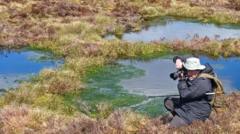
For decades, global climate strategies ignored the mud. Environmental policy focused heavily on planting trees, a visible and photogenic solution to carbon emissions. However, a quiet rebellion led by specialized wetland scientists—frequently symbolized by figures like Scotland's "Bogfather," Dr. Roxane Andersen—has forced a radical shift in perspective. Peatlands cover a mere 3% of the Earth's land surface but store twice as much carbon as all the world’s forests combined. Stripping away the romanticism of rural conservation reveals a harsher reality: rewriting global carbon accounts requires more than just blocking drainage ditches with plastic boards. It demands a massive, legally fraught overhaul of industrial agriculture and a confrontation with a carbon credit market currently plagued by systemic flaws.
The Anatomy of a Methane Spike
Peatlands are evolutionary anomalies. In a healthy bog, waterlogged conditions suffocate the microbes that would otherwise decompose organic matter. Dead moss accumulates layer by layer over millennia, locking carbon deep underground.
When landowners cut drainage channels into these landscapes—historically encouraged by government subsidies to expand sheep farming or commercial forestry—oxygen rushes into the soil. The dormant microbes wake up. They consume the dried peat and release massive plumes of carbon dioxide into the atmosphere. Dried, degraded peatlands are no longer carbon sinks. They are slow-motion wildfires. Combined, they account for roughly 5% of all human-caused global carbon emissions.
Restoration sounds deceptively simple. You bring in heavy excavators, smash the artificial drainage networks, and allow the water table to rise back to the surface. Sphagnum moss returns, and the carbon leaking stops.
The immediate chemical consequence, however, is far messier than most corporate sustainability reports care to admit.
When you flood a dry, degraded bog, you create an initial spike in methane emissions. Methane is a greenhouse gas with a warming potential significantly higher than carbon dioxide over a twenty-year timescale. For the first decade or two following rewetting, a restored bog can actually accelerate atmospheric warming before it stabilizes into a net-cooling asset.
Healthy Bog (Anoxic)       --> Absorbs CO2, emits trace methane
Drained Bog (Aerated)      --> Emits massive CO2
Newly Rewetted Bog         --> Drops CO2 emissions, spikes methane emissions
Fully Restored Bog (Decades)--> Stable carbon sink
This temporary surge creates an accounting nightmare for corporations looking for quick offsets. A business cannot fund a peatland project today and legitimately claim a net reduction in atmospheric warming tomorrow. The math simply does not work that way.
The Paper Bogs of the Offset Markets
The financial system underpinning ecological restoration is built on shaky foundations. Private finance has rushed toward peatland credits, drawn by the promise of high-integrity, long-term carbon storage. Wealthy buyers pay premium prices for these credits, believing they are funding permanent ecological fixes.
They are often buying illusions.
The methodologies used to quantify carbon savings from peatland restoration rely heavily on proxy measurements rather than direct emissions tracking. Measuring the actual gas exchange above a remote, windswept Scottish blanket bog or an Indonesian tropical peat swamp requires incredibly expensive equipment. Scientists use eddy covariance towers—metallic structures packed with fast-response sensors that calculate the vertical movement of gases within the atmospheric boundary layer.
Because these towers are rare and expensive to maintain, carbon registries use water-table depth as a proxy. The logic dictates that if the water is within ten centimeters of the surface, a specific volume of carbon is being saved.
This assumption oversimplifies highly volatile systems. A sudden drought can drop the water table for months, turning a credited project right back into a carbon emitter. Most carbon markets lack the rigorous verification mechanisms needed to catch these shifts in real time.
Compounding this technical gap is the issue of permanence. A forest can burn down in a week, a vulnerability that carbon markets try to mitigate through "buffer pools" of extra credits. Peatlands face a more insidious, long-term threat from shifting climate zones. As global temperatures climb, the geographic regions capable of supporting self-sustaining, wet bogs are shrinking. Funding a restoration project in an area projected to face severe multi-year droughts by 2050 is a losing gamble. The locked carbon will eventually return to the atmosphere, rendering today's corporate carbon-neutral claims retroactively false.
The Fierce Resistance from the Soil
The technical challenges of rewetted dirt pale in comparison to the socio-economic warfare playing out on the ground. Peatland restoration is not happening in a vacuum; it occurs on land that people rely on for their livelihoods.
In Western Europe and parts of North America, centuries of agricultural development have turned fertile, drained peat soils into prime farming territory. The Fens in eastern England or the organic soils of the American Midwest produce a disproportionate share of high-value crops. Telling a multi-generational farming community that their highly productive fields must be turned back into unproductive, mosquito-breeding swamps for the sake of global carbon accounting is a political non-starter.
This tension has birthed a compromised approach known as paludiculture, or wet agriculture. This method allows farmers to cultivate specialized water-loving crops like reeds for insulation material, cattails for building fibers, or specific mosses for horticulture, all while keeping the water table high enough to protect the underlying peat.
| Land Use Type | Carbon Emissions Profile | Economic Output |
|---|---|---|
| Drained Agriculture | Extremely High CO2 source | High-value food crops |
| Full Restoration | Methane spike, then long-term sink | None (Conservation only) |
| Paludiculture | Near-neutral or low sink | Specialized industrial fibers |
Paludiculture remains an experimental niche. Supply chains for reed-based insulation or moss-based potting soil are virtually non-existent. Processing facilities do not exist at scale, and manufacturers are hesitant to retool their factories for unproven raw materials. Farmers face a steep financial cliff if they abandon traditional crops, and the current value of carbon credits is nowhere near high enough to bridge that income gap.
The Industrial Turf Wars
Further complications arise in regions where peat extraction remains an active, legal industry. In parts of Eastern Europe, Ireland, and Canada, peat is still harvested for fuel or sold to the global horticultural industry as a cheap growing medium for backyard gardeners and commercial greenhouses.
Transitioning these economies away from extraction involves navigating dense webs of land rights, mining permits, and local employment dependency. When a government decides to phase out peat harvesting, it faces immediate pushback from labor unions and industrial lobbies.
Even when extraction halts, the remaining landscape is deeply scarred. Industrial harvesting strips away the living top layer of sphagnum moss, leaving behind bare, black fields of compressed, ancient organic matter. Restoring these industrial sites is not a matter of simply turning off the pumps. The natural seed bank is gone. The microclimate has changed completely. Without active, highly labor-intensive intervention—such as manually spreading harvested moss fragments and anchoring them down with straw mulch—the bare peat will continue to erode into local river systems, poisoning aquatic ecosystems with dissolved organic carbon and clogging water treatment plants downstream.
Re-engineering the Restoration Matrix
If peatland restoration is to transcend its current status as a corporate public relations trend, the entire operational framework must be rebuilt from scratch.
First, the carbon markets must abandon the fiction of cheap, hands-off verification. Technology must replace guesswork. Satellite-based radar systems can now track millimeter-scale changes in land surface elevation, a phenomenon known as "bog breathing." As a peatland takes on water and recovers, the entire surface physically rises and expands. By pairing this satellite interferometry with targeted AI modeling and a denser network of ground-based flux towers, registries could establish an undeniable, transparent record of whether a bog is actually storing carbon or quietly rotting away.
Second, the definition of success needs a radical rewrite. Governments must stop funding projects based on the sheer number of hectares rewetted or the number of dams installed. This creates a perverse incentive for quick, shoddy work where contractors block a few ditches, cash the check, and walk away before the dams fail during winter floods. Instead, public and private financing must be tied to long-term ecological performance indicators measured over decades, including the return of specific plant communities and the stabilization of the local water table.
This shift requires rewriting property laws and creating new legal frameworks for "environmental easements" that bind landowners to maintenance schedules lasting a century or more. It means acknowledging that true carbon sequestration cannot be bought on a standard quarterly corporate timeline.
The mud will not save the climate on the cheap. Restoring the global peatlands requires a gritty, expensive, and politically uncomfortable confrontation with how we value land, food, and time. Until the financial and scientific structures match the scale of the physical challenge, the vital work of wetland scientists will remain a drop of water in a rapidly drying bucket.