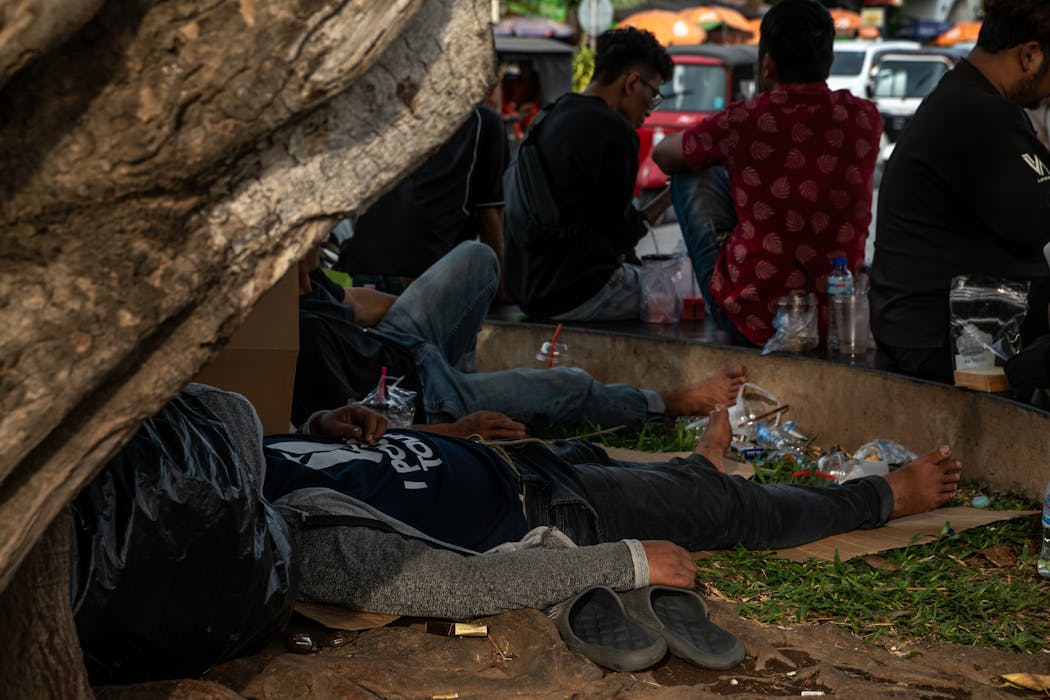
The nightmare doesn't end when the gates of a Cambodian scam compound swing open. You might think escaping a high-security "special economic zone" or a fortified casino building in Sihanoukville means you've won. It doesn't. For hundreds of foreign nationals who managed to flee these modern-day slave camps, the reward isn't a flight home. It’s a concrete slab on a Phnom Penh sidewalk and the constant fear of being hunted by the very syndicates they just escaped.
Human trafficking in Southeast Asia has shifted from the traditional sex trade or fishing boats into something much more corporate and much more sinister. We're talking about massive, multi-billion dollar industrial complexes where people are forced to sit at computers and scam others worldwide. When they get out—whether through a police raid that actually happens or a desperate jump over a barbed-wire fence—they find themselves in a legal vacuum.
Cambodia's streets are now home to a growing population of "survivors" who are technically free but practically trapped. They have no passports. They have no money. Most importantly, they have no official status that protects them from being deported back into the hands of traffickers or thrown into immigration detention centers that feel like the prisons they just left.
Why Escaping a Scam Factory is Only Half the Battle
Most people who end up in these compounds were lured by "high-paying tech jobs" advertised on Telegram or Facebook. They arrive expecting a legitimate customer service role and instead find their passports confiscated. If they refuse to work, they're beaten. If they try to leave, they're sold to another compound.
When someone finally hits the pavement in the outside world, the immediate problem is documentation. These syndicates don't just keep your passport to be mean; they keep it as a leash. Without that little booklet, a victim is an "illegal alien" in the eyes of Cambodian law.
I've seen how this plays out in Phnom Penh. You'll find men and women from Vietnam, Thailand, Malaysia, and even further afield sleeping near the riverside or under bridges. They can't check into a hotel because hotels require passports. They can't get a job because they're physically and mentally broken, and again, they have no papers. They're stuck in a loop. They’re too scared to go to the police because the police in some of these provinces are often on the payroll of the compound owners.
The Complicity of Local Authorities
It’s an open secret. Organizations like Cyber Rights Organization and various UN agencies have documented the deep ties between the elites running these compounds and the local law enforcement. When a victim escapes and runs to a local station, there's a terrifyingly high chance the officer will simply call the compound manager to come pick up their "property."
This isn't just a Cambodia problem, but Cambodia has become the epicenter. The lack of political will to shut these places down creates a permanent underclass of escaped workers. If the government truly wanted to end this, they’d stop treating the victims like criminals. Instead, the official narrative often focuses on "illegal gambling" rather than "human trafficking." By framing it as a gambling issue, the state avoids the messy responsibility of providing victim support services.
Survival on the Sidewalks of Phnom Penh
Life on the streets for a former scam worker is a frantic exercise in staying invisible. They blend in with the urban poor, but the trauma makes them stand out. You see it in the way they flinch when a black SUV with tinted windows passes by. Many of these compounds use private security forces that act like bounty hunters. If a high-value worker—someone with good English or tech skills—escapes, the syndicate might actually put a price on their head.
Food comes from local pagodas or the kindness of strangers. Some local NGOs try to help, but they’re overwhelmed. The sheer volume of people fleeing these sites has outpaced the capacity of every shelter in the city.
The Mental Toll of the "Golden Handcuffs"
Psychologically, these people are shattered. They spent months, sometimes years, being forced to manipulate strangers online. They’ve been complicit in ruining lives, all while their own lives were being ruined by physical abuse and sleep deprivation. Moving from that high-pressure, violent environment to the absolute void of street life causes a specific kind of psychic break.
They don't just need a plane ticket. They need intensive trauma care. But in Cambodia, they’re lucky if they get a bowl of rice and a plastic mat to sleep on.
The Role of Foreign Embassies
You’d think the home countries of these victims would be rushing to help. Some do. Others are shockingly slow. The process for issuing an emergency travel document can take weeks or months, especially if the victim can't prove their identity. During that waiting period, the embassy often doesn't have the budget to house them.
So, the embassy tells them to "wait." And where do they wait? On the street.
I’ve talked to people who have spent three months living outside their own embassy, waiting for a piece of paper that says they exist. It’s a bureaucratic nightmare that ignores the life-and-death stakes on the ground. These people are witnesses to massive international crimes. They are the evidence. Yet, they’re treated like an inconvenience.
How the Scam Industry Reinvents Itself
Every time there's a bit of international pressure, the Cambodian authorities perform a "crackdown." They show up at a compound, take some photos of computers, and announce they’ve cleared the area.
Don't believe it.
The syndicates just move. They move from Sihanoukville to Bavet on the Vietnamese border, or into the remote jungles of Koh Kong. They change their names. They rebrand. And the workers who managed to escape during the chaos of the "crackdown" are often left behind in the dust, forgotten as the circus moves to a new town.
The "scandemic" isn't slowing down. It's evolving. We're seeing more AI-driven scams, which means the syndicates need fewer workers but higher-skilled ones. This makes the remaining human capital even more valuable—and the consequences for escaping even more severe.
Steps to Take if You Want to Help
If you're reading this and feeling helpless, there are actual things that can be done. It’s not just about "awareness." It’s about resources.
- Support Ground-Level NGOs: Groups like Winrock International or local Cambodian human rights organizations like LICADHO are actually doing the work. They provide legal aid and emergency shelter when the government won't.
- Pressure Your Government: If you live in a country where citizens are being trafficked into these zones, demand that your foreign office provides immediate, funded repatriation for victims. Emergency shelters shouldn't be the responsibility of a handful of overstretched charities.
- Report Scam Platforms: Most of this traffic happens on Telegram. Report the "recruitment" channels. It feels like a drop in the ocean, but it disrupts their pipeline.
The reality is that as long as the profit from these scams exceeds the cost of the occasional police bribe, the factories will stay open. And as long as they stay open, the streets of Cambodia will continue to fill with the ghosts of people who thought they were applying for a job in IT.
The next time you see a headline about a "successful rescue" in Cambodia, look closer. Ask where those people are a week later. If they're sitting on a sidewalk in Phnom Penh, they haven't been rescued yet. They've just changed prisons.
Go to the official websites of the International Organization for Migration (IOM) or the Global Coalition Against Ransomware to see the data for yourself. Read the reports. Then, look at the people around you and realize that the person scamming you on a dating app might be the same person currently starving under a bridge in a country they never wanted to visit.


