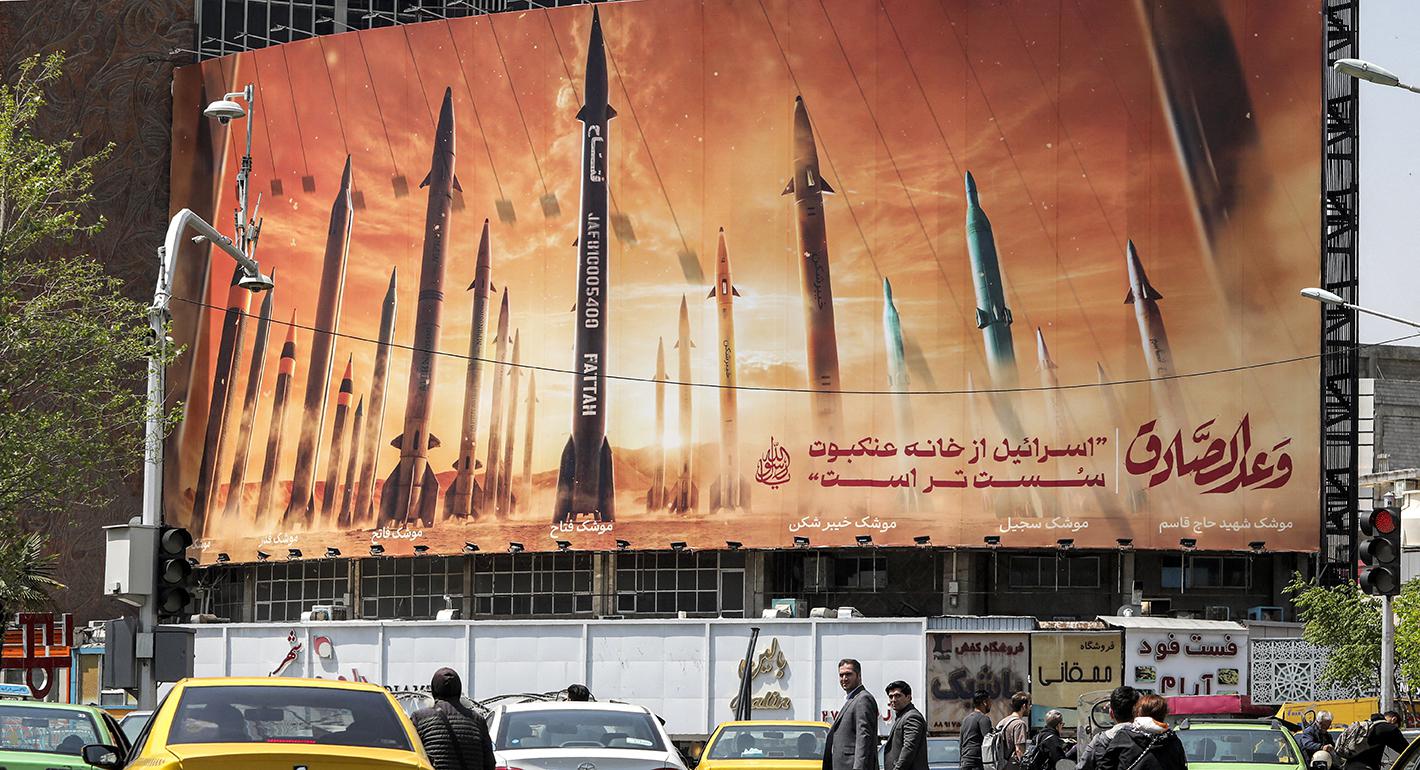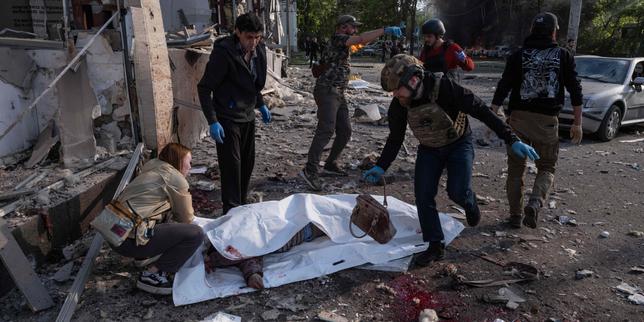
The shift is no longer a matter of debate among ballistics experts and front-line monitors. Since the start of 2024, the frequency and lethality of Russian strikes on Ukrainian urban centers have evolved from sporadic terror into a systematic, high-precision campaign designed to break the domestic social contract. While early in the conflict the world watched the blunt force of unguided "dumb" bombs, the current reality involves a lethal cocktail of North Korean-supplied short-range ballistic missiles, Iranian-designed loitering munitions, and Russian-made glide bombs that are being used to erase the distinction between military targets and residential blocks.
The numbers provide a grim ledger of this escalation. According to data tracked by the United Nations Human Rights Monitoring Mission in Ukraine, civilian casualties increased by nearly 20 percent in the first half of the year compared to the final quarter of 2023. This is not an accident of war. It is the result of a deliberate change in Russian targeting doctrine that prioritizes "double-tap" strikes and the destruction of the thermal and electrical grids that keep civilian populations viable in cities like Kharkiv, Odesa, and Zaporizhzhia.
The Evolution of the Double Tap
One of the most harrowing developments in the recent air campaign is the normalization of the double-tap strike. The mechanism is simple and cruel. A missile hits a residential building or a public square. As first responders, paramedics, and neighbors rush to the scene to pull survivors from the rubble, a second missile hits the exact same coordinates roughly 15 to 30 minutes later.
This tactic is not intended to destroy infrastructure. Its primary goal is to liquidate the rescue infrastructure of the state. When you kill the rescuers, you ensure that the victims of the first strike bleed out. In Kharkiv, a city less than 30 miles from the Russian border, this has become a weekly reality. The short flight time of missiles launched from the Belgorod region gives civilians almost no time to reach shelters, making the second strike even more effective at catching people in the open.
The Glide Bomb Crisis
While the world focuses on high-profile Patriot batteries and ATACMS missiles, the real butcher of Ukrainian civilians right now is the KAB, or guided aerial bomb. These are Soviet-era heavy bombs—some weighing 1,500 kilograms—outfitted with "wings" and GPS guidance kits.
The advantage for Russia is twofold. First, they are incredibly cheap to produce compared to a multimillion-dollar Kalibr cruise missile. Second, they can be launched from Russian aircraft flying 40 to 60 kilometers behind the front lines, well outside the reach of most Ukrainian medium-range air defenses. These bombs do not possess the pinpoint accuracy of Western smart munitions, but when you are dropping a ton and a half of high explosives on a supermarket or a high-rise apartment complex, "close enough" is devastating. The sheer overpressure from a KAB-1500 hit can collapse an entire city block, burying dozens of families under tons of Soviet-strength concrete that even heavy machinery struggles to clear.
Weaponizing the Grid
Beyond the immediate kinetic impact of explosions, Russia has refined its strategy of "strategic deprivation." The objective is to make Ukrainian cities uninhabitable through the systematic destruction of energy generation capacity.
In previous winters, the Kremlin focused on the distribution network—the transformers and substations that move electricity around. These were relatively easy to fix. This year, the focus shifted to the generation itself. Thermal power plants and hydroelectric facilities are being targeted with massive, coordinated waves of drones and missiles.
When a city loses power, it doesn't just lose lights. It loses the ability to pump water to the upper floors of apartment buildings. It loses the ability to process sewage. It loses the ability to keep hospital ventilators running without expensive, fuel-hungry generators. By targeting the "heart" of the utility system, Russia is attempting to force a mass exodus of the population, creating a refugee crisis that puts immense pressure on Western European allies.
The North Korean and Iranian Pipeline
This level of sustained bombardment would be impossible for the Russian defense industry to maintain alone. The influx of North Korean KN-23 ballistic missiles has changed the calculus on the ground. These missiles have been found to have significant failure rates, often landing far from intended military targets and instead striking civilian neighborhoods. To the Russian military command, this inaccuracy is a feature, not a bug. It maintains a constant state of atmospheric terror where no basement is truly safe.
Simultaneously, the Shahed drone—now being manufactured in a specialized facility in the Alabuga Special Economic Zone in Tatarstan—serves as the "chaff" of the Russian air war. By launching dozens of these slow, noisy drones ahead of a cruise missile strike, Russia forces Ukrainian air defense crews to reveal their positions and deplete their limited stocks of interceptor missiles. When a $2 million Patriot interceptor is used to down a $20,000 plastic drone, the economic attrition favors the aggressor.
The Psychological Toll of Constant Alert
To understand the impact on the ground, one must look at the data on sleep deprivation and long-term trauma. In Kyiv, air raid sirens have sounded for thousands of cumulative hours since the invasion began. The constant state of "hyper-vigilance" is a physiological weapon.
Psychologists working with internal refugees note that the unpredictability of the strikes is what causes the most damage. In the early days, strikes followed a somewhat predictable pattern. Now, the Russian Aerospace Forces vary their launch times and flight paths, using the Carpathian mountains or river beds to hide the radar signatures of missiles until the last possible moment. This ensures that the civilian population can never truly settle into a routine of safety.
International Law and the Accountability Gap
Despite the clear evidence of war crimes provided by organizations like Human Rights Watch and Bellingcat, the international legal framework remains largely paralyzed. The International Criminal Court has issued warrants, but on the ground, these do little to stop a flight of Tu-95 bombers from taking off.
The challenge is that Russia has successfully exploited the "gray zone" of international law. By claiming that a struck apartment building was housing "foreign mercenaries" or "clandestine ammo dumps," they provide enough disinformation to muddy the waters in the global South and among Western populist factions. However, the debris found at these sites—toys, schoolbooks, and kitchen appliances—tells a different story.
The Defense Bottleneck
Ukraine’s ability to protect its civilians is currently hamstrung by a math problem. They have a finite number of high-end air defense systems, and they must choose between protecting the front-line troops from air superiority or protecting the millions of civilians in the rear.
When a battery is moved to Odesa to protect grain silos and residential ports, a gap opens in the Donbas. Russia monitors these movements via satellite and drone reconnaissance, often striking exactly where a defense system was recently removed. The arrival of F-16s is expected to provide some relief by acting as mobile interceptors, but they are not a silver bullet against a massed ballistic missile strike.
The Geography of Death
The casualty rates vary wildly depending on proximity to the Russian border. In the west, in cities like Lviv, the "death toll" is often measured in the single digits during a strike, as the missiles must travel hundreds of kilometers through layers of air defense. In the east, in cities like Sumy or Kharkiv, the death toll is often much higher.
In these "zero-warning" zones, the Russian military uses S-300 surface-to-air missiles in a ground-attack mode. Because these missiles were originally designed for air defense, they are highly erratic when used against ground targets. They are essentially massive, high-speed flying bricks of shrapnel. They strike without the warning of a long-range cruise missile launch, giving people in their homes exactly zero seconds to react.
The Economic Attrition of the Civilian State
Russia’s strategy is also an economic one. Each strike on a civilian target forces the Ukrainian government to divert funds from the military budget to emergency services, healthcare, and reconstruction.
Building a modern "passive defense" for the electrical grid—massive concrete bunkers around transformers—costs billions of dollars. Repairing a single struck apartment complex can take months and millions in capital. By forcing Ukraine to spend its limited resources on simply surviving, Russia hopes to hollow out the state from the inside out, making it a failed state regardless of where the front lines are drawn.
The Role of Tactical Innovation
Ukrainians have responded with their own innovations, such as the "e-PPO" app, which allows civilians to report the sound or sight of a missile or drone. This crowdsourced radar data has helped fill the gaps in official coverage, particularly against low-flying Shahed drones.
However, technology can only do so much against the sheer physics of a three-ton missile moving at several times the speed of sound. The only effective counter to the current Russian doctrine is the destruction of the platforms—the bombers on their airfields and the launchers on their pads—which requires a level of deep-strike capability that Western partners have been hesitant to fully endorse.
The reality on the streets of Ukrainian cities is one of exhausted resilience. The "new normal" is a state where the sound of a motorcycle engine can trigger a panic attack and where checking the Telegram "monitoring" channels is the first and last thing people do every day. The escalation of civilian deaths is not a byproduct of the war; it is the central pillar of the current Russian strategy to win by making the cost of Ukrainian existence too high to pay.
The international community's response to this systematic slaughter will determine the future of urban warfare. If the targeting of civilians through guided high-yield explosives becomes an accepted, or at least unpunished, norm, then the concept of the "battlefield" has effectively ceased to exist. Every city is now a target, and every civilian is now a combatant by default.
The defense of Ukraine's airspace is no longer just a military necessity. It is the only way to preserve the basic distinction between a war and a massacre. Until the cost to Russia for launching these strikes exceeds the perceived benefit of breaking the Ukrainian spirit, the strikes will not only continue but will grow in intensity and precision.