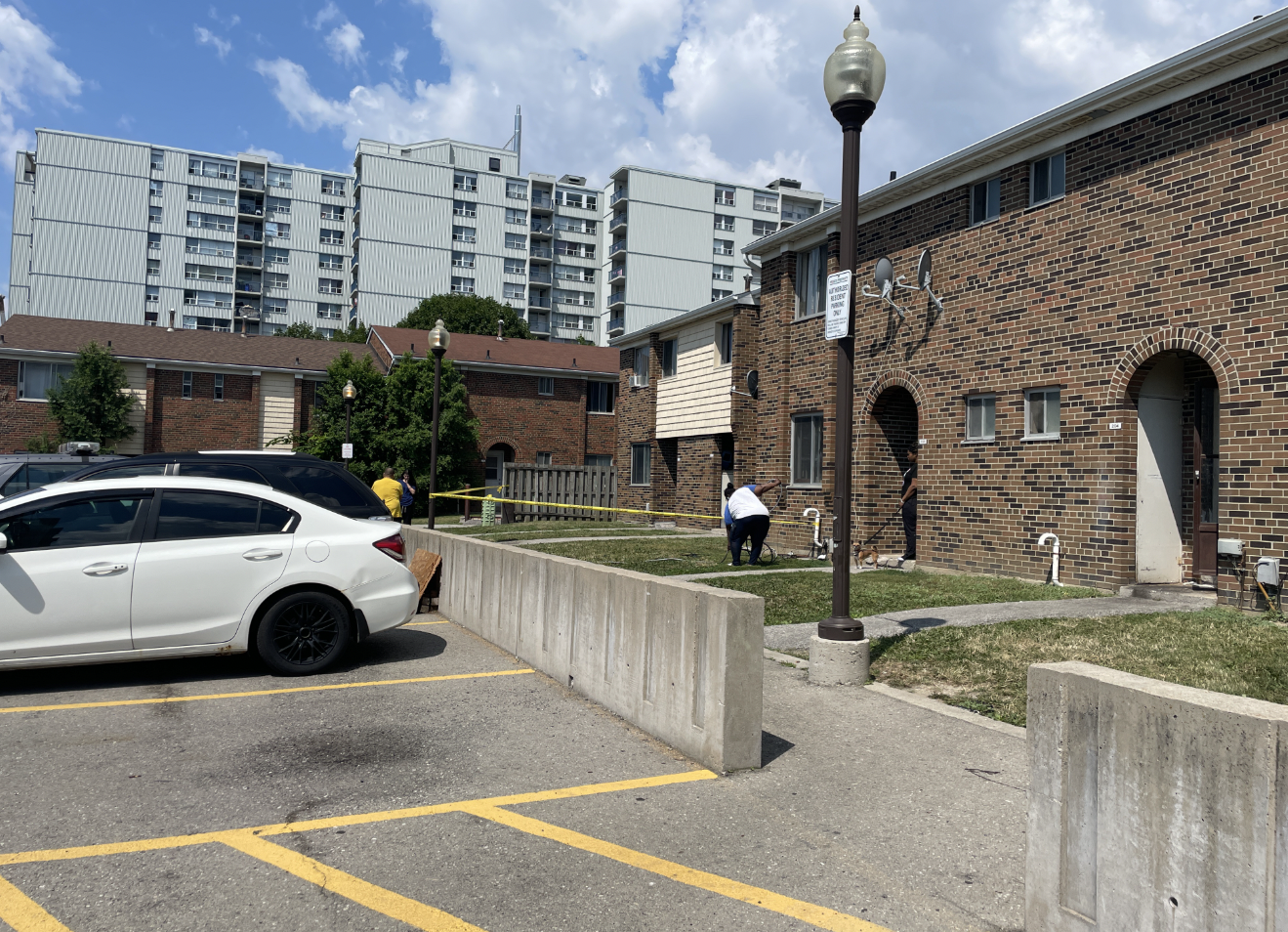
Toronto police are hunting for three suspects after a daylight shooting in North York left a man dead. The incident, which unfolded near a busy intersection, marks another bloody chapter in a pattern of localized violence that municipal officials have repeatedly failed to contain. While investigators process the immediate ballistic evidence and canvas for security footage, the neighborhood is left dealing with the immediate aftermath of systemic failures that go far deeper than a single trigger pull.
This is not an isolated tragedy. It is the predictable consequence of shifting criminal dynamics, failing community infrastructure, and law enforcement strategies that consistently treat the symptoms of gun violence rather than its source. For a different view, check out: this related article.
To understand why North York keeps seeing these targeted executions, you have to look past the standard police press releases. You have to look at how illegal firearms enter the province, how local youth are being recruited into increasingly volatile street networks, and why traditional policing models are failing to stop the bleeding.
The Failure of Regional Containment
Every time a fatal shooting occurs in the outer rings of Toronto, the public ritual is identical. Police tape goes up. A spokesperson stands before microphones, calling the incident "targeted" to reassure the broader public. Similar insight on the subject has been published by The New York Times.
But saying a shooting is targeted does not make the neighborhood any safer. Bullets stray. Bystanders duck behind concrete walls. The immediate perimeter becomes a zone of trauma.
The real issue is that the geographic nature of Toronto's gun violence has evolved dramatically over the last decade. Crime has decentralized. As downtown core areas underwent massive gentrification and hyper-surveillance, criminal networks pushed outward into the inner suburbs like North York, Etobicoke, and Scarborough.
These areas present unique challenges for law enforcement. The sprawling transit corridors, high-density residential complexes, and vast strip malls make rapid escape simple for suspects. A getaway vehicle can hit Highway 401 within minutes, scattering into neighboring municipalities before local divisions can even establish a perimeter. This geographic reality means that local police divisions are perpetually playing catch-up, reacting to crises rather than preventing them.
The Pipeline of Untraceable Iron
We hear constant political posturing about handguns. Yet, the street-level reality in North York remains unchanged. The weapons being used in these fatal encounters are rarely legally sourced domestic firearms.
The vast majority of handguns used in Toronto street violence flow across the international border. They are smuggled through porous entry points, often hidden in commercial shipping or driven across remote crossings.
- The Iron Pipeline: Smugglers buy cheap handguns legally in American states with lax gun laws.
- The Surcharge: Those same weapons are sold on Toronto streets for three to four times their original retail value.
- The Ghost Factor: An increasing number of seized weapons are partially or fully 3D-printed, featuring no serial numbers and making ballistic tracing nearly impossible.
When three suspects can easily acquire firearms, execute a targeted hit in broad daylight, and vanish into the grid, it exposes a massive gap in intelligence-led policing. The focus remains heavily weighted toward post-incident investigation rather than disrupting the supply chains that arm these individuals in the first place.
The Illusion of Preventive Policing
For years, the city has poured resources into specialized units meant to suppress gang activity and gun violence. We have seen the rise and fall of various anti-violence initiatives, community response units, and targeted task forces.
The numbers tell a frustrating story. While overall violent crime rates occasionally dip, the lethality of street-level confrontations has risen.
This happens because the underlying social architecture of these neighborhoods is being ignored. Specialized police units operate on a suppression model. They flood a high-crime area with cruisers, conduct aggressive stops, warrants, and arrests, and then move on to the next hot spot.
This creates a vacuum. When older, established players in the criminal ecosystem are arrested, it does not eliminate the market for illicit activity. It creates a chaotic scramble among younger, less experienced, and far more reckless individuals who are eager to establish their reputations. The lack of institutional memory within these street networks leads directly to brazen daylight shootings in public spaces.
The Limits of Surveillance Tech
Municipalities often turn to technology as a silver bullet. Closed-circuit television cameras and automated gunshot detection systems are frequently touted as modern solutions to urban violence.
They are useful for building a court case after the fact. They do almost nothing to deter a shooter who is committed to a hit.
[Gunshot Detection Alert] -> [Dispatch to Scene] -> [Police Arrival: 4-7 Minutes] -> [Suspects Gone]
A camera captures a masked figure. It records a stolen vehicle speeding away. It provides the footage that news stations broadcast to ask for the public's help, but it does not intervene when the trigger is pulled. Reliance on these tech tools creates a false sense of security while diverting funds away from human intelligence and deep-rooted community intervention programs that could actually identify friction points before they turn fatal.
Rebuilding the Broken Trust
Investigative work in communities like North York is routinely stymied by a wall of silence. When police appeal for witnesses after a three-suspect shooting, they are often met with blank stares and locked doors.
This is not necessarily because residents support the criminals. It is because they fear them, and they do not trust the system to protect them if they speak up.
Decades of heavy-handed policing tactics have alienated the very people whose cooperation is vital to solving these crimes. If a young man believes that talking to an investigator will mark him for retaliation while the police offer nothing but a business card and a promise to look into it, he will keep his mouth shut.
Breaking this cycle requires a fundamental shift in how the city views safety. It requires a sustained, multi-year commitment to funding localized community workers who actually live in these neighborhoods, understand the interpersonal feuds, and possess the credibility to de-escalate tensions before they spill over onto the asphalt.
The current model relies on an exhausted strategy of reaction, political hand-wringing, and empty promises of a crackdown. Until the province and the city address the border pipeline, the structural isolation of the inner suburbs, and the profound trust deficit between communities and the state, the police tape will keep going up in North York.