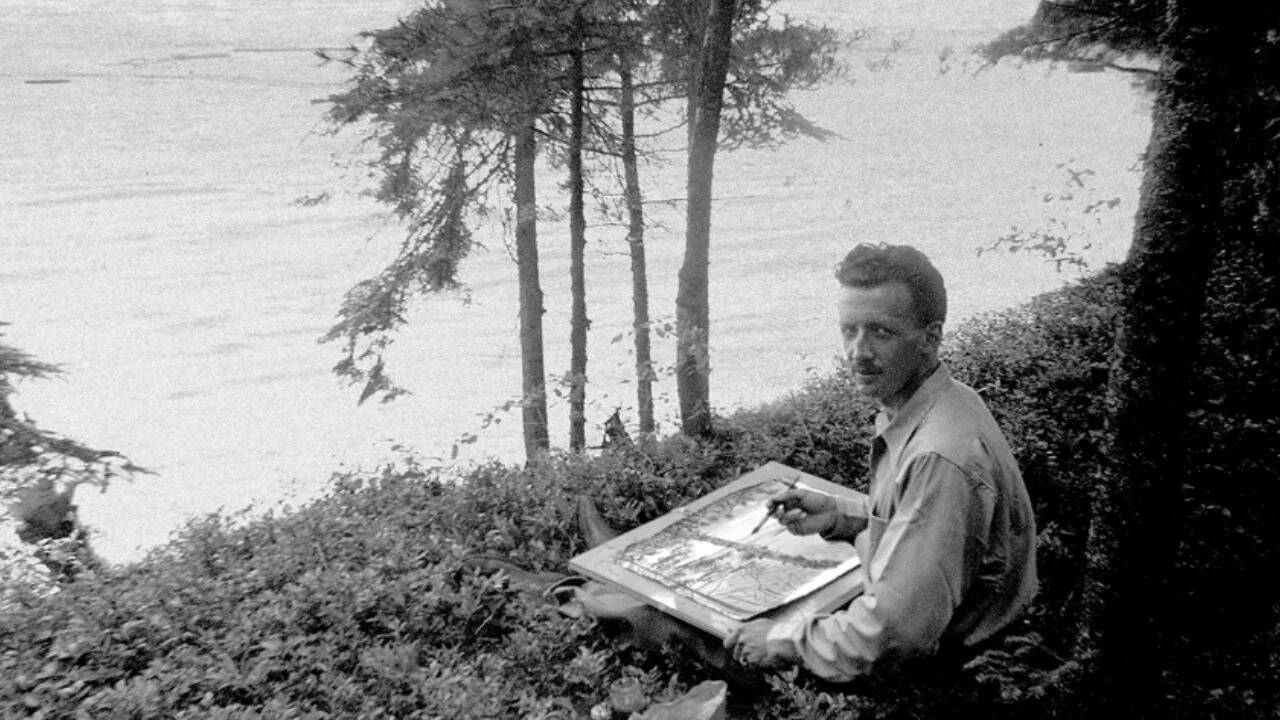
An ordinary yard sale in Ontario recently yielded a discovery that exposes the profound inefficiencies of the secondary art market: a discarded painting purchased for two hundred Canadian dollars subsequently commanded four hundred two thousand five hundred dollars at auction. That canvas, an authentic work by celebrated British Columbia artist E.J. Hughes, sat unrecognized among household clutter until sharp eyes spotted it. This transaction highlights a recurring phenomenon in the trade of fine art, where immense value remains locked behind layers of public ignorance, lack of authentication infrastructure, and an opaque secondary market that routinely fails to recognize historical significance until an expert intervenes.
Most people walking through suburban driveways on a Saturday morning possess zero training in provenance research. They see a framed piece of wood and canvas, assess its decorative appeal against an arbitrary budget, and move on. The couple who secured the Hughes painting did not possess a master's degree in art history; they simply recognized quality workmanship and gambled a nominal sum. That gamble paid off exponentially, but the mechanics that turned a two-hundred-dollar garage find into a half-million-dollar auction asset reveal an uncomfortable truth about how cultural heritage is priced, ignored, and eventually redeemed.
The Anatomy of a Hidden Masterpiece
E.J. Hughes spent decades painting the coastal majesty of the Pacific Northwest, capturing the crisp light, muted greens, and distinct topography of British Columbia with a modernist eye. His work commands serious attention among Canadian collectors, yet his canvases were not always treated as blue-chip investments. During mid-century, these pieces sold for modest sums directly from galleries or through local exhibitions. As tastes shifted and artists drifted out of the contemporary limelight, many of these works drifted into private homes, summer cabins, and suburban basements.
When an original painting vanishes into a domestic interior for fifty years, it enters a state of cultural limbo. The original receipt fades. The framing store stamp degrades. Families inherit objects without documentation, treating them as sentimental heirlooms of negligible monetary worth. When estate clearances happen or downsizing forces a garage sale, descendants often price items based on immediate garage-sale economics: old equals used, and used equals cheap.
This information asymmetry forms the foundation of the secondary art hunt. Professional pickers and estate liquidators comb through rural towns specifically because the general public lacks the tools to evaluate provenance. Yet, even among professionals, works slip through the cracks. The Ontario find was not salvaged by a predatory dealer preying on an uninformed seller; it was found by ordinary buyers who simply liked the look of the composition. That luck underscores the fragility of art preservation. If the weather had turned sour, forcing the sale indoors, or if a different buyer had purchased it to paint over the canvas, a significant piece of Canadian artistic heritage could have vanished permanently.
Why the Secondary Market Operates on Blind Luck
The valuation of fine art relies heavily on institutional validation, cataloguing raisonné entries, and authenticated provenance. Without these markers, an authentic masterpiece is functionally indistinguishable from a talented amateur's hobbyist copy. Auction houses like Heffel, which handled the sale of the Hughes painting, spend considerable resources verifying signatures, matching archival exhibition labels, and tracking down purchase ledgers.
Yet, before an auction house ever sees a work, it must survive the garbage bin of modern domestic life. Our society generates an overwhelming volume of consumer goods, leading to a cultural conditioning where old objects are routinely devalued. We live in an era of rapid replacement. When families clean out a deceased relative's estate, the psychological pressure to clear physical space often overrides the inclination to investigate historical value. Speed supersedes scrutiny.
Consider the friction points in typical estate liquidations:
- Families lack the time or expertise to research obscure mid-century signatures.
- Local thrift stores are overwhelmed with donations and routinely discard unverified framed prints and paintings.
- Appraisers charge fees that casual sellers are unwilling to pay for items found in domestic clutter.
These structural barriers mean that high-value cultural assets are continuously filtered through a broken sieve. Every year, valuable canvases are likely destroyed or sold for pennies because our economic and social systems provide no accessible bridge between a suburban garage and an accredited fine art expert.
The Economics of Scarcity and Authenticity
When a painting like Hughes's coastal landscapes surfaces from obscurity, the resulting media coverage focuses almost entirely on the financial windfall. Headlines trumpet the dramatic markup from two hundred dollars to over four hundred thousand. But this narrative obscures the underlying economics of artistic scarcity.
E.J. Hughes produced a finite body of work, and he was notoriously slow and deliberate in his painting process. He created relatively few canvases over his long career, meaning that supply is strictly capped. As institutional collections lock up his best works, the pool of available pieces for private collectors shrinks. When a fresh, previously undocumented painting enters the market, pent-up demand explodes. Collectors who have waited years for a prime example of his mid-century output suddenly find themselves competing against one another in a heated auction room.
The auction house environment amplifies this dynamic. Bidding wars are driven not just by intrinsic aesthetic appreciation, but by the psychological thrill of acquisition and the scarcity premium. Once an item is authenticated by recognized authorities, its status shifts instantly. It is no longer an interesting garage sale find; it is a certified investment-grade asset with a documented paper trail.
This transformation happens overnight, yet the gap between worth and recognition can span decades of quiet neglect in a damp basement. The Ontario couple did not create value out of thin air; they acted as a vital rescue mechanism for an asset that the market had temporarily misplaced.
The Systemic Failure to Preserve Cultural Heritage
We should not romanticize these garage-sale discoveries as heartwarming fairy tales of sudden wealth. Instead, they represent a systemic failure in how society catalogs and preserves its own material culture. If finding a major work of art requires a combination of blind luck, acute observation, and a willingness to gamble spare cash on an unverified canvas, then our cultural preservation strategy is essentially running on a lottery system.
Public institutions are chronically underfunded, unable to deploy researchers to vet every estate sale across the province. Private galleries focus on high-end transactions with established clients, leaving the vast expanse of suburban basements entirely unmonitored. As a result, the protection of historical artifacts is outsourced to random chance.
The market thrives on these anomalies because they generate public interest and feed the mythology of the art world. Every headline-grabbing garage sale find reinforces the fantasy that anyone might be sitting on a fortune. But the inverse reality is far more sobering: for every painting that survives to reach an auction house podium, dozens of others likely meet an ignominious end in a landfill, cleared out by exhausted relatives who simply wanted the house empty by Monday morning.
Until we build better, more accessible infrastructure for ordinary people to evaluate household art without incurring prohibitive appraisal costs, our artistic heritage will remain at the mercy of weekend estate sales and accidental discoveries. The system works for the fortunate few whose discarded items catch the right eye, but it is fundamentally erratic, wasteful, and indifferent to the history it claims to celebrate.