The alarm rings before the sun remembers how to rise.
In the pale, bruised light of a Tuesday morning that feels entirely too much like a Monday, millions of people across Brazil wake up to a reality written in exhaustion. Coffee cups are refilled with desperation. Shoes are tied against the ache of feet that stood for nine hours yesterday and will stand for nine hours tomorrow. You might also find this similar coverage interesting: The Indus Water Treaty is Dying and Diplomacy Cannot Save It.
There is a math to modern survival, and it is brutally simple. Six days on. One day off.
For generations, this equation went unquestioned. It hummed in the background of industrial factories, retail floors, and quiet corner offices like a malfunctioning generator that everyone simply learned to shout over. You work. You sleep. You survive. You repeat. The seventh day, Sunday, is not a gift of rest; it is a recovery period. It is the time required to bandage the psychological and physical wounds of the previous six days just enough to make you fit for labor once more. As discussed in latest articles by The Guardian, the effects are worth noting.
Then came a phone screen.
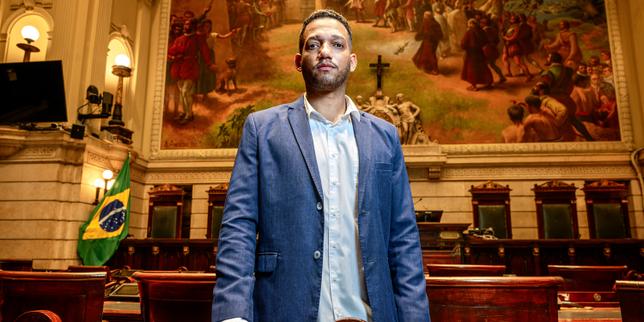
Rick Azevedo did not look like a revolutionary. He looked like an ordinary worker, tired in the way that only modern labor can make a person tired. A pharmacy assistant in Rio de Janeiro, he stared into the front-facing camera of his smartphone and spoke words that millions had trapped behind their teeth.
"When are we, the working class, going to put an end to the six-day workweek?"
The question hung in the digital air. It did not vanish into the ether of algorithmic noise. Instead, it struck a nerve so raw and exposed that it triggered a seismic tremor across a nation.
To understand why a short video could spark a political earthquake, you have to look past the spreadsheets and step directly onto the polished linoleum of a crowded pharmacy or the concrete floor of a bustling fulfillment center.
Consider a hypothetical worker named Lucas. Lucas is twenty-eight. He works in retail sales in São Paulo. His shift begins at nine in the morning and ends at six in the evening. On paper, it looks standard. But paper does not account for the two-hour commute squeezed into crowded buses where personal space is a luxury of the past. Paper does not account for the mental weight of smiling through exhaustion when a customer demands perfection.
Lucas works Monday through Saturday. His single day off is Sunday.
On Sunday, Lucas does not paint. He does not read philosophy. He does not take his younger sister to the park. Lucas washes clothes. He cleans the small apartment he shares with a roommate. He sleeps for ten hours, waking up with a dull headache caused by the sudden shift in adrenaline. By Sunday evening, a heavy, familiar knot forms in his stomach. The clock ticks toward Monday. The cycle resumes.
This is the hidden cost of the scale-6-by-1 schedule, known locally as the escala seis por um. It is a system that legally permits employers to demand six consecutive days of labor in exchange for a single day of rest. Proponents of the model argue that flexibility is necessary for a competitive economy, that commerce cannot pause just because humans get tired.
But at what point does commerce consume the very people required to keep it running?
The historical roots of this struggle run deep. Labor rights are never handed down by benevolent corporations out of the goodness of their balance sheets. They are extracted through friction, sweat, and collective voice. When the five-day workweek was first popularized elsewhere in the world, championed by industrialists who realized that rested workers made fewer mistakes and produced better goods, Brazil and many other developing economies remained tethered to older, harsher paradigms.
The six-day model treats human beings like heavy machinery. Run it hard. Run it often. Fix it only when it breaks completely. And when a part wears out, replace it with another fresh recruit from the endless line of the unemployed.
Azevedo’s video exposed the cruelty of this assumption. It proved that millions of Brazilians were carrying the same quiet resentment, believing themselves to be alone in their exhaustion. When the video accumulated millions of views, the illusion of isolation shattered. A private grievance became a public movement.
The transition from a viral video to a legislative petition is rarely smooth. Power does not surrender its privileges easily. When Azevedo launched a formal petition to amend the constitution and abolish the six-day workweek, skeptics smiled patronizingly. They called it populist theater. They argued that the economy would collapse, that small businesses would shutter overnight, that prices would skyrocket.
These arguments are old ghosts. They are the exact same warnings issued when child labor was restricted, when the eight-hour workday was established, and when paid vacation was introduced. Every single time human dignity attempts to claim a stake in the economic engine, the prophets of doom predict total ruin.
Yet, the world did not end when people stopped working sixteen-hour days. It improved. Creativity sparked. Health outcomes rose. Families stabilized.
The debate in Brazil zeroed in on a fundamental question: Is productivity a measure of hours spent chained to a desk, or is it a measure of human focus, energy, and well-being?
Modern behavioral science offers a clear answer. Study after study confirms that human cognitive function degrades sharply after extended periods without adequate recovery. A brain operating on chronic sleep deprivation and physical exhaustion makes errors, misses details, and burns out. The sixth day of work is rarely a day of peak output; it is often an exercise in physical presence with diminishing returns.
When workers are given time to breathe, something remarkable happens. They return to their jobs with sharper minds, higher morale, and genuine engagement. They are no longer sleepwalking through their shifts.
The political momentum behind the movement forced lawmakers to take notice. Signatures flooded in by the hundreds of thousands, then millions. Politicians who had ignored the daily grind of the working class suddenly found themselves drafting statements of support, eager to stand in front of a wave they had failed to predict.
Change, when it comes, rarely arrives like a cinematic explosion. It arrives through messy negotiations, late-night committee debates, and stubborn persistence. The fight to eliminate the six-day workweek in Brazil is far from over. Resistance from powerful business lobbies remains fierce, and the legislative hurdles are formidable.
Yet the genie cannot be put back into the bottle.
The conversation has shifted. No longer is the six-day schedule viewed as an unalterable law of nature like gravity or the rotation of the earth. It is now understood for what it truly is: a human-made policy that can be unmade by human will.
Think back to the alarm clock ringing in the dark.
Imagine a future where that ring does not signal the beginning of a relentless six-day marathon. Imagine a Tuesday where a retail worker feels the steady, grounding rhythm of adequate rest. Imagine a society that measures its success not merely by the volume of goods moved across a counter, but by the health, vitality, and peace of the people who move them.
The clock on the wall keeps ticking. Every second brings us closer to a choice. We can cling to the tired machinery of the past, or we can build an economy that remembers people are more than fuel for the fire.