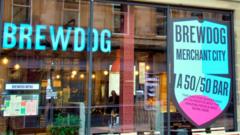
Outrage is the cheapest currency in the modern economy. It costs nothing to manufacture, spreads like a virus, and requires zero critical thinking. The current pile-on regarding Brewdog’s supposed "fire and rehire" tactics is a masterclass in this intellectual laziness. While the internet pearl-clutches over the "betrayal" of the brand’s punk ethos, they are missing the brutal, necessary math of survival in a dying hospitality sector.
The narrative is simple: Big bad corporation cuts benefits to save pennies while the little guy suffers. It's a heartwarming David vs. Goliath story that happens to be a total fabrication of how a P&L statement works. If you want a company to act like a charity, don't buy their beer; go to a soup kitchen. If you want a company to survive a decade of economic volatility, you should start paying attention to the hard choices that actually keep the lights on.
The Myth of the Ethical Premium
Most people crying foul on social media have never had to make payroll during a double-digit inflation spike. They want the "Living Wage" badge on the window, but they aren’t willing to pay £9 for a pint of Punk IPA to fund it. This is the "Virtue Gap"—the distance between what a consumer says they value and what they are actually willing to swipe their card for.
Brewdog grew by being loud, aggressive, and disruptive. Now that they are making the same cold-blooded fiscal adjustments every major FTSE 250 firm makes, the public acts shocked. Why? Because we’ve been conditioned to believe that "brand values" are a suicide pact. They aren’t. A brand is a marketing skin; the skeleton is the balance sheet.
When the cost of CO2, energy, and malt skyrockets simultaneously, you have three choices:
- Raise prices and lose market share.
- Shrink the product and lose customer trust.
- Optimize labor costs to reflect the new reality.
The third option is the only one that preserves the entity itself. Calling it "fire and rehire" is a convenient rhetorical trick used by unions to bypass the fact that the underlying economic model of the UK high street has fundamentally broken.
Survival is the Only Real Punk Move
The critics love to point to the "Lost Dog" open letter from years ago as proof of a toxic culture. I’ve spent twenty years in boardrooms and on factory floors. You know what’s truly toxic? A company that lies to its staff about its financial health until the day the liquidators show up and the locks are changed.
Equity for Punks was a brilliant piece of financial engineering. It turned customers into stakeholders. But stakeholders also need to understand that their "investment" is tied to a company that must be ruthless to stay competitive against the likes of AB InBev and Heineken. You cannot fight global behemoths while carrying the legacy costs of a small-town microbrewery.
The "fire and rehire" label is being applied to a shift from the voluntary Real Living Wage to the statutory National Living Wage. Let's be precise here. The Real Living Wage is a choice. It is a luxury of a high-margin environment. When those margins are crushed by a 10% increase in business rates and a 20% jump in raw materials, the luxury is the first thing to go. To do otherwise is to prioritize a badge on a website over the long-term employment of thousands of people.
The Hospitality Death Spiral
Let’s look at the data the headlines ignore. UK hospitality is currently a graveyard. According to data from CGA by NIQ, we are seeing an average of eight pub and bar closures a day. This isn't because owners are "mean." It's because the math doesn't work.
If Brewdog had stayed on the path of ignoring the shifting labor market, they wouldn't be "virtuous." They would be insolvent. The "lazy consensus" says that a company with £300m in revenue can afford anything. The reality is that revenue is not profit. In a high-volume, low-margin business, a 2% swing in labor costs is the difference between a reinvestment budget and a bank default.
Imagine a scenario where a CEO chooses to keep every benefit and wage premium in place while the company loses £5m a month. Within six months, the bank pulls the credit line. 2,000 people lose their jobs. Is that the "ethical" outcome? Is that the "punk" way? Of course not. The most pro-worker thing a company can do is remain a going concern.
The Lie of the "Safe" Corporate Culture
The modern employee has been sold a dream of "psychological safety" that doesn't exist in the private sector. The job of a corporation is to provide a service for a profit. The employment contract is a trade of time for money. When the value of that time changes or the ability of the company to pay changes, the contract must be renegotiated.
The "fire and rehire" outrage assumes that a job description and its compensation should be frozen in amber. This is a fantasy. If you are a mid-level manager at a tech firm and your department gets automated, you don't expect to keep your salary for doing nothing. Why do we expect hospitality—a sector under massive technological and economic pressure—to behave differently?
Why You Should Stop Asking "Is This Fair?"
"Fair" is a term for the playground. In the market, there is only "Sustainable."
Most "People Also Ask" queries regarding Brewdog focus on whether the brand is still "cool" or "ethical." You’re asking the wrong question. You should be asking: "Is this company agile enough to survive the next five years?"
If a company is willing to take the massive PR hit of adjusting its wage structure, it tells you two things:
- They are under significant financial pressure.
- They have the stones to address it head-on instead of hiding behind accounting tricks.
I would rather invest in—or work for—a company that makes the hard, unpopular call early than one that bleeds out slowly while telling me everything is fine.
The High Cost of Pure Ideology
We saw this with the collapse of several "ethical" startups over the last decade. They prioritized the social contract over the fiscal one, and they are all gone. Their former employees now work for the "soul-less" corporations they once mocked.
Brewdog is being punished for its transparency. If they had done this quietly, through attrition and "restructuring," no one would have blinked. Because they are a high-profile target, their every move is scrutinized through a lens of moral purity that no business can satisfy.
The "Punk" branding was always about breaking rules. Now they are breaking the most sacred rule of modern corporate PR: never admit that the bottom line matters more than the feelings of the collective. It’s an ugly truth, but it’s the only one that keeps the taps flowing.
Stop looking for a hero in your beer glass. James Watt isn't your friend, and the Brewdog "crew" isn't a family. It’s a business. Start treating it like one, and the "fire and rehire" noise suddenly sounds like the sound of a company deciding not to die.
Buy the beer because you like the taste. Don't buy it because you think the company is going to fix the inherent flaws of global capitalism. They aren't. They're just trying to make sure they're the ones still standing when the dust settles.
Go to the bar and look at the prices. Then look at the staff. If you want everyone to get a 20% raise, prepare to pay £12 for that lager. If you aren't reaching for your wallet to make that happen, shut up about the wage structure.
The market has spoken, and it’s a lot colder than your Twitter feed.
Don't look for a moral compass in a capitalist engine. Look for the exit strategy.
Next time you see a headline about "corporate greed" in hospitality, check the price of a pint of milk and the cost of a commercial gas bill. Then do the math yourself. You’ll find that "fire and rehire" is often just a synonym for "we want to be here next year."
Stop demanding that businesses lie to you. Accept the cold reality of the trade. If you can't handle the heat of the P&L, stay out of the investment pool.
The taps stay open because someone was willing to be the villain. That's the real punk rock.


