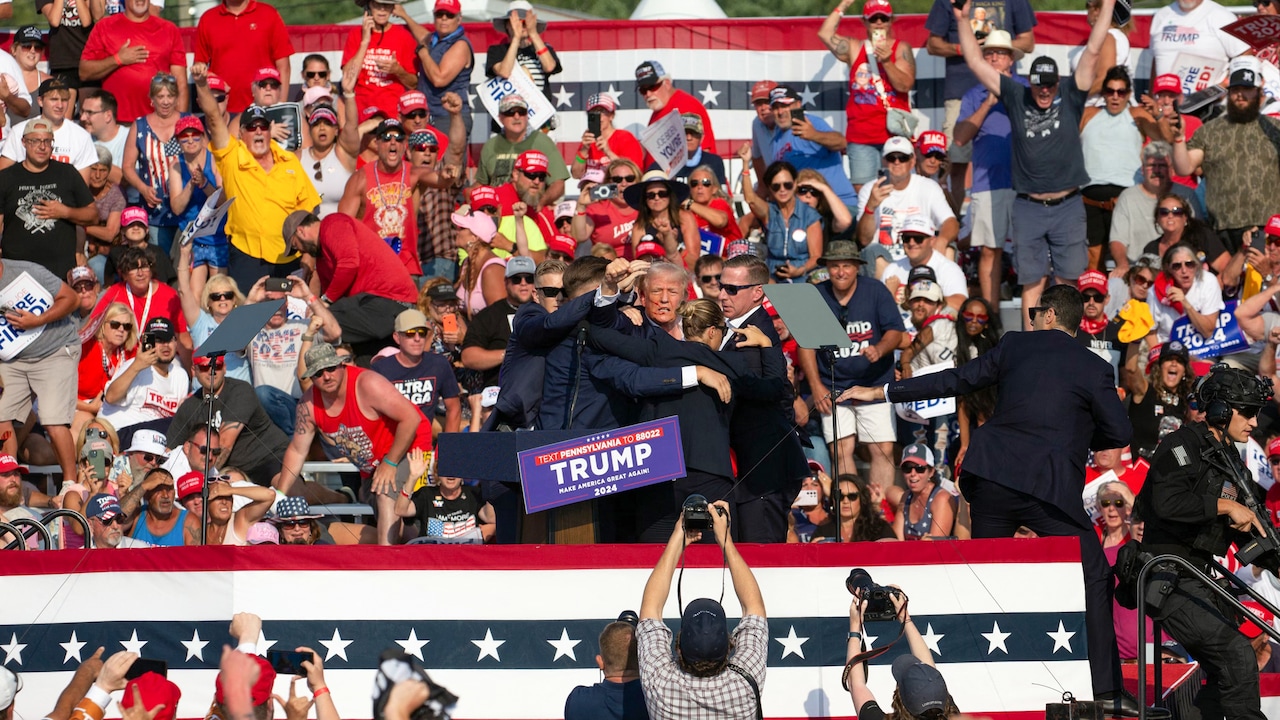
The headline flashes across your screen. A man injured in the July 2024 assassination attempt against Donald Trump in Butler, Pennsylvania, has died. Within minutes, the digital assembly line kicks into overdrive. Major outlets publish identical 300-word blurbs. Social media erupts into predictable tribal warfare. Everyone moves on by dinner.
This is the lazy consensus of modern political journalism, and it fails the public on a fundamental level.
When standard news coverage reduces a human life and a historic national security failure to a fleeting wire report, it treats symptoms rather than causes. In the newsrooms I have worked in and advised over the past two decades, the unspoken metric of success is speed, not comprehension. Editors push reporters to aggregate the bare facts—who, what, when, where—and hit publish before the algorithm shifts. By doing so, they strip away the human cost of political violence and obscure the systemic accountability that should follow a catastrophic security breakdown.
The Illusion of Closure in Breaking News
Look closely at how mainstream outlets report delayed fatalities resulting from high-profile violence. A headline stating that a survivor of the Butler rally has passed away frames the event as an isolated footnote to a closed chapter.
That framing is wrong.
In trauma medicine and public policy, the aftermath of mass violence does not end when the crime scene tape comes down. When a bystander—like Corey Comperatore, who died at the scene in July 2024, or other attendees like David Dutch and James Copenhaver, who suffered critical injuries—becomes collateral damage at a political event, the legal, medical, and institutional consequences stretch across years.
Yet, standard reporting treats a death months or years later as a mere update to an old file. Reporters rely on brief police blotters or family statements without interrogating the broader chain of events. They fail to ask the uncomfortable questions:
- How did long-term medical complications stem from the initial failures in perimeter security?
- What financial and systemic burdens do survivors of political violence bear once the fundraising campaigns fade from the front page?
- Why does media coverage spike during moments of immediate spectacle while ignoring the slow-motion tragedy of recovery?
By treating these updates as routine news items, the media accidentally sanitizes the reality of political violence. A gunshot wound is not a headline; it is a permanent alteration of human biology and family structure.
The Anatomy of a Systemic Failure
To understand why this coverage falls short, you have to look at how the industry covers national security and domestic extremism. Whenever an incident like the Butler rally occurs, coverage immediately splits into two predictable tracks: partisan finger-pointing or bureaucratic process stories.
According to bipartisan congressional task force reports and independent reviews commissioned by the Department of Homeland Security following the July 2024 shooting, the security breakdown in Butler was not the result of a single rogue actor's cleverness. It was a cascading failure of communication, unclear command structures, and complacency between the Secret Service and local law enforcement.
Yet, when subsequent news breaks about the victims of that day, those documented institutional failures are rarely connected back to the human toll.
The "Event-Driven" Trap
Journalism operates on an event-driven model. A rally happens; a shot is fired; an investigation is launched; a report is released; a victim dies. Each node on that timeline is treated as a separate news cycle.
In reality, these are not separate stories. They are a single, continuous narrative about the fragility of public safety in a polarized era. When an outlet publishes a bare-bones report about a victim's passing without contextualizing the documented lapses in counter-sniper coverage, radio interoperability, and advance planning, it severs cause from effect.
Readers are left with a vague sense of sadness rather than a clear understanding of institutional accountability. If the public cannot see the direct line between a bureaucratic failure on a rooftop in Pennsylvania and a funeral months later, the pressure on agencies to reform evaporates.
What People Actually Want to Know (And Why Journalists Won't Tell Them)
If you look at search trends and public reaction whenever news breaks about the Butler shooting victims, people are not just looking for an obituary. They are asking fundamental questions about safety, accountability, and the state of American democracy.
"Could this have been prevented?"
The honest answer, backed by both the House Task Force on the Attempted Assassination of Donald J. Trump and internal Secret Service assessments, is unequivocally yes. Basic line-of-sight vulnerabilities were left unaddressed. Local police and federal agents were operating on separate communication channels. When media outlets treat the aftermath solely as a human-interest story or a political talking point, they let leadership off the hook for preventable errors.
"Are political rallies actually safe anymore?"
Standard commentary offers platitudes about "resilience" and "not letting fear win." That is rhetoric, not analysis. The reality is that open-air political events present severe logistical challenges for protective details, especially when resources are stretched thin across multiple protectees. Securing a sprawling rural fairground requires vastly different assets than securing an indoor arena. Pretending otherwise does a disservice to every citizen who chooses to participate in the political process.
"Why does political violence seem to be escalating?"
Pundits love to blame their political opponents' rhetoric. Conservatives blame the left; progressives blame the right. Both sides are taking the easy way out. Research from institutions like the Center for Strategic and International Studies (CSIS) and the University of Chicago's Project on Security and Threats shows that modern domestic threats are rarely driven by clean ideological manifestos. Instead, they are increasingly fueled by mixed, incoherent grievances, social isolation, and a desire for notoriety amplified by digital ecosystems. Blaming a single speech or a single politician misses the structural drivers of modern violence.
The Limits of the Contrarian Critique
It is easy to criticize breaking news desks from the sidelines, so let us be intellectually honest about the constraints journalists face.
Newsrooms today operate with a fraction of the staff they had twenty years ago. Local beat reporters who used to spend months building trust with families, doctors, and local officials have been laid off. When a major story breaks, a national desk editor often has fifteen minutes to verify a death certificate, confirm details with a coroner or family spokesperson, and publish an accurate report before misinformation takes over social media.
In an environment flooded with conspiracy theories—where every death connected to a political event is immediately weaponized by online grifters—publishing a fast, factual, stripped-down report is often a defensive measure. Journalists stick to the bare minimum because anything else invites accusations of bias or speculation.
However, understanding why the system is broken does not mean accepting it. Defensive journalism is still bad journalism. When mainstream outlets retreat into sterile, wire-service prose, they cede the emotional and analytical territory to partisan commentators and algorithmic rage-baiters.
How to Actually Consume and Cover High-Stakes News
If you are a reader trying to make sense of major political tragedies—or a writer trying to cover them without falling into the industry's worst habits—you have to reject the breaking-news cycle entirely.
- Wait 48 hours before forming an opinion. Initial reports on deaths, medical complications, and security incidents are routinely incomplete. The first wave of coverage tells you what happened; the second wave tells you what it means.
- Follow the primary documents, not the pundits. When congressional committees, inspectors general, or independent panels release findings on security failures, read the executive summaries yourself. The gap between what an official investigation actually concludes and how cable news summarizes it is massive.
- Demand longitudinal reporting. Support outlets and journalists who revisit stories six months, one year, and five years after the cameras leave. True accountability is measured in long-term policy changes and sustained care for victims, not in day-one headlines.
- Separate grief from political utility. Whenever a tragedy occurs, political operatives immediately calculate how to use it for fundraising or messaging. Recognize that mechanism for what it is, and refuse to let genuine human loss be reduced to a campaign talking point.
A death connected to a national tragedy is never just a minor update for the bottom of a news feed. Until media institutions stop treating human lives as fleeting content, the public will remain informed about everything and understand nothing.