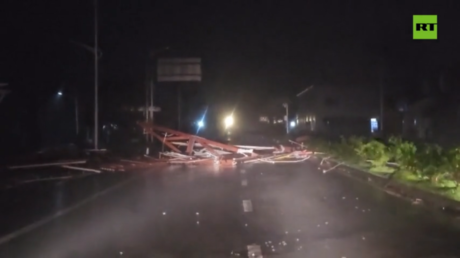
The media narrative following the recent typhoon in southern China is a masterclass in deflection. We see the same tired script every time: footage of shredded roofs, flooded streets, and desperate rescue efforts. Reporters stand in the rain, breathless, blaming "unprecedented" weather patterns and "nature’s fury."
It is a convenient lie.
Nature does not rip roofs off buildings. Poor engineering, cost-cutting materials, and bureaucratic negligence do. Blaming a typhoon for structural failure is like blaming a heavy load for a bridge collapse that was built with rusted steel. The weather is a constant variable in this region. If your infrastructure cannot survive what it is statistically guaranteed to encounter every few years, your infrastructure is not "unlucky." It is garbage.
The Myth Of Uncontrollable Force
Let’s dismantle the "act of God" defense. Southern China has been dealing with cyclones for centuries. The risk profile is not a secret. When a building loses its roof, it is almost never because the wind speed exceeded the laws of physics. It is because the roof connections were improperly anchored, or the building code was ignored in favor of speed.
I have spent two decades looking at urban planning projects across Asia. I have watched developers shave 15% off the budget by using lower-grade fasteners or ignoring wind-uplift calculations. When the storm hits, those savings manifest as shrapnel flying through the air.
Imagine a scenario where a high-rise in Shanghai or Guangzhou is designed with the actual force of a Category 4 storm in mind rather than the minimum legal requirement. The cost difference is negligible when compared to the repair bill, yet the market dictates a "race to the bottom" mentality. If you build to the bare minimum, you are not building for longevity; you are building for the next insurance payout.
The Drainage Fallacy
Then there is the flooding. We hear about "record-breaking rainfall." If you look at the raw data, the rainfall totals are often high, but they are rarely historic. The problem is the urban sponge. We have paved over every square inch of permeable soil with concrete that offers zero drainage capacity.
When you replace wetlands and soil with high-density concrete, you lose the ability to manage runoff. The water has nowhere to go but into the lobby of your luxury condo. This is not a climate phenomenon. It is an urban planning failure. Cities in the region have been transformed into massive, non-absorbent funnels. Expecting them not to flood during a heavy rain is like pouring a gallon of water into a shot glass and complaining that it spilled.
The Real Cost Of Cheapness
The industry thrives on the illusion of progress. Developers point to gleaming skylines as evidence of success. But look closer at the maintenance records. Look at the cladding material that peels off during moderate wind.
- Engineering shortcuts: Architects are pushed to prioritize aesthetics over structural aerodynamics.
- Maintenance neglect: Building managers treat storm preparation as a checkbox exercise rather than a systematic safety protocol.
- Regulatory capture: Local enforcement of building codes is often compromised by the very people who stand to profit from the construction.
We need to stop treating these events as tragedies. A tragedy is something that could not be prevented. These are predictable outcomes of a system that incentivizes quantity over quality.
If you own property in these zones, you are playing a game of Russian Roulette. Stop listening to the talking heads who characterize these events as "surprising." They are not surprising. They are the inevitable result of a regional fixation on short-term expansion at the total expense of structural integrity.
When you strip away the hysteria, you are left with a simple math problem: the cost of building it right today is infinitely cheaper than the cost of fixing the aftermath tomorrow. Yet, the industry keeps choosing the latter because the payout for the builder happens before the storm hits, and the loss belongs to the owner afterward.
Until building codes are enforced by independent bodies with zero ties to the development sector, the roofs will keep flying. Until urban planners are mandated to incorporate massive subterranean water retention systems, the streets will keep turning into rivers.
Stop asking if the storm was powerful. Start asking why the building was weak. The storm is just doing what storms do. The industry is the one failing its mandate.