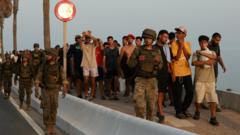
Blaming algorithms for human panic is the ultimate intellectual cop-out.
Every time a European shoreline receives another wave of arrivals and the political needle spikes toward radicalism, the diagnosis from the commentariat remains identical. We are told the crisis is manufactured. We are fed the narrative that innocent citizens are being radicalized by malicious bots, foreign actors, and stoke-heavy TikTok clips. If only we could moderate the feeds better, clean up the digital town square, and fact-check the xenophobes, the political storm would simply dissipate. If you liked this piece, you might want to check out: this related article.
It is a comforting fantasy. It turns a structural, grinding policy failure into a technical software glitch.
I have spent years watching policymakers panic over trending hashtags while entirely ignoring the concrete pouring, the structural budget cuts, and the institutional rot happening right outside their air-conditioned offices. Social media did not write the budget allocation for coastal municipalities. Algorithms did not fail to process asylum backlogs for four years. The digital mob is loud, but it is merely echoing a reality that national governments refuse to manage with competence. For another angle on this event, see the latest update from BBC News.
Stop looking at the screen. Look at the ledger.
The Myth of the Digital Spark
The lazy consensus holds that social media creates the political storm out of thin air. The premise assumes that voters are tabulae rasae, blank slates sitting quietly at home until a targeted ad or a sensationalized video radicalizes them into demanding border walls.
This gives our ruling class an excuse. If public anger is an artificial construct generated by bad actors online, then the government does not need to change its policies. It just needs to censor, regulate, and lecture the public about misinformation.
Let us look at the mechanics. When local authorities absorb thousands of arrivals without adequate housing, medical support, or integration infrastructure, friction occurs. That friction is not algorithmic. It is physical. When a municipal sports center is converted into a temporary shelter, citizens living three streets away do not need a viral tweet to notice that their community pool is closed. They notice because their tax-funded amenities are overburdened.
When politicians claim that social media is "whipping up" the crisis, they are reversing cause and effect. The panic online is a symptom, not the pathogen. The pathogen is institutional paralysis.
[Reality] ──> [Physical Strain on Municipalities] ──> [Citizen Frustration] ──> [Digital Amplification]
To pretend that silencing the amplification will fix the strain is administrative malpractice.
The Economics of Incompetence
Let us talk about what actually happens when arrivals hit the shores of the Canary Islands or Andalusia.
The European framework for migration management relies on a complex mix of local municipalities, regional autonomous communities, and the central state in Madrid. On paper, it is a division of labor. In practice, it is a game of hot potato where every level of government tries to pass the financial and logistical liability to someone else before the cameras start rolling.
I have watched regional presidents beg Madrid for emergency transfers, only to be met with bureaucratic silence and ideological posturing. When resources are scarce and coordination is non-existent, local friction turns explosive.
The political storm in Spain is not being manufactured by Russian troll farms or right-wing influencers. It is being manufactured by the sheer, unadulterated refusal of successive administrations to build a permanent, scalable infrastructure for border processing and integration. Instead, we get crisis management. Every single summer is treated as an unexpected anomaly, as if geography were a surprise and the Atlantic Ocean only recently opened up.
When you treat a permanent logistical reality as an emergency year after year, citizens lose faith. And when citizens lose faith in the state's baseline competence, they look for alternatives. Blaming Twitter for that loss of faith is like blaming the thermometer for a fever.
The Counter-Intuitive Truth About Free Speech and Borders
Here is the part that makes everyone uncomfortable.
The current panic over online speech regarding migration is a smoke screen designed to justify state censorship under the banner of public safety. Watch how quickly the conversation shifts from "We have a housing shortage in our coastal towns" to "We need stricter oversight of digital discourse to prevent hate speech."
Notice the bait-and-switch. The state fails to secure borders, fails to fund integration, fails to manage municipal budgets, and then turns around and says, "The real threat is what your neighbor is posting on Facebook."
If you want to deflate the political storm, the solution is counter-intuitive: stop trying to sanitize the internet and start fixing the infrastructure.
People do not become radicalized against migration because they saw a misleading clip. They become cynical because they watch institutions fail in real-time and then gaslight them by pretending the problem is just bad manners online.
Imagine a scenario where the central government fully funded municipal integration from day one, provided immediate housing solutions that did not drain local resources, and transparently published every single euro spent and every single migrant processed. The oxygen for the digital demagogues vanishes instantly. You cannot run a populist crusade on social media against a government that is demonstrably competent, transparent, and in control.
Right now, the government is neither competent nor in control. Hence, the digital storms rage.
The Price of Comfort
We love simple villains because complex systems require hard work to fix.
Blaming social media lets journalists write think pieces about algorithmic radicalization without leaving their newsrooms. It lets politicians campaign on digital reform instead of structural overhaul. It lets bureaucrats keep their jobs while failing upward.
Meanwhile, the actual human beings arriving on those boats remain trapped in limbo, used as political footballs by both the extreme left and the extreme right, while local communities bear the brunt of administrative abandonment.
The storm is real. The anger is real. The strain on public services is real. But the idea that this is all a ghost story conjured up by social media is a lie we tell ourselves so we can sleep at night without demanding actual competence from our leaders.
Tear down the algorithms if you want. Clean up the feeds. Ban the accounts.
The boats will still arrive. The municipalities will still be broke. The infrastructure will still be broken.
And the storm will still be waiting for you when you log off.