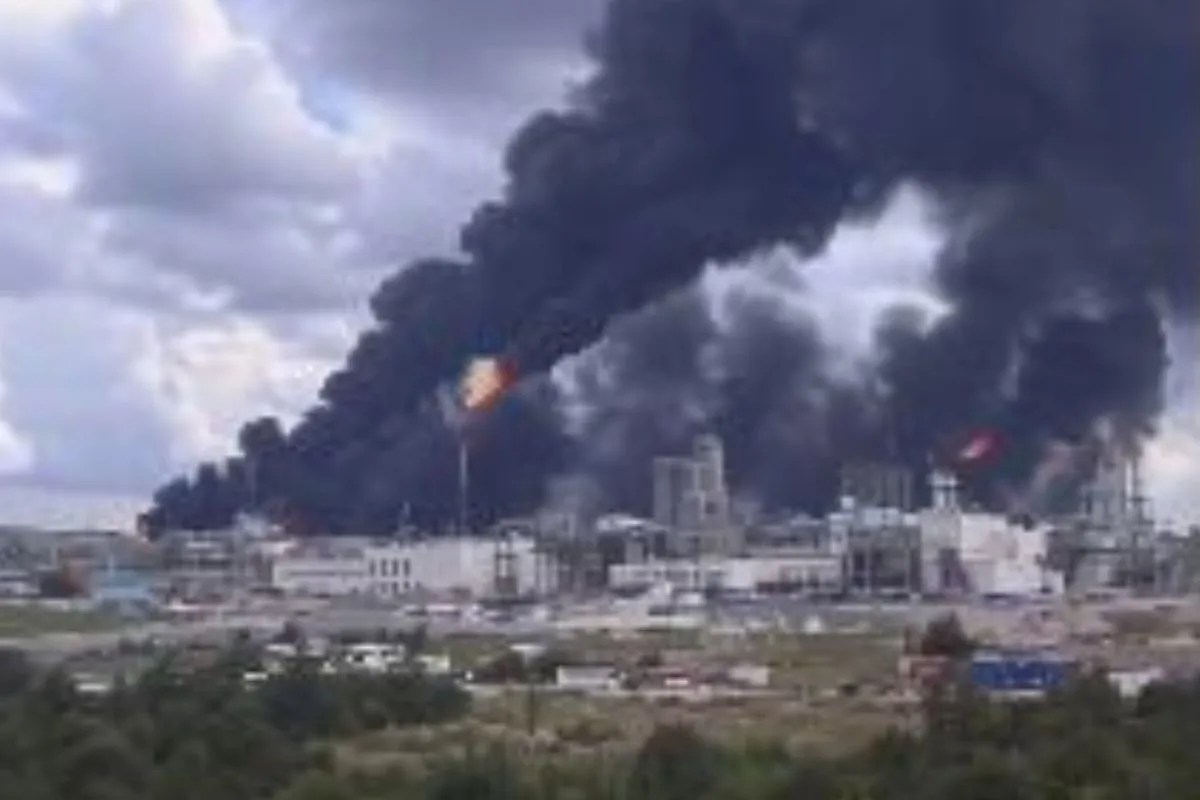
The headlines write themselves whenever an industrial flare goes up in Siberia or the Urals. A gas-chemical plant explodes, tragic casualties hit the ticker, and the immediate reflex across global newsrooms is to point the finger straight at Western sanctions. The narrative is always the same: supply chain strangulation, missing specialized components, overworked local staff forced to run legacy infrastructure into the ground because spare parts from Europe stopped crossing the border. It is neat. It fits the geopolitical mood music. And it is fundamentally lazy.
I have spent the better part of two decades walking through heavy industrial zones, auditing high-pressure processing facilities, and looking at maintenance budgets where the zeroes blur together. I have watched plant directors in Omsk and Tomsk cut corners on turnaround schedules long before any trade restrictions were drafted in Brussels or Washington. When a massive gas-chemical complex suffers a catastrophic failure, reducing the root cause to a lack of imported valves or Siemens microchips ignores the structural decay that predates every single geopolitical embargo of the 2020s.
Let us look past the sensationalized casualty counts and the immediate rush to blame geopolitics. The real story of modern Russian industrial accidents is not about what is missing from Europe; it is about institutional rot, systemic underinvestment in safety culture, and a management philosophy that treats human capital as a disposable input.
The Myth Of The Missing Part
The dominant lazy consensus suggests that Russian petrochemical plants are running on duct tape and prayer because European OEMs cut off supply lines. Every time a distillation column ruptures or a cracking unit goes off-line with fatal consequences, the reflexive defense from local operators—and the immediate assumption of foreign analysts—is that a sanctioned component failed.
This argument collapses under basic engineering scrutiny. Gas-chemical complexes are not consumer sedans waiting for an exotic microchip. They operate on massive pumps, heavy-walled pressure vessels, piping networks, and catalytic reactors. While specialized instrumentation and proprietary control software do rely on imported tech, the catastrophic failures making headlines rarely stem from a sudden electronic glitch in a high-tech sensor. They stem from over-pressurization, structural metal fatigue, corrosion under insulation, and bypassed safety interlocks.
Imagine a scenario where a high-pressure ethylene pipeline fails because maintenance crews skipped acoustic emission testing. You can have a warehouse full of imported replacement valves, but if the inspection team falsified the ultrasonic thickness logs to save a few days of downtime, the plant is going to blow regardless of who manufactured the valve.
The Western press loves the sanctions narrative because it validates a clean cause-and-effect loop. Sanctions cause parts shortages; shortages cause maintenance failures; maintenance failures cause explosions. But operational realities on the ground in remote industrial hubs are far messier. The bottleneck has rarely been the availability of physical steel; it has always been the willingness to spend money on rigorous, unsexy, non-productive maintenance cycles.
The Safety Culture Vacuum
In Western processing facilities, safety protocols are often criticized as bureaucratic nightmares, but they serve as redundant barriers against human error and corporate greed. In many Eastern European and Eurasian heavy industrial conglomerates, safety culture operates on a very different, deeply transactional frequency.
When production quotas are tied directly to executive bonuses and regional political stability, downtime is treated as a systemic threat. If a plant manager shuts down a gas-processing unit for a scheduled catalyst change or comprehensive wall-thickness survey, output drops. In a state-driven or tightly managed export economy, a drop in output triggers immediate administrative pressure.
I have seen engineering logs where vibration anomalies on high-speed centrifugal compressors were marked as "acceptable for monitoring" for six consecutive quarters simply because taking the machine offline for an overhaul meant missing quarterly delivery targets. When those bearings finally seize or the casing shatters at operating pressure, the resulting fireball has nothing to do with international trade restrictions and everything to do with a corporate hierarchy that incentivizes gambling with physics.
The presence of foreign workers—often cited in recent tragic incidents involving Chinese or Central Asian contractors—adds another layer of vulnerability. Major infrastructure projects and facility expansions across Russia frequently rely on transient, contract labor forces. These workers are brought in to bridge localized labor shortages or to execute complex turnaround projects under tight deadlines.
When you combine aggressive turnaround schedules with language barriers, compressed training windows, and subcontracted tiers of accountability, the margin for error evaporates. A single misinterpretation of a lockout-tagout procedure during routine maintenance can introduce an explosive gas mixture into a hot work zone. Blaming sanctions for that disaster is an insult to the mechanics and engineers who know that the real killer was a supervisor who rushed a clearance permit to stay on schedule.
The True Cost Of Deferred Maintenance
Deferred maintenance is a silent cancer in heavy industry. It is easy to ignore a thinning pipe wall or a degrading flange gasket when the plant is humming along smoothly. The financial incentive to kick the can down the road is overwhelming, especially when replacement capital is expensive or tied up in bureaucratic approvals.
Over the past several years, capital expenditure priorities within large-scale Russian industrial holdings have shifted dramatically. Navigating parallel import channels, securing alternative logistics corridors for heavy machinery, and absorbing higher transactional costs for Asian-sourced components require immense financial overhead. Where do companies find the cash to offset these logistical penalties? Often, they squeeze internal budgets. Non-essential maintenance, continuous emissions monitoring upgrades, and long-term asset integrity management programs are the first line items to face budget trimming.
This creates a dangerous compounding effect. Facilities that were already operating past their optimal design life are pushed harder to compensate for broader economic disruptions. When you run aging infrastructure at maximum capacity while quietly scaling back non-destructive testing frequency, you are not exercising economic resilience. You are playing Russian roulette with a chemical reactor.
The tragedy in these plants is rarely a sudden, unavoidable act of God. It is the predictable culmination of a thousand small compromises made in boardrooms thousands of miles away from the flare stacks.
Dismantling The Spectator Sport Of Geopolitics
Global media coverage of industrial accidents in adversarial nations suffers from a severe analytical bias. Every event is viewed solely through the lens of state-level conflict. If a refinery burns in Texas, it is investigated as an operational failure or a corporate safety lapse. If a chemical plant explodes in Siberia, it is framed as a strategic victory for sanctions or a sign of an impending state collapse.
Both perspectives are dangerously myopic.
Industrial chemistry does not care about geopolitical alignments. Hydrocarbons do not check a passport to see whether the pipe carrying them was manufactured in Germany or China before they detonate. The physical laws governing thermal stress, explosive limits, and material fatigue remain entirely indifferent to trade embargoes.
By reducing every industrial disaster to a simple morality play about sanctions compliance, observers miss the structural lessons that actually matter. The decay of industrial safety standards, the pressures of centralized production quotas, and the dangers of mismanaged contractor workforces are universal hazards. They happen in developing economies, they happen in transitioning industrial sectors, and they occasionally happen in heavily regulated Western jurisdictions when oversight lapses.
If we want to understand why workers are dying in remote processing hubs, we have to stop treating these sites as political abstractions. We have to look at them as heavy industrial machinery operated by human beings who are too often trapped between ruthless production targets and institutional neglect.
The next time an industrial complex lights up the night sky across the Eurasian plains, do not look for the nearest diplomat or trade official to blame. Look at the maintenance logs from three years ago, check the capital expenditure allocations for non-destructive testing, and ask yourself who signed off on delaying the turnaround. That is where the truth actually lies.


