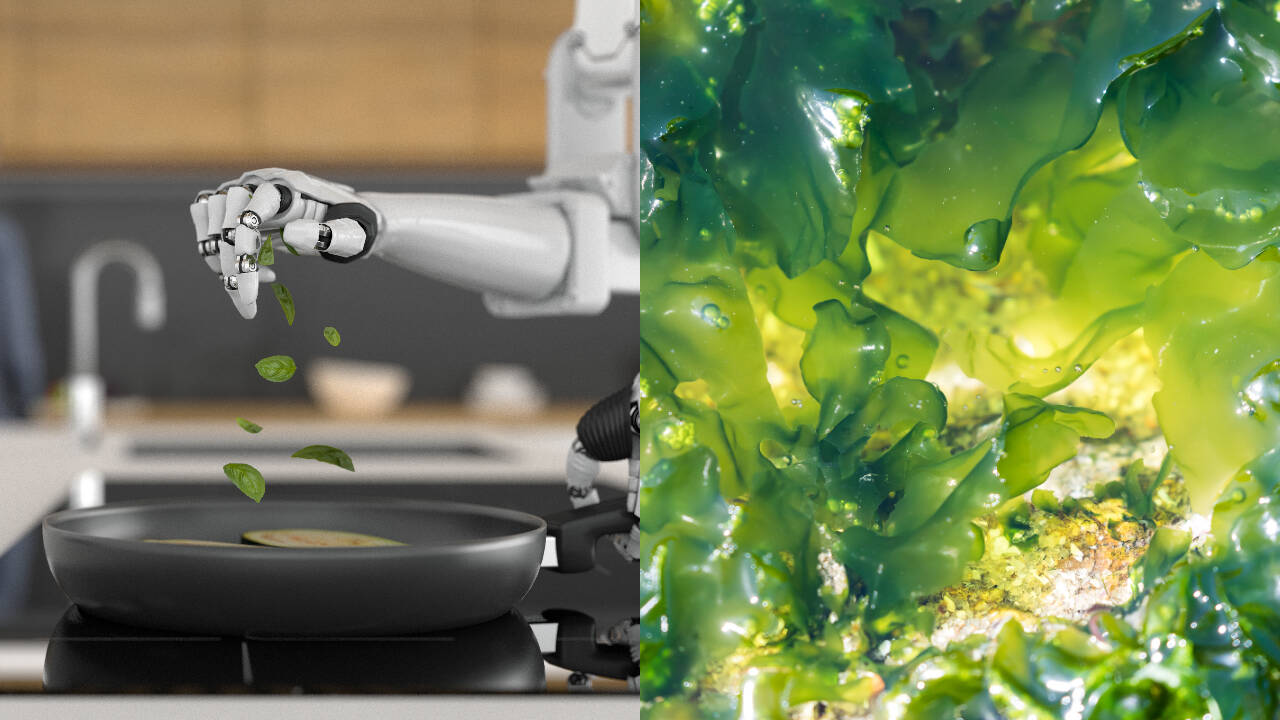
Engineering synthetic actuators that rely on external energy fields without tethered electrical infrastructure requires a transition from rigid electronic architectures to soft, responsive material systems. The integration of living photosynthetic organisms within hydrogel matrices represents a functional convergence of biological energy transduction and responsive polymers. This structural framework bypasses conventional servo-driven mechanics by substituting internal chemical energy conversion directly into spatial deformation.
To understand the operational envelope of light-powered biohybrid arms, one must analyze the energy transfer function. Conventional robotic systems decouple the power source from the actuator via copper wiring, pneumatic lines, or hydraulic channels. Biohybrid systems integrate the power source directly into the structural material. Living microalgae suspended within a hydrogel layer act as local transducers, converting photons into chemical potential gradients through active metabolism or osmotic shifts. For a different perspective, consider: this related article.
The primary physical challenge in soft robotics is directional control. Hydrogels typically swell or de-swell uniformly when exposed to environmental stimuli, leading to isotropic expansion rather than vector-directed bending. To achieve articulation, engineers must induce anisotropic stress gradients across the cross-section of the material. By layering active biological components asymmetrically, localized changes in water retention or metabolic gas generation create differential mechanical stress. When a specific wavelength of light strikes the algal-hydrogel matrix, the localized metabolic activity alters the osmotic pressure or triggers polymer contraction, resulting in a predictable spatial bend.
The functional limitations of these biohybrid structures dictate their deployment vectors. Organic actuators exhibit constrained response times relative to piezoelectric or electromagnetic motors. The rate-limiting step is mass transport—specifically, the diffusion of water, ions, and metabolic byproducts through the hydrogel matrix. While electrical currents propagate at near-instantaneous speeds, diffusion-based mechanical response scales quadratically with thickness. Consequently, scaling these systems up to handle macroscale payloads introduces critical latency issues. Related insight on this matter has been provided by CNET.
Energy efficiency metrics present a distinct trade-off profile. Traditional robotics demand continuous electrical current to maintain a fixed position under load, leading to high thermal dissipation. Biohybrid arms leverage the homeostatic properties of living cells to maintain baseline states with minimal exogenous energy input, relying on ambient photon flux to sustain structural integrity. However, the operational lifespan is bounded by biological viability. Algal cells require specific nutrient concentrations, hydration levels, and temperature ranges to sustain metabolic function. Exceeding these environmental tolerances induces cellular senescence, resulting in mechanical degradation of the actuator.
Integrating these systems into industrial or field environments requires shifting the operational paradigm from rigid control loops to biological maintenance protocols. Rather than managing voltage inputs and pulse-width modulation, system architects must monitor nutrient diffusion rates, light-dark cycle adaptation phases, and cellular replication thresholds. Future development depends less on raw processing power and more on microfluidic nutrient delivery networks embedded directly within the soft structural layers to prevent localized cell death during continuous actuation cycles.