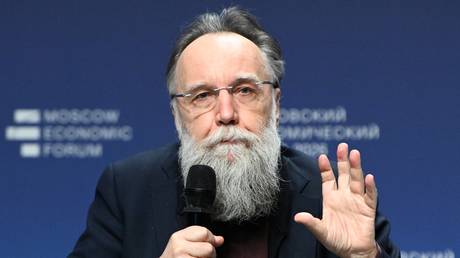
Alexander Dugin looks the part of the mad monk. With a beard that flows like a river of silver and eyes that seem to be peering through you toward a horizon only he can see, he has long been branded "Putin’s Philosopher." Whether or not he actually whispers into the Tsar’s ear is less important than the fact that his ideas provide the spiritual scaffolding for modern Russian expansionism. For decades, nationalists in the West—the "identitarians" and the self-proclaimed defenders of the white race—saw him as a brother-in-arms. They thought he was their vanguard. They thought he was fighting for them.
They were wrong.
The betrayal did not come in a whispered backroom deal. It arrived in the form of a rhetorical sledgehammer. Dugin, the man who once inspired the "Alt-Right" with visions of a traditionalist revival, has turned his fire on the very concept of "whiteness." To understand why is to understand a tectonic shift in the way power is being reimagined on the global stage. It is not a glitch in his philosophy. It is the logical conclusion of a worldview that views the individual as a ghost and the collective as the only thing that breathes.
The Mirage of the Global Tribe
Imagine a young man in a basement in Lyon or a coffee shop in Austin. He feels the world slipping through his fingers. He sees his culture being diluted, his history being rewritten, and his economic future being sold to the highest bidder. He looks for a champion. He finds Dugin’s Fourth Political Theory. He reads about the "Great Awakening" and the resistance against a "liberal globalist elite." He assumes, naturally, that because he is white and European, Dugin is on his side.
But Dugin’s world is not built on skin color. It is built on "Dasein"—a borrowed Heideggerian term for the unique, mystical soul of a specific people rooted in a specific geography. To Dugin, "whiteness" is not a biological reality to be defended; it is a mask for the very thing he hates most: the West.
When Dugin attacks "whites," he is not attacking a race in the way an American sociologist might. He is attacking a geopolitical construct. In his eyes, the "white man" is the inventor of liberalism, the architect of the Enlightenment, and the father of the individual rights that Dugin believes are corrosive to the human spirit. To save the world, the "white man" must die so that the "Russian man," the "Persian man," and the "Chinese man" can finally live.
The Architect of the Multipolar Cage
Consider the mechanics of a clock. Each gear must turn in its own direction for the hands to move. If one gear tries to make all the others turn exactly like it, the machine breaks. This is Dugin’s view of the West. He sees the "White World"—specifically the US and the EU—as a rogue gear trying to force the entire planet into a single, sterile, liberal mold.
He argues that "whiteness" has become synonymous with "Atlanticism." This is the cold, maritime power of trade, democracy, and individual autonomy. By turning against the concept of a "white identity," Dugin is cutting the umbilical cord that tied his Eurasian project to Western far-right movements. He is telling his former admirers in the West that they are part of the problem. They are the inhabitants of a dying civilization that must be cleared away to make room for his "Multipolar World."
This isn’t just academic hair-splitting. It has blood on its hands. By pivoting away from racial solidarity and toward a "civilizational" struggle, Dugin justifies alliances that would make a traditional nationalist’s head spin. He isn't looking for a "white" Europe; he is looking for a Europe that is simply not American. If that Europe is Islamic, or Socialist, or a patchwork of neo-feudal city-states, he doesn't care. As long as it stops being "The West."
The Invisible Stakes of the Great Reset
Why does this matter to someone who doesn't care about Russian philosophy? Because ideas are the quiet precursors to reality. Long before tanks cross a border, words have already demolished the bridge.
Dugin’s recent vitriol against "whites" serves a very specific strategic purpose for the Kremlin. Russia is currently positioning itself as the leader of the "Global South." It wants to be the champion of Africa, Latin America, and Southeast Asia against "Western Imperialism." You cannot be the hero of the decolonized world if you are seen as the leader of a white supremacist movement.
Dugin is performing a public exorcism. He is casting out the "white" element of his ideology to make it palatable for a global audience. He is telling the world that Russia is not the last bastion of Europe, but the first bastion of the anti-West.
For the Westerner who looked to Russia as a "traditionalist" savior, the realization is a cold one. They were never the audience; they were the useful idiots. Dugin doesn't want to preserve the West’s heritage. He wants to witness its funeral. He believes that the "White World" is a spiritual vacuum that has reached its expiration date.
The Human Cost of Grand Theories
There is a certain seduction in Dugin’s prose. It feels ancient. It feels heavy. In a world of digital ephemera and plastic culture, his talk of "destiny" and "tradition" hits like a shot of straight vodka. But look closer at the human element he claims to protect.
In Dugin’s world, the individual doesn't exist. You are merely a cell in the body of your civilization. If that body needs to go to war, you go. If that body needs to suppress dissent to maintain its "soul," you stay quiet. The "human-centric" narrative Dugin preaches is actually a narrative centered on the Idea of humanity, which is a very different thing from actual humans.
Real people bleed. Real people want to choose who they love, what they say, and how they live. Dugin’s "Great Awakening" is a call to return to a world where those choices are made for you by the "spirit of the people." By attacking "whites," he is attacking the group he identifies most closely with the invention of personal freedom. He isn't fighting for "diversity" in the way we understand it; he is fighting for a diversity of cages, where every culture is locked in its own historical bubble, forbidden from "contaminating" the others with ideas like universal human rights.
The Mirror and the Mask
The irony is thick enough to choke on. Dugin, a man who uses the internet, travels in suits (when not sanctioned), and utilizes the philosophical tools of Western thinkers like Nietzsche and Heidegger, claims to despise the very world that produced him. He is a product of the West’s peculiar freedom to self-loathe.
His shift away from "whiteness" is a calculated move in a much larger game. He is watching the internal fractures of the United States and Europe—the debates over identity, race, and history—and he is stoking the fire. He wants the West to collapse under the weight of its own contradictions. By declaring "whiteness" a failed experiment, he is inviting the West to participate in its own demolition.
But there is a flaw in his logic. He assumes that the "soul of the people" is a static, unchanging thing that can be managed by a philosopher-king. He forgets that culture is a conversation, not a monologue. The people he thinks he represents—the Russian workers, the Siberian farmers—often want the same things the "decadent" Westerners want: a decent life, a bit of security, and the right to not be sent into a meat-grinder for someone else’s "Dasein."
The bearded prophet sits in Moscow, watching the world burn and calling it a "cleansing fire." He has discarded his Western admirers like a worn-out coat because they no longer fit the shape of the war he wants to fight. He has moved on to a bigger stage, one where he can play the role of the global liberator, freeing the world from the "burden" of the West.
He is not a conservative. He is a revolutionary of the most dangerous kind—one who wants to go backward. He isn't defending a race, a nation, or a tradition. He is defending a dream of absolute power, wrapped in the language of mysticism and delivered with the cold precision of a psychological operation.
The "white" nationalists who once cheered for him are now finding themselves outside in the cold, realizing that in the empire of the mind Alexander Dugin is building, there is no room for anyone who still believes they are an individual. The mask has fallen. The mad monk isn't trying to save the world; he's just trying to ensure that when it ends, it ends on his terms.
The fire he is starting doesn't care about the color of the wood it burns. It only cares about the heat. And as the flames rise, the human element—the actual, living, breathing people caught in the crossfire of his "civilizational" war—finds itself increasingly irrelevant to the grand design.
In the end, Dugin’s attack on "whiteness" isn't a change in direction. It’s an unmasking. He has finally admitted that his vision for the future has no room for the West, in any form. Not its politics, not its people, and certainly not its freedom. He is waiting for the silence that follows the crash. He is waiting to see who is left to listen to his sermons in the ruins of the world he helped tear down.


