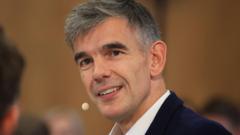
The chattering classes are clutching their pearls again. The mere mention of Matt Brittin—the man who spent nearly two decades turning Google into Europe's dominant digital advertising engine—potentially taking the reins at the BBC has sent the old guard into a tailspin. They ask if he is the "right person" to steer the ship. They worry about "public service values" and "cultural integrity."
They are asking the wrong questions because they are terrified of the right answer.
The BBC is not a cultural monument in need of a curator. It is a legacy media conglomerate drowning in a sea of algorithmic competition, and it is currently bringing a knife to a drone fight. The consensus view suggests the BBC needs a "creative" leader who understands the soul of British broadcasting.
That view is a death sentence.
The BBC doesn’t need a soul searcher. It needs a cold-blooded operator who understands how to weaponize data, crush distribution bottlenecks, and survive in an attention economy that doesn’t give a damn about the history of the Reithian principles.
The Myth of the Creative Savior
Every time a major legacy institution hits the skids, the board looks for a "creative." They want someone who can talk about the magic of storytelling and the sanctity of the script. It’s a comforting lie.
In the modern era, content is no longer king. Distribution is the king, the queen, and the entire royal court. You can produce the most brilliant documentary in the history of the medium, but if the YouTube algorithm buries it or the Netflix interface out-maneuvers your clunky iPlayer UX, that content effectively does not exist.
Brittin isn't a "content guy." That’s exactly why he’s dangerous—and why he’s necessary. He spent his career at Google building the pipes. He understands that the battle for the 21-year-old in Birmingham isn't being won on the quality of the drama; it's being won on the friction-less nature of the delivery.
Critics argue that a Google executive would "commercialize" the BBC. This ignores the reality that the BBC is already in a brutal commercial fight for human attention. Every minute someone spends scrolling TikTok is a minute they aren't engaging with the license fee's output. If you aren't winning the data war, you are losing the cultural war.
Digital Transformation is a Polite Term for Controlled Demolition
Most "digital transformations" in the public sector are just expensive ways to put a website on top of a 1950s bureaucracy. I have seen organizations burn through nine-figure budgets trying to "modernize" while keeping their bloated middle management and archaic decision-making processes intact.
The BBC is a labyrinth of internal politics where "strategy" goes to die in a thousand committee meetings. A tech insider from the Big Tech era doesn't look at the BBC and see a prestigious broadcaster. They see a massive amount of technical debt and a fragmented data strategy.
If Brittin were to take over, the "disruption" wouldn't be about selling ads on BBC One. It would be about the brutal simplification of the organization.
Imagine a scenario where the BBC stopped trying to be everything to everyone on every platform and instead used Google-style data analytics to identify exactly where their unique value lies.
- The Data Truth: Most of what the BBC produces is ignored by the very people paying for it.
- The Tech Solution: Shifting from a broadcast-first mentality to a platform-first mentality. This isn't just about a better app; it's about an entire backend overhaul that treats every piece of content as a modular data point.
The old guard calls this "devaluing the brand." I call it surviving the decade.
The Ad-Tech Bogeyman
The loudest outcry against a tech-heavy leader is the fear of "Google-fication." People point to Google's various antitrust battles and privacy scandals as proof that Brittin is morally incompatible with the BBC’s mission.
This is a lazy, emotional argument.
Working at a company that optimizes for clicks doesn't lobotomize your ability to understand a different mission statement. What it does do is give you a front-row seat to how the world actually works now.
The BBC's current leadership spends its time defending the license fee to skeptical politicians. They are playing defense. A tech-native leader would play offense. They wouldn't just beg for the license fee to stay; they would make the BBC’s digital infrastructure so indispensable that the platform itself becomes the value proposition, not just the shows.
We need to stop pretending that the BBC is a "special case" exempt from the laws of digital gravity.
$A = \frac{C}{F}$
In this simple model for digital relevance, $A$ (Attention) is the result of $C$ (Content Quality) divided by $F$ (Friction). The BBC has historically focused entirely on $C$ while allowing $F$ to skyrocket. Netflix and Amazon have won by driving $F$ toward zero.
A "creative" leader will try to fix the numerator. A tech leader like Brittin will fix the denominator. One is a vanity project; the other is a survival strategy.
The Competitor’s Blind Spot: The "Public Service" Trap
The competitor article suggests that the BBC needs someone who "understands the unique public service remit." This is a classic trap. It assumes that "public service" and "high-tech efficiency" are mutually exclusive.
In reality, the greatest public service the BBC can perform is to be reachable and relevant.
If the BBC’s news department continues to operate with the agility of a Victorian steamship while "fake news" operators use AI-driven distribution to saturate the market, the BBC has failed its remit. You cannot serve the public if the public has moved to a different neighborhood and you don't have a map.
The skepticism toward Brittin is rooted in an elitist fear of the "algorithm." But the algorithm is just a reflection of human behavior. Ignoring it isn't "noble"—it’s negligent.
Stop Asking if He's "Right" and Start Asking Who Else Can Do It
Look at the alternatives. Usually, it's a carousel of the same five media executives who have spent their careers moving from one declining TV network to another. They know how to manage decline. They know how to cut costs without changing the culture. They know how to fail gracefully.
Is Brittin a risk? Absolutely. His tenure at Google was defined by aggressive tax optimization and dominant market positions—things that sit uncomfortably with a publicly funded entity.
But the downside of a "safe" appointment is 100% certain: a slow, agonizing slide into irrelevance. The BBC is currently a high-quality product stuck in a broken vending machine. You don't need a poet to fix the machine. You need an engineer who knows how the gears turn.
The critics aren't worried that Brittin will fail. They are worried he will succeed in a way that makes their traditional power structures obsolete. They are worried he will look at the bloated departments and the redundant roles and ask, "Why does this exist in 2026?"
That is exactly why he should be there.
The BBC is currently operating on a 20th-century blueprint in a 21st-century storm. The people complaining about a tech insider are the same people who would have complained about putting an engine on a sailing ship because it "ruined the aesthetic of the sails."
The sails are shredded. The mast is snapping. It’s time to start the engine.
Stop looking for a leader who loves the BBC's past. Start looking for one who is capable of forcing it into the future. If that person happens to be the guy who helped build the very platforms that are currently eating the BBC’s lunch, then so much the better. You don't beat a shark by sending in a lifeguard; you send in a bigger shark.
Hire the tech titan. Let him break things. It’s the only way to save what’s left.