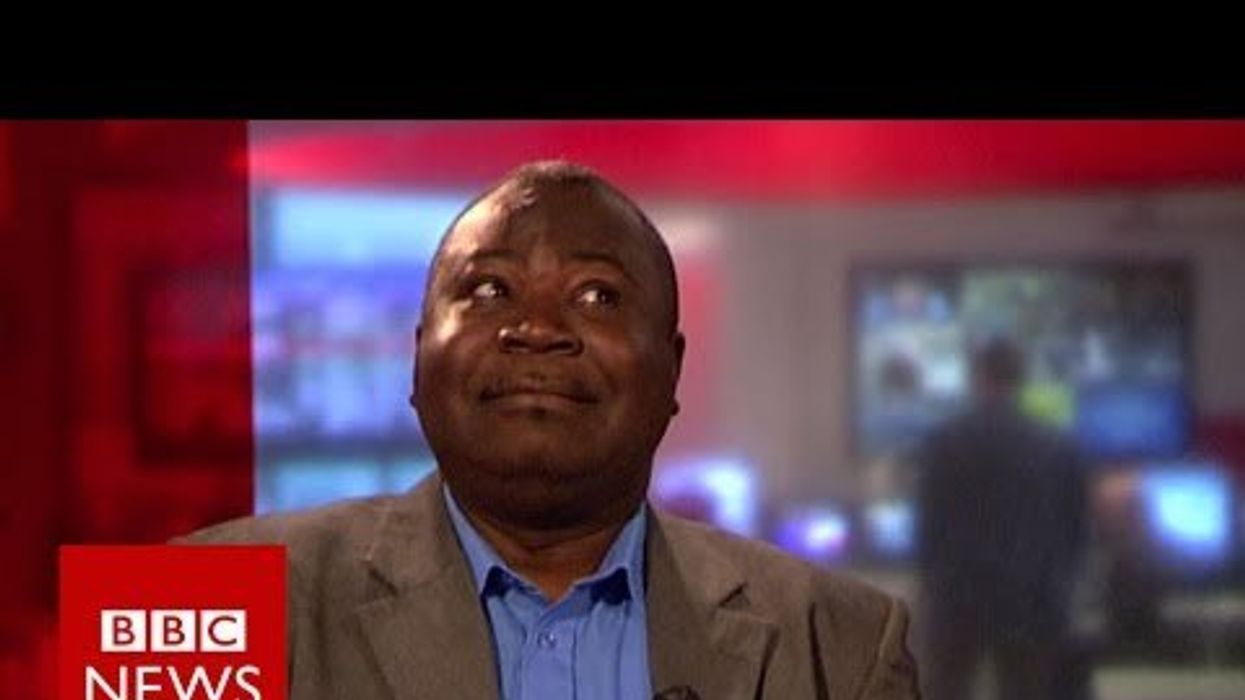
Guy Goma didn't go to the BBC to become a living meme. He went for a job interview. It’s been twenty years, but that clip of a confused man from the Congo being interviewed on live TV about a legal battle between Apple Corps and Apple Computer is still the gold standard for live broadcasting disasters. It isn't just a funny video. It’s a masterclass in human psychology, corporate failure, and the way the internet preserves our most awkward moments forever.
You’ve seen the face. That wide-eyed "oh no" moment when the producer introduces him as Guy Kewney, an expert on internet technology. Goma was actually there for a data support role. He sat in the wrong waiting area. A producer asked for "Guy," he said yes, and the rest is history. We keep talking about it because it represents a universal fear. We've all been in a situation where we’re completely out of our depth but feel forced to play along.
Why the BBC Goma blunder survived the viral era
Most viral clips die in a week. This one stuck. You’ve got to look at the timing to understand why. In 2006, YouTube was barely a year old. The world was just starting to shift toward user-generated content and "real" moments over polished TV. Goma was the first true hero of this transition. He wasn't a celebrity. He was a guy looking for a paycheck who ended up explaining complex trademark law without a single clue.
The technical failure on the BBC’s part is staggering. They had two waiting rooms. They had a guest list. They had photos of the real Guy Kewney. Yet, the sheer momentum of a live newsroom took over. Newsrooms are frantic. If someone says "I'm Guy," they’re getting a mic clipped to their shirt. Goma’s decision to actually answer the questions is the secret sauce. He didn't run. He didn't scream. He just tried his best.
The psychology of the Guy Goma look
That split second where his eyebrows shoot up is the most analyzed frame in British television history. It’s the "fight or flight" response caught in 4K. Goma chose a third option: "fake it." Honestly, his answers weren't even that bad. He talked about the spread of downloading and the future of the industry. He was vague enough to sound like a consultant.
Psychologists call this the "spotlight effect." We think everyone is noticing our mistakes, so we overcompensate. Goma felt the weight of the cameras and the lights. He assumed the BBC knew what they were doing. If they put him in the chair, he must be the guy, right? This speaks to a deeper trust in authority that we’ve mostly lost by 2026. Today, we’d assume it was a prank. In 2006, it was just a terrible, wonderful mistake.
Legal battles and the cost of fame
The real Guy Kewney, the expert who should’ve been there, sadly passed away in 2010. He was a brilliant journalist, but his legacy is now tied to a man who didn't know him. That’s the harsh reality of the internet. It doesn't care about your credentials. It cares about the punchline.
Goma later tried to sue the BBC for a share of the royalties from the clip. It makes sense. That video has been viewed millions of times. It’s appeared in documentaries, training videos, and retrospectives. He never got a penny from those views. While the BBC claimed he was never an employee and the interview was "fair use" for news, Goma felt exploited. He didn't get the job he interviewed for, either. Imagine failing a job interview because you were too busy being a global celebrity for ten minutes.
How to handle being out of your depth
We can learn a lot from how Goma handled the pressure. Most people would crumble. He leaned in. If you ever find yourself in a high-stakes situation where you realize you shouldn't be there, you have three choices.
- Own the mistake immediately. This is the boring way. You stop the interview, apologize, and leave. You don't become a meme, but you don't get the story.
- The Goma Method. Try to survive. Use broad language. Focus on trends. Smile through the panic.
- Pivot. Turn the mistake into an opportunity. Goma tried this later, but he lacked the PR machine to turn a moment into a career.
The BBC improved their guest vetting process after this. Now, guests are usually checked by multiple people before they get anywhere near a studio. They use photos. They verify IDs. The Goma incident is literally used in broadcast journalism schools as a "what not to do" guide. It’s the reason why your local news station seems so repetitive with their introductions. They’re terrified of another Guy.
The permanence of a digital identity
In 2026, we’re obsessed with our digital footprint. Goma is the ultimate example of a "fixed" identity. No matter what he does, he’s the BBC Guy. He could win a Nobel Prize and the headline would still mention the 2006 interview. It’s a reminder that we don't own our reputations anymore. The algorithm does.
When you search for Guy Goma today, you see a man who has embraced it with a certain level of grace. He’s appeared on anniversary shows. He’s talked about the absurdity of it. But he also highlights a darker side of the media. The BBC made money and gained prestige from that moment. Goma got a funny story and a lot of frustration. It’s an unequal trade.
Media literacy in the age of deepfakes
The Goma interview was a "shallow fake." It was a real person in the wrong place. Now, we deal with AI-generated videos that look more real than the 2006 broadcast. The lesson here is skepticism. If a world-renowned expert looks terrified and gives vague answers, maybe he’s not the expert.
The BBC producers ignored their eyes because the schedule demanded a guest. They had a hole to fill in the 24-hour news cycle. That pressure to produce content constantly leads to errors. It happened then with a human error, and it happens now with AI hallucinations. The "content mill" is a dangerous place.
Steps for modern media guests
If you're ever invited to speak on a platform, take Goma's experience as a checklist.
- Verify the topic. Don't just show up. Ask for the specific angles they want to cover.
- Identify the producer. Know who is responsible for your segment.
- Check the monitor. Most studios have a screen showing the "lower third" graphics. If it says you're a tech expert and you're an accountant, speak up before the red light goes on.
- Have a backup plan. If things go sideways, have a "safety" sentence. "I think there's been a mix-up, but I'm happy to discuss the general impact of this news" is a lot better than staring into the void.
Goma’s story is a tragedy wrapped in a comedy. It’s about a man who wanted a better life and ended up as a punchline for a world that didn't know his name. We owe it to him to remember that he was a job seeker first and a celebrity second. Next time you see the clip, don't just laugh at the face. Think about the broken system that put him there.
Make sure your own professional profiles are updated and clear. Don't let a mistake define your career path. If you're in a situation where you feel like an impostor, remember Guy Goma. He actually was one—by accident—and he survived. You'll be fine too.
Check your LinkedIn tags today. Ensure your expertise is clearly defined so no producer can "accidentally" make you the face of a movement you don't understand.
:max_bytes(150000):strip_icc()/Whitney-Leavitt-Jen-Affleck-063025-6249409f3e634d3d8889b627b49eb21f.jpg)