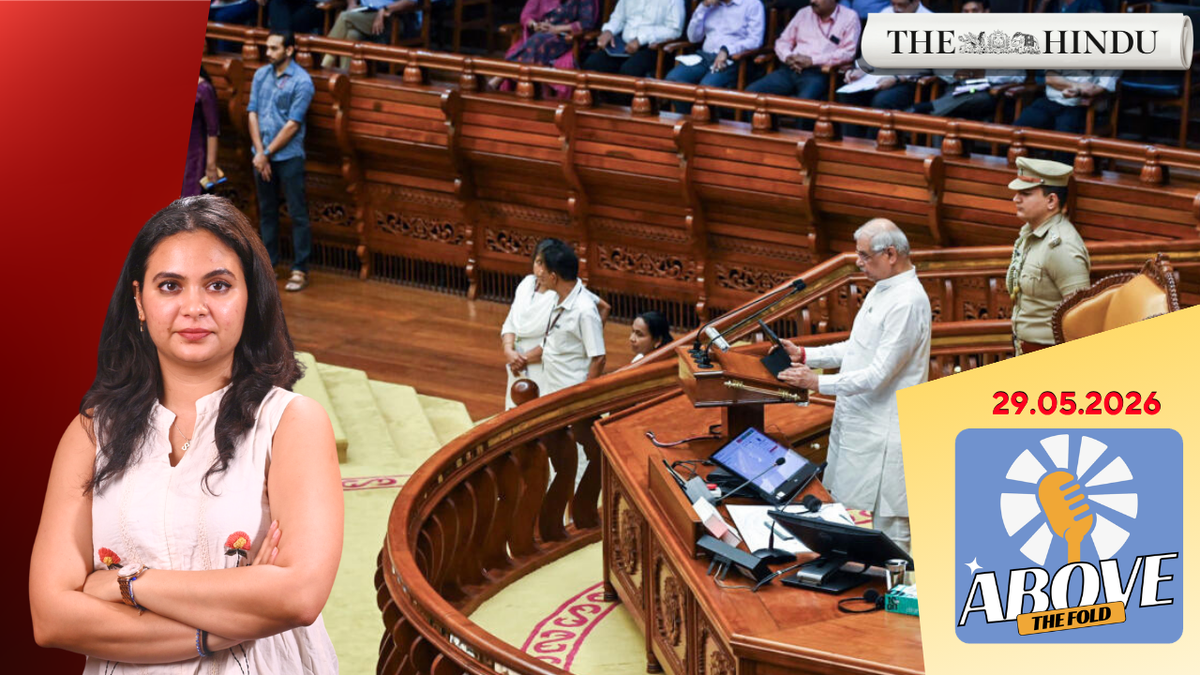
The newly minted Congress-led United Democratic Front government in Kerala wanted its opening week to be about policy victories and governance overhauls. Instead, it has been completely blindsided by a 150-year-old song. On Friday, the opening day of the 16th Kerala Legislative Assembly degenerated into an ideological sandbox when the official police band played only the first two stanzas of India’s national song, Vande Mataram, before abruptly stopping.
This truncated rendition was not a technical glitch. It was a deliberate political calculation by Chief Minister V.D. Satheesan’s administration to bypass an explicit directive from Raj Bhavan, which had demanded the six-stanza version be played in full. By silencing the band midway, the government thought it was avoiding a confrontation with the Left opposition. Instead, it walked straight into a crossfire that exposes the fragile, high-stakes nature of identity politics in southern India.
The Swearing In Trap
To understand how a musical score became a political liability, one must look back to last week’s cabinet swearing-in ceremony. The event was managed entirely by Raj Bhavan under the watchful eye of Governor Rajendra Vishwanath Arlekar. Without consulting the incoming cabinet, the Governor’s office introduced a full recital of Vande Mataram to mark the song’s sesquicentennial anniversary.
The newly elected ministers stood through all six stanzas. The backlash from the opposition bench was immediate and fierce.
The Communist Party of India (Marxist), reeling from its electoral defeat and reduced to just 35 seats, seized the moment. The CPI(M) state secretariat instantly accused Satheesan of "surrendering to the Sangh Parivar," claiming that forcing a pluralistic society to endure the highly theological later stanzas of Bankim Chandra Chattopadhyay's 1875 poem was an affront to secularism. In Kerala's finely balanced electoral ecosystem, where minority coalitions hold decisive weight, such an accusation is lethal.
Satheesan panicked. He claimed his cabinet was caught off guard and simply stayed standing because interrupting the song mid-ceremony would have looked worse.
Determined not to be painted into a corner twice, the chief minister ordered the police band to slash the song down to its opening lines for Friday's assembly session. The move backfired spectacularly. Governor Arlekar walked out of the house and immediately went public with his fury, flagging a direct protocol violation and summoning the Assembly Speaker for an explanation.
The 1937 Compromise Metastasizes
The historical literacy of the current debate is remarkably shallow, yet both sides dig into deep historical trenches. The controversy hinges on what parts of the song are actually being played.
The first two stanzas of Vande Mataram are an idyllic, secular ode to a bountiful motherland filled with clean water, fresh fruits, and green fields. The later stanzas shift tone dramatically, explicitly equating the nation with Hindu deities like Durga and Lakshmi.
Stanzas 1-2: Secular imagery of nature, water, and fertile earth. (Globally accepted as the National Song)
Stanzas 3-6: Highly specific religious iconography, historically contested.
This is not a new debate. In 1937, the Congress Working Committee, facing intense pressure from internal factions and minority leaders, formally recommended that only the first two stanzas be sung at public gatherings. When the Constituent Assembly adopted Vande Mataram as the national song in 1950, it did so with the implicit understanding that this 1937 compromise remained the standard.
By demanding all six stanzas, Raj Bhavan is attempting to overwrite decades of established post-independence convention. By complying and then aggressively retreating, the UDF government has made itself look weak, unprincipled, and easily rattled.
A Three Way Political Extortion
The tragedy of the current impasse is that it has nothing to do with patriotism and everything to do with survival in a changing assembly. For the first time in history, the Bharatiya Janata Party has gained a meaningful foothold in the Kerala Assembly with three legislators. They do not have the numbers to pass legislation, but they have the microphone.
BJP leader V. Muraleedharan lost no time in labeling the truncated song an insult to national heritage, accusing the Congress of appeasing extremist outfits like the Jamaat-e-Islami. This puts the ruling UDF in an impossible vice.
- If they play the full song: They alienate their vital secular and minority vote banks, allowing the CPI(M) to claim the mantle of the sole defenders of Kerala's secular fabric.
- If they cut the song: They hand the BJP a powerful narrative weapon, allowing them to broadcast across national airwaves that the Kerala Congress is anti-national.
Satheesan tried to defuse the bomb on Friday evening by stating that rendering the song in full is not legally mandatory because no formal law has been enacted by Parliament. It was a legally accurate but politically tone-deaf defense. In a cultural war, nobody cares about the fine print of statutory law.
The Real Cost of Symbolism
While the state administration spends its energy managing the fallout of a police band’s setlist, the real structural issues facing Kerala are pushed to the back burner. The state's fiscal deficit is ballooning. The agricultural sector is struggling with volatile commodity pricing, and youth unemployment remains stubbornly high despite a highly literate workforce.
Instead of debating budgetary allocations or industrial policies, the first week of the new assembly will be dominated by a shouting match over who stood up, who sat down, and how many stanzas were played.
The relationship between the Raj Bhavan and the state government is now poisoned from day one. In Indian state politics, a hostile governor can stall bills, delay appointments, and turn governance into an endless bureaucratic nightmare. By choosing to fight on the terrain of cultural symbolism, the UDF government has traded long-term administrative stability for a short-term political shield. It is a terrible trade, and the people of Kerala will likely pay the price.