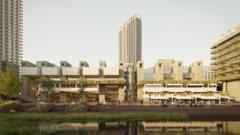
The announcement that the Barbican will receive £231 million for repairs is less a victory for culture and more a masterclass in institutional denial. Watching the City of London throw nine figures at a concrete relic is like watching a gambler double down on a losing hand because they cannot bear the shame of admitting the initial bet was a mistake. Everyone in the planning and arts sphere is applauding this as a preservation success, but they are ignoring the cold, hard physics of the project.
I have spent decades watching developers, municipal boards, and cultural trusts blow through capital budgets on assets that were obsolete the moment they were poured. The Barbican is the king of this graveyard. We are told this money is for "modernization" and "accessibility," but what is actually happening is a desperate attempt to delay the inevitable decay of a building system that has reached its chemical and structural shelf life.
The Concrete Trap
Let us address the material reality. The Barbican is a fortress of reinforced concrete. To the uninitiated, this is "permanent" architecture. To anyone who understands civil engineering, it is a ticking time bomb of chemical instability. Concrete is porous. Over decades, atmospheric carbon dioxide penetrates the surface, reacting with calcium hydroxide to lower the pH of the concrete. Once that internal environment becomes acidic, the protective passivating layer around the internal steel reinforcement bars—the rebar—is neutralized.
Once the rebar begins to oxidize and rust, it expands. This expansion creates internal pressure. Eventually, the concrete spalls—it breaks off in chunks. This is not a maintenance issue that gets solved with a fresh coat of paint or a new HVAC system. This is a structural condition requiring extensive, invasive, and recurring remediation.
When you read about this "revamp," do not be fooled by the sanitized language of architectural restoration. This is about patching up a crumbling skeleton. The budget of £231 million is a drop in the ocean compared to what is required to actually modernize a site of this scale, complexity, and specific structural failure profile. They are essentially putting a high-end bandage on a compound fracture.
The Myth Of The Masterpiece
There is a reflexive, almost religious, devotion to the Barbican. Critics call it a "Brutalist masterpiece." The term has become a shield against criticism. If you question the efficiency, the accessibility, or the sheer misery of navigating its dark, windswept, labyrinthine walkways in mid-January, you are accused of lacking taste.
This status is why the money is being spent. It is not about the utility of the space. It is about the preservation of an aesthetic ego. The architects, Chamberlin, Powell and Bon, created a vision that functioned perfectly in the idealistic drawings of the 1960s but has proven to be a logistical nightmare for every day since.
Consider the user experience. You have a complex that is notoriously difficult to navigate, with signage that actively confuses rather than informs, and a layout that creates dark, isolated zones—the exact opposite of modern urban planning goals. If you built a commercial office complex today with the Barbican’s connectivity and spatial flow, it would be condemned as a failure before the ribbon was cut. Yet, because we call it "heritage," we pour hundreds of millions into keeping this specific form of dysfunction alive.
Addressing The Obsolescence
When stakeholders talk about "accessibility," they are admitting that the building fails to meet basic modern standards for movement and inclusion. But you cannot retrofit an uncompromising, rigid concrete grid for accessibility without fundamentally altering the very thing you are trying to preserve.
The struggle to make the Barbican "accessible" is a battle against the architecture itself. Ramps, lifts, and wider paths are alien to the original design intent. Every time the institution tries to wedge modern accessibility standards into the Barbican, they weaken the aesthetic "purity" that makes the building beloved to its defenders. It is a lose-lose scenario. Spend the money and lose the soul of the building, or keep the soul of the building and remain exclusionary.
There is a pervasive belief that we can simply "upgrade" old systems. We see this in the reliance on outdated heating and ventilation designs. The Barbican is a thermal sieve. In an era where energy costs and carbon targets are the primary drivers of commercial real estate value, this complex is an anchor.
Refurbishing the building envelope of an estate of this size to modern thermal standards is essentially impossible without gutting the interior, which would involve destroying the very residential and cultural units that the project aims to save. This leads us to the reality that this £231 million will be spent on surface-level improvements that do not solve the fundamental energy and operational inefficiency of the estate.
The Fiscal Sunk Cost
Why does this continue? Why do we keep authorizing these massive expenditures? The answer is the sunk cost fallacy, writ large on the skyline of London.
The City of London has invested so much, both financially and in terms of branding, into the Barbican that they cannot afford to admit it is a dying asset. If they were to objectively analyze the cost of maintenance versus the cost of a complete teardown and site redevelopment, the numbers would look significantly different.
Imagine a scenario where we stop treating the Barbican as a sacred object and start treating it as a piece of real estate. If you were a developer looking at a plot of land that size, in that location, would you look at those crumbling, dark, expensive-to-run concrete towers and think, "Yes, I want to spend a quarter of a billion pounds fixing this"? No. You would clear it. You would build something that actually serves the current density needs of the city, that uses modern, sustainable materials, and that creates an environment people actually want to work and live in.
But we do not do that. We treat the Barbican like a museum piece, even though people live there and work there. We prioritize the historical fetish over the present need.
Dismantling The Common Excuses
There are arguments frequently made to defend this expenditure. They deserve to be dismantled.
"The Barbican is architecturally significant."
Significance does not equal utility. A guillotine is historically significant, but we do not use it to solve modern legal disputes. We can preserve the history through documentation and archives without forcing modern taxpayers to fund the upkeep of a flawed living environment.
"It's about social value."
There is a massive amount of social value locked up in the Barbican’s footprint. That value is not being maximized. By trapping that land in a low-density, high-maintenance, aging structure, we are actively preventing the creation of more and better social value. Think of the housing, the community space, or the modern cultural infrastructure that could be built on that land for £231 million—not just repaired, but built from scratch.
"We need to protect the arts community there."
The arts community is vital. But is the Barbican the only place they can thrive? We are holding the arts community hostage inside an expensive, inefficient structure because we are afraid to disrupt the status quo. If we stopped spending this money on the concrete shell, we could provide more direct, higher-quality support to the artists themselves.
The Cost Of Inaction
If we do not stop this cycle, we know exactly what happens next. In ten years, another report will surface detailing the "unexpected" degradation of the concrete. Another appeal for funds will go out. The price tag will be higher. The excuses will remain the same.
This is the cycle of institutional rot. It is the refusal to accept that things have a finite life. We pretend that with enough money, we can stop time. We cannot. The concrete is carbonating. The steel is rusting. The energy grid is failing.
We are not preserving a landmark. We are funding a slow-motion demolition.
Every pound spent on this revamp is a pound taken away from innovation. Every hour spent by planners trying to navigate the restrictions of this building is an hour not spent creating new, meaningful urban spaces. We are choosing the past over the future, and we are paying a premium for the privilege.
The City of London is currently celebrating its commitment to the future while chaining itself to the concrete mistakes of the mid-20th century. They think they are being good stewards. They are actually being custodians of a museum that nobody asked for, in a building that is actively working against its own survival.
The Barbican will continue to exist because the City of London cannot handle the embarrassment of its own architectural choices. It is a monument to a past that never should have been built, and now, we are all paying for the privilege of keeping it upright.