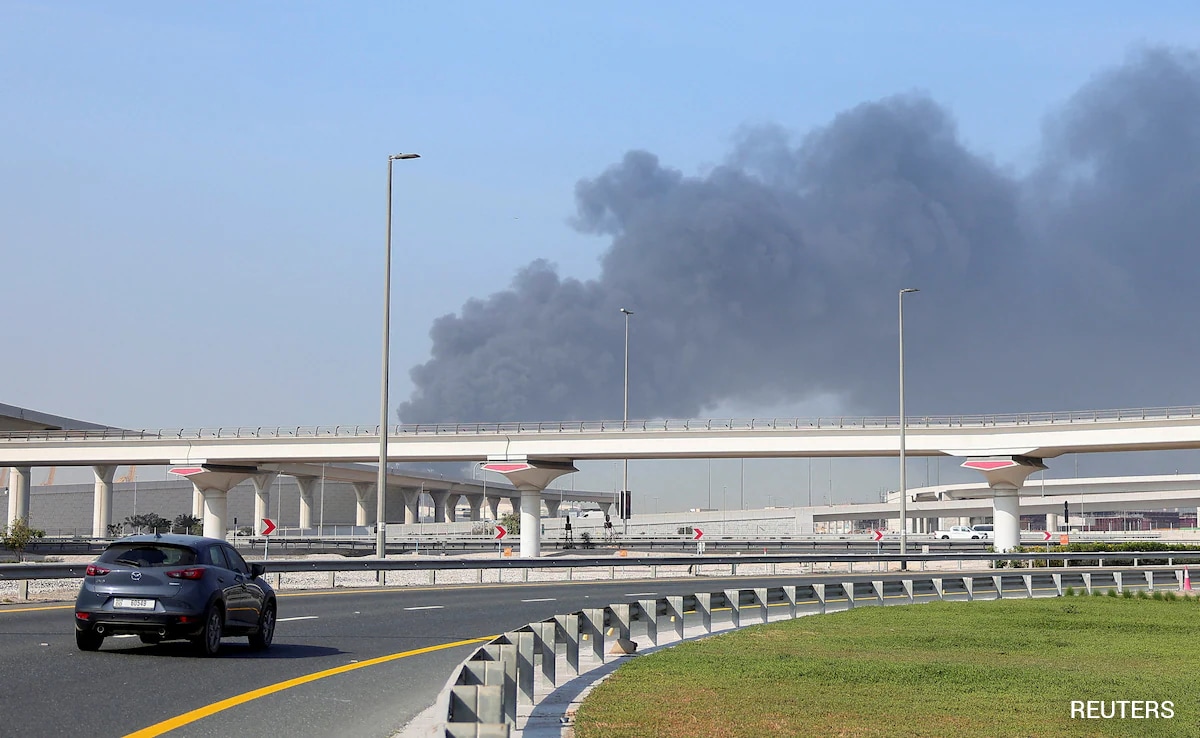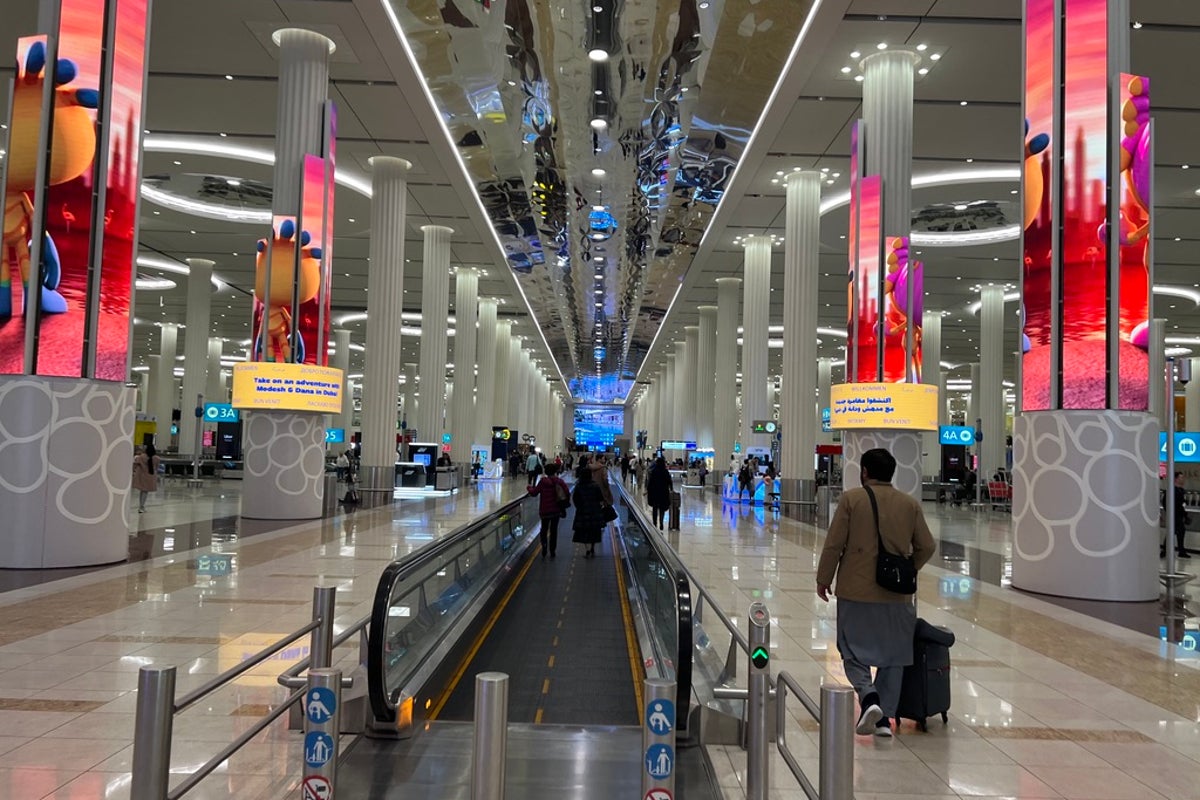
The closure of high-density aviation hubs during regional kinetic conflict is not an isolated operational failure but a systemic collapse of the "Just-in-Time" global transit model. When injuries occurred at Dubai International (DXB) during a period of Iranian missile strikes across the Middle East, the immediate cause—physical trauma—masked the more significant structural vulnerability: the total saturation of emergency response systems when geopolitical friction meets peak-load logistics. Analyzing this event requires moving beyond the surface-level reportage of "incidents" to quantify the cascading failures in airspace management, passenger density risks, and the physics of mass-panic in enclosed critical infrastructure.
The Triad of Infrastructure Vulnerability
The incident at DXB serves as a case study in how modern aviation hubs fail under non-linear stress. Three specific pillars define this vulnerability:
- Density-Induced Friction: DXB operates as a high-velocity transit point where the ratio of passengers to floor area is maximized for commercial throughput. When air traffic control (ATC) halts movement due to missile threats, the sudden cessation of the "flow" converts a kinetic transit system into a static, high-pressure mass.
- Information Asymmetry and Secondary Trauma: In the absence of real-time, high-fidelity data regarding the nature of the Iranian strikes, the passenger population defaults to a state of hyper-vigilance. The injuries reported—often the result of stampedes or rapid evacuations—are the direct output of an information vacuum.
- Airspace Sequestration: The proximity of Dubai to the Iranian coastline creates a minimal "Decision Window." Standard operating procedures (SOPs) for civil aviation are designed for mechanical failure, not for the evasion of hypersonic or ballistic trajectories.
The Physics of Civil-Military Airspace Conflict
The intersection of commercial flight paths and military strike corridors creates a "No-Win" scenario for hub operators. Dubai’s geographic position places it within the terminal phase of various regional missile envelopes. When Iran initiates large-scale launches, the regional ATC network—specifically the Jeddah and Bahrain Flight Information Regions (FIRs)—undergoes a process of Reactive Fragmentation.
This fragmentation forces immediate ground stops. At DXB, a ground stop does not merely mean planes stay on the tarmac; it triggers a logistical "Bullwhip Effect." For every 60 minutes of total airspace closure, the recovery time for a hub of Dubai’s scale is approximately 6 to 10 hours. The physical injuries noted during the incident occurred precisely at the inflection point where the terminal reached a "Critical Occupancy Threshold," where the number of humans per square meter exceeded the safety limits for rapid egress.
Quantifying the Cost of Panic: The Kinetic Feedback Loop
Human behavior in a high-density environment during a perceived missile strike follows a predictable, quantifiable decay.
- The Ignition Phase: Sound or visual cues (even unrelated to the actual strikes) trigger a localized flight response.
- The Propagation Phase: In a facility with glass and steel architecture, acoustic resonance amplifies the sound of running or shouting, creating a feedback loop of perceived danger.
- The Impact Phase: Injuries typically concentrate at "Choke Points"—escalators, security checkpoints, and boarding gates—where the physical architecture restricts the volume of the fleeing mass.
The reports of injuries at Dubai are the physical manifestation of the Panic Velocity Equation. If the rate of information dissemination is slower than the speed of rumor propagation, the resulting kinetic energy of the crowd exceeds the structural capacity of the terminal's safety barriers.
Technical Limitations of Missile Defense Integration in Civil Hubs
A significant misconception in the reporting of the DXB incident is the efficacy of Point Defense Systems (like the Iron Dome or C-RAM) in protecting civilian airports. While the UAE utilizes advanced multi-layered missile defense, these systems are optimized for intercepting threats to high-value military or governmental assets.
Integrating missile defense into a civilian airport environment introduces three systemic risks:
- Debris Fields: Interceptions at high altitudes generate supersonic fragmentation patterns. A successful intercept directly above an airport could result in higher casualty rates than a missed strike, due to the fragility of civilian aircraft and terminal roofing.
- Electronic Interference: High-powered X-band radar used for tracking missiles can disrupt civil SSR (Secondary Surveillance Radar) and transponder signals, leading to potential mid-air near-misses during the "Scramble" phase of a ground stop.
- Operational Paralysis: The mere activation of a localized defense battery necessitates the immediate grounding of all civilian hulls, effectively "killing" the hub’s economic utility to protect its physical existence.
The Geopolitical Risk Premium in Aviation Strategy
Aviation consultants and state-owned enterprises (SOEs) must now recalculate the "Resilience Metric" for Middle Eastern hubs. The Dubai incident proves that the traditional model of a centralized mega-hub is a liability during periods of regional escalation.
The strategy must shift toward Distributed Transit Redundancy. This involves:
- Dynamic Rerouting Protocols: Software-defined airspace management that can shift entire flight banks to alternative hubs (such as Riyadh or Muscat) the moment a launch is detected, rather than allowing planes to enter the high-threat zone.
- Hardened Terminal Nodes: Redesigning terminal interiors to include "Blast-Dampening Zones" and high-capacity egress routes that do not rely on electrified systems like escalators, which are prone to failure during emergency power cuts.
- Real-Time Biometric Communication: Using the airport’s existing facial recognition and mobile integration to push "Validated Truth" notifications directly to passenger devices, bypassing the delay of overhead PA systems.
Strategic Maneuver: Decoupling Hub Operations from Regional Kinetic Events
The long-term viability of Dubai as a global transit leader depends on its ability to decouple its operational status from the kinetic activity of its neighbors. This is not a diplomatic challenge, but a technical one. The "Incident" on the day of the Iranian strikes was not a failure of security, but a failure of Dynamic Capacity Management.
Operators must move toward a "Cold-Start" capability—the ability to freeze and then resume total hub operations within a 30-minute window without inciting mass-casualty events. This requires the implementation of AI-driven crowd flow controllers that can physically partition terminal sections using automated barriers to prevent stampedes before they reach critical mass.
The next evolutionary step for aviation hubs in high-friction zones is the "Autonomous Airspace" model, where the transition from civil to military-emergency status is handled by low-latency algorithms, removing the human hesitation that leads to the very chaos witnessed during the Iranian strikes. The priority is no longer just the safety of the hull in the air, but the management of the human mass on the ground.
Maintain a permanent, pre-cleared "Shadow Airspace" corridor for emergency departures, ensuring that no more than 15% of total hub capacity is ever caught in a ground-side bottleneck during a Tier-1 regional threat. Failure to implement these structural dampeners will result in the permanent migration of premium transit volume to more stable, albeit less efficient, latitudes.