Security architecture in the Pacific Islands has shifted from a post-Cold War administrative afterthought into a primary theater of great-power competition, driven by a single geographic reality: whoever controls the sea lanes and exclusive economic zones (EEZs) of Oceania controls the logistical arteries connecting North America to East Asia. When China signed a bilateral security agreement with the Solomon Islands in April 2022, it shattered a decades-old assumption that Washington, Canberra, and Wellington held an uncontested monopoly over regional defense. The resulting scramble for bilateral treaties, defense cooperation agreements, and policing pacts across Melanesia, Micronesia, and Polynesia is not a series of isolated diplomatic wins or losses. It is a structured contest over access, denial, and institutional lock-in.
To understand the mechanics of this competition, one must strip away diplomatic rhetoric and examine the underlying strategic calculus. Great powers do not sign security pacts with microstates out of altruism; they sign them to alter the cost-benefit equation of military projection. For the United States and its allies—primarily Australia, New Zealand, France, and Japan—the objective is area denial and operational depth. In the event of a kinetic conflict in the Taiwan Strait or the South China Sea, US forces require secure secondary supply lines running through the Second and Third Island Chains. Conversely, Beijing’s objective is strategic breakout and perimeter disruption. By establishing dual-use infrastructure, policing agreements, and port access behind the Second Island Chain, China complicates allied logistics, gathers signals intelligence, and fractures the diplomatic consensus that isolates Beijing in international forums.
The Structural Asymmetry of Pacific Security Deals
A fundamental analytical error in mainstream coverage of Pacific geopolitics is treating Chinese and Western security agreements as symmetrical instruments. They operate on entirely different mechanisms, targeting distinct vulnerabilities within Pacific Island governance structures.
The Western Model Institutional Lock-In and Sovereign Veto
The United States and Australia rely on comprehensive, legally binding defense treaties designed to create long-term institutional dependency and explicit third-party exclusion. The gold standard of this approach is the Compact of Free Association (COFA) framework linking Washington with Palau, the Federated States of Micronesia (FSM), and the Marshall Islands. Under COFA, the US provides budgetary support, federal services, and defense guarantees in exchange for strategic denial—the legal right to block any third-party military from entering those nations' territories or waters without Washington's explicit consent.
Australia has replicated this mechanism through bilateral treaties such as the Falepili Union with Tuvalu (signed in November 2023) and the Bilateral Security Agreement with Papua New Guinea (signed in December 2023). The Falepili Union is particularly instructive: Canberra offered Tuvaluans a specialized climate migration pathway and adaptation funding, securing in return a binding clause requiring Tuvalu to mutually agree with Australia before entering into any security or defense arrangement with another state. This is sovereign veto power purchased through existential climate mitigation.
The Chinese Model Policing, Infrastructure, and Ambiguity
Beijing rarely seeks immediate, overt military basing rights in the Pacific, recognizing that such demands trigger immediate diplomatic pushback from Canberra and Washington. Instead, China utilizes a two-tiered entry strategy:
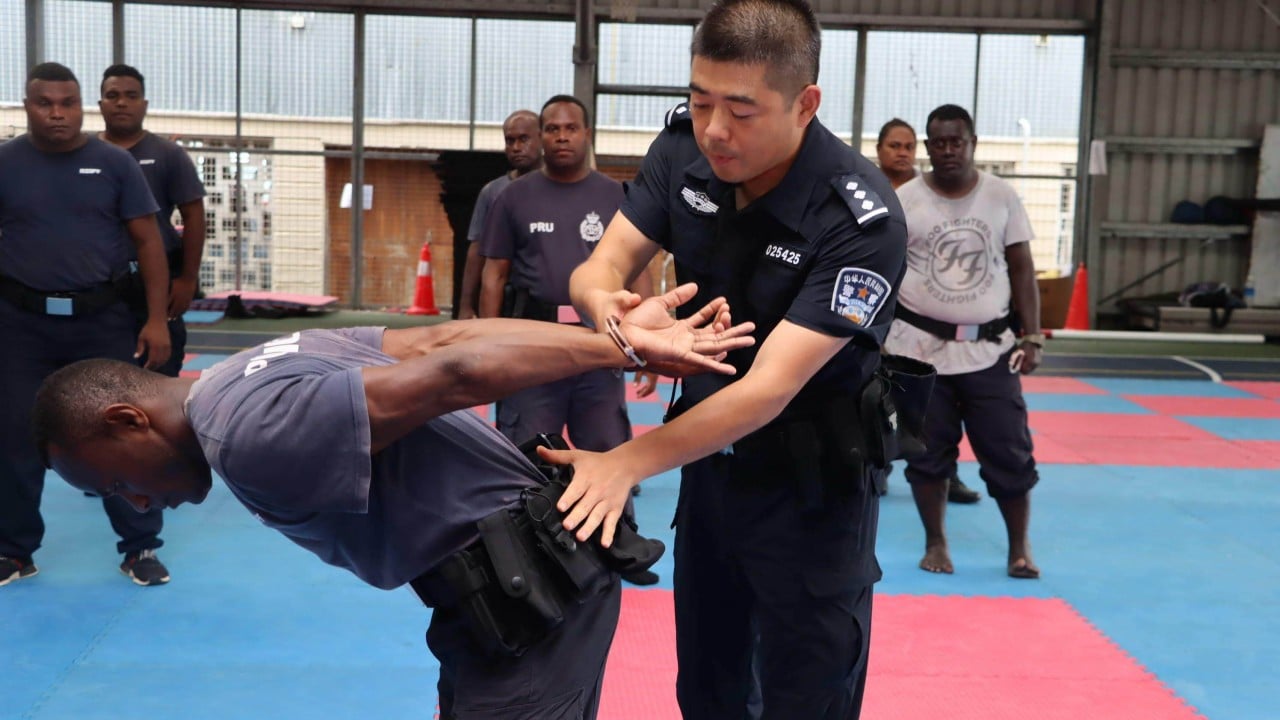
- Internal Security and Policing Pacts: Pacific Island nations face acute domestic challenges—civil unrest, transnational crime, and limited state capacity—rather than external invasion. Beijing exploits this gap by offering riot-control training, surveillance hardware, and police advisors, as seen in the Solomon Islands and Kiribati. Policing agreements carry lower political thresholds for local leaders to approve than military treaties, yet they embed Chinese personnel directly within the host nation's coercive apparatus.
- Dual-Use Commercial Infrastructure: Through state-owned enterprises (SOEs), Beijing finances deep-water ports, fiber-optic cables, and airstrip upgrades. While legally commercial, a port engineered to accommodate large container vessels can easily berth People's Liberation Army Navy (PLAN) replenishment ships. This creates latent military utility without triggering the alarm bells of a formal naval base.
The Three-Vector Competition Matrix
Evaluating influence in Oceania requires measuring outcomes across three distinct operational vectors rather than counting signed memorandums of understanding.
1. Geographic Chokepoints and the Second Island Chain
Geography dictates that not all Pacific Island states carry equal strategic weight. Analytically, the region divides into three tiers of value:
- Tier 1 (Critical Chokepoints): Papua New Guinea (PNG), the Solomon Islands, and the COFA states (Palau, FSM, Marshall Islands). PNG sits directly north of Australia, guarding the Torres Strait and the Coral Sea. The Solomon Islands straddle the maritime approaches between the US mainland and Australia—the exact corridor Imperial Japan attempted to sever in 1942. The COFA states span an area of ocean roughly the size of the continental United States, forming the maritime bridge between Hawaii and Guam.
- Tier 2 (Logistical Hubs and Peripheral Anchors): Fiji, Tonga, and Vanuatu. Fiji serves as the diplomatic and transportation hub of the South Pacific, hosting regional headquarters and fielding the region's most capable military force, the Republic of Fiji Military Forces (RFMF).
- Tier 3 (Diplomatic Votes and EEZ Space): Kiribati, Tuvalu, Nauru, and Samoa. While small in landmass, these states control vast EEZs rich in polymetallic nodules and tuna stocks, and each holds an equal vote in the United Nations General Assembly and the Pacific Islands Forum (PIF).
When the US signed its Defense Cooperation Agreement (DCA) with Papua New Guinea in May 2023—granting US forces unimpeded access to Lombrum Naval Base on Manus Island and Momote Airport—it neutralized a major Tier 1 vulnerability. Similarly, reopening embassies in Honiara, Nuku'alofa, and Tarawa was a corrective measure to restore diplomatic presence after decades of neglect.
2. The Economics of Sovereignty and Aid Dependency
Pacific Island economies suffer from structural constraints: extreme geographic dispersion, tiny domestic markets, vulnerability to natural disasters, and narrow revenue bases. Consequently, external budget support is not supplementary; it is foundational to state survival.
This economic reality creates a bidding market for alignment. Pacific leaders have become adept at leveraging great-power rivalry to extract maximum concessions—a strategy best described as hedged non-alignment. When Nauru severed diplomatic ties with Taiwan in January 2024 to recognize Beijing, the decision followed direct calculations regarding budgetary shortfalls and infrastructure financing. Similarly, when the US Congress delayed approving the $7.1 billion COFA renewal package for months in late 2023 and early 2024, leaders in Palau and Micronesia openly warned that the delay was eroding Washington's credibility and creating openings for Chinese economic coercion.
The limitation of Beijing's economic statecraft in the region is the debt-sustainability ceiling. Several Pacific nations, notably Tonga and Samoa, carry high external debt burdens owed to the Export-Import Bank of China. As debt service consumes larger portions of national budgets, local populations and opposition politicians grow skeptical of new Chinese loans, shifting the comparative advantage back toward Western grant-based financing and multilateral development banks.
3. Regional Institutionalism The Pacific Islands Forum
Great powers attempt to shape the regional norms that govern security through the Pacific Islands Forum (PIF), the region's premier political body. The PIF operates on a principle of consensus and champions the "Blue Pacific Continent" narrative, which asserts that Pacific nations should manage their own security without external militarization.
Australia and New Zealand, as founding PIF members, use the forum to establish regional frameworks like the 2018 Boe Declaration on Regional Security, which expands the definition of security to include climate change and cybersecurity while affirming that regional security challenges should be addressed internally first ("Pacific family first"). Beijing, as a Dialogue Partner rather than a member, attempted to bypass the PIF in May 2022 by proposing a sweeping ten-nation multilateral pact—the China-Pacific Island Countries Common Development Vision. That effort collapsed precisely because Pacific leaders recognized it as an attempt to fracture PIF unity and subvert regional consensus mechanisms.
Operational Friction and Strategic Vulnerabilities
Neither Washington nor Beijing holds an insurmountable advantage. Both coalitions face acute operational bottlenecks that constrain their ability to translate signed agreements into durable influence.
The US and Allied Bottlenecks
- Legislative Paralysis and Execution Lag: While Beijing can deploy capital and personnel via executive fiat within weeks, US commitments are subject to congressional appropriations, environmental impact assessments, and Pentagon procurement cycles. The multi-month congressional hold on COFA funding demonstrated to Pacific capitals that US domestic polarization poses a direct threat to their national budgets.
- The Climate Credibility Deficit: For Pacific Island nations, climate change is an immediate existential threat, not a secondary policy issue. Australia's continued status as one of the world's largest fossil fuel exporters, combined with fluctuating US climate commitments, creates persistent friction. Security deals that ignore decarbonization and climate finance are viewed by Pacific leaders as transactional and tone-deaf.
- Post-Colonial Sensitivities: Heavy-handed diplomatic pressure backfires in Melanesia and Polynesia. When Western envoys publicly lecture Pacific leaders on the risks of Chinese debt or security ties, they trigger nationalist backlash. The US DCA with Papua New Guinea sparked domestic protests in Port Moresby over concerns that granting US troops legal immunity compromised PNG's constitutional sovereignty.
Beijing's Bottlenecks
- Opacity and Elite Capture Backlash: Chinese security deals are routinely negotiated behind closed doors with small circles of political elites, bypassing parliamentary scrutiny and public consultation. While this enables rapid signing, it makes the agreements fragile. A change in government via democratic elections—common across the Pacific—can result in the immediate suspension or cancellation of Beijing-backed projects, as seen when political shifts in Fiji led Prime Minister Sitiveni Rabuka to review and downgrade police cooperation agreements with China.
- Lack of Cultural and Diaspora Integration: Unlike Australia and New Zealand, which share deep historical, sporting, educational, and diaspora ties with the Pacific (hundreds of thousands of Pacific Islanders reside in Auckland, Sydney, and Brisbane), China lacks organic societal integration. Friction between local communities and imported Chinese labor on infrastructure projects frequently generates localized anti-China sentiment, limiting Beijing's soft power.
- Overreach on Security: Beijing's push to insert itself into domestic policing crosses a clear red line for traditional partners. When Solomon Islands Prime Minister Manasseh Sogavare leaned heavily on Chinese policing support, it catalyzed a massive counter-reaction: Australia increased its policing footprint, the US reopened its embassy, and regional neighbors scrutinized Honiara's actions at the PIF, ultimately raising the diplomatic cost for both Honiara and Beijing.
The Structural Trajectory of Pacific Alignments
The competition for security influence in Oceania will not resolve into a neat Cold War-style binary bloc system. Pacific Island states will continue to refuse binary choices, maximizing their leverage by compartmentalizing their foreign policies: accepting Western security guarantees while retaining Chinese trade and infrastructure capital.
To maintain a decisive strategic advantage under these conditions, Western policymakers must shift from reactive crisis management to structural integration. First, Washington and Canberra must fully automate and insulate Pacific development and climate adaptation funding from domestic legislative cycles, ensuring capital arrives faster than Chinese state-backed loans. Second, security agreements must be explicitly decoupled from public anti-China rhetoric; framing treaties around maritime domain awareness, illegal fishing enforcement (which costs Pacific nations hundreds of millions of dollars annually), and disaster response aligns directly with local priorities while naturally building the dual-use logistics infrastructure allied militaries require. Finally, Australia and New Zealand must aggressively expand labor mobility schemes and visa pathways—tying Pacific economic survival directly to integration with allied economies rather than state-to-state aid handouts. In Oceania, durable security alignment is ultimately secured not by military bases, but by making Pacific economies structurally inseparable from the allied sphere.