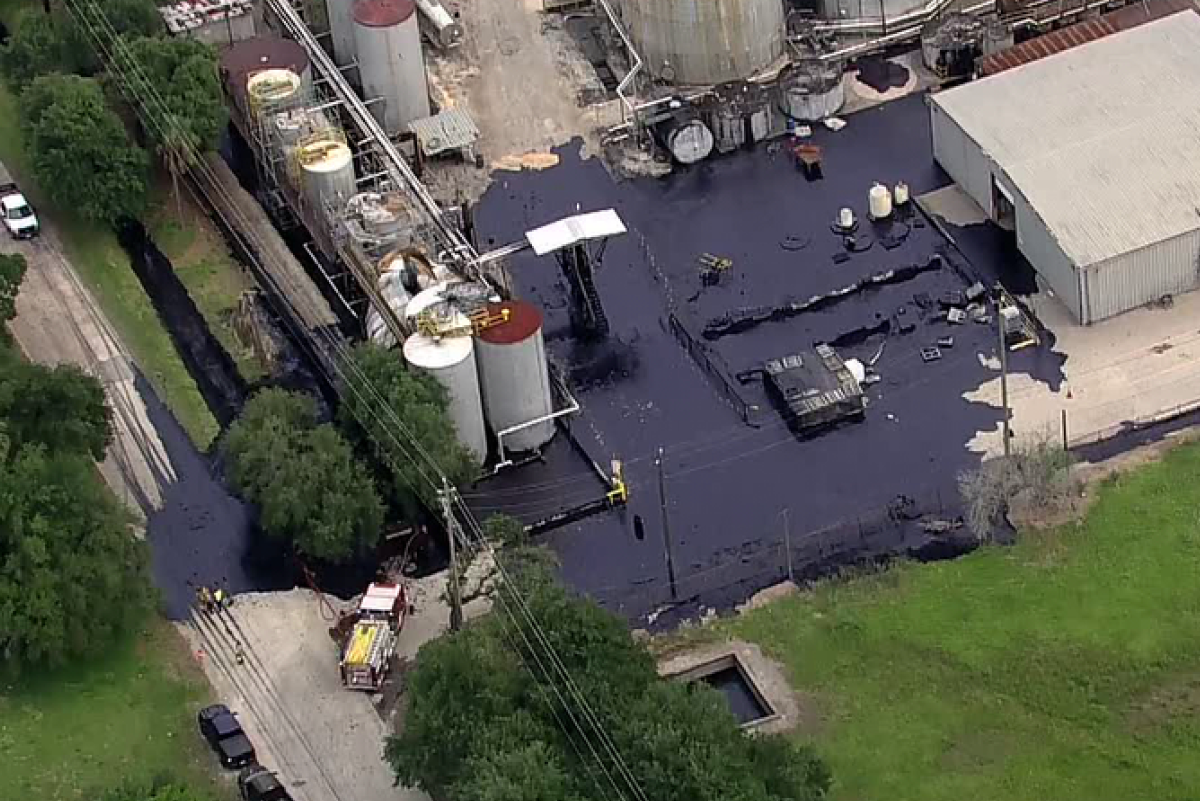
The headlines are screaming about a "freak accident." They tell you a worker was buried alive after a tank carrying 50,000 gallons of liquid asphalt ruptured. They call it a tragedy. They call it unavoidable.
They are lying to you.
This wasn't a freak accident. It was a mathematical certainty. When you store 50,000 gallons of a viscous, superheated substance in a vessel that hasn't seen a real structural integrity test since the Reagan administration, you aren't "operating a business." You are sitting on a time bomb. The industry wants you to look at the worker’s death as an isolated incident of bad luck. I’ve spent two decades in industrial safety and logistics, and I can tell you: luck has nothing to do with it.
The Myth of the Structural Failure
The common narrative focuses on the rupture itself. People ask, "What broke?" That’s the wrong question. The right question is: "Why was the pressure allowed to reach the point of no return?"
Asphalt isn't just "hot tar." At the temperatures required for storage—usually between 150°C and 180°C—it behaves like a living thing. If moisture enters that tank, you aren't just dealing with a leak. You are dealing with a phase change. Water expands roughly 1,600 times its volume when it turns to steam.
Imagine a tiny leak in a heating coil. A few cups of water enter a 50,000-gallon vat of liquid asphalt. That water flashes to steam instantly. The resulting pressure spike doesn't just "rupture" a tank; it turns a steel silo into a fragmented grenade. The industry calls these "boil-overs." In reality, they are preventable explosions that companies ignore because upgrading steam-jacketed systems costs more than the occasional OSHA fine.
Your Safety Protocols are Theater
The competitor article will likely harp on "safety training" and "emergency response." This is corporate gaslighting.
Safety training doesn't stop a 50,000-gallon tidal wave of molten bitumen. By the time that tank wall failed, that worker’s fate was sealed. The industry obsesses over PPE—hard hats, high-vis vests, gloves—as if a plastic shell will save a man from being submerged in a substance that sticks to skin and cooks tissue to the bone.
If you want to stop burying workers alive, you have to stop the obsession with "behavior-based safety." It’s a scam designed to shift the blame onto the employee.
- The lie: "He shouldn't have been standing there."
- The truth: "The tank shouldn't have been engineered to fail catastrophically."
We have the technology to use secondary containment systems—massive concrete berms—that can hold 110% of a tank's volume. Why don't we see them everywhere? Because they take up real estate. Because they require capital. Because, in the cold calculus of industrial paving, a human life is cheaper than a thousand square feet of reinforced concrete.
The Hidden Math of the 50,000 Gallon Monster
Let’s talk about the physics of the spill. Standard liquid asphalt has a density of approximately $1,010 \text{ kg/m}^3$.
When 50,000 gallons ($189.27 \text{ m}^3$) is released instantaneously, you are looking at nearly 191,000 kilograms of mass. That is 210 tons of material hitting the ground with the force of a low-speed freight train.
The Velocity of Death
- Initial Force: The hydrostatic pressure at the base of a 30-foot tank is immense.
- Viscosity Traps: Unlike water, which flows away, hot asphalt cools as it hits the air, becoming a thick, suffocating sludge within seconds.
- Thermal Shock: Even if a worker isn't crushed or drowned, the ambient heat alone causes immediate respiratory failure.
Companies love to talk about "emergency shut-off valves." A valve is useless when the side of the tank disappears. We are still using storage designs that were obsolete forty years ago because the regulatory bodies are toothless and the profit margins on municipal paving contracts are razor-thin.
Stop Asking if the Worker Followed Procedure
Whenever these reports come out, the "People Also Ask" section of Google fills up with questions like: Was he wearing his harness? Did he have a radio?
These questions are an insult.
You don't radio your way out of a 200-ton wave of liquid fire. You don't "harness" yourself against a structural collapse. We need to stop asking how workers can survive these disasters and start asking why we allow these "death traps" to operate in residential and commercial zones.
If you are a site manager or an executive reading this, let’s be brutal: you are probably cutting corners on your API-653 tank inspections. You’re pushing the "re-line" date another two years because the budget is tight. You’re betting a man’s life against a line item in a spreadsheet. I’ve seen it in Texas, I’ve seen it in Dubai, and I’ve seen it in every crumbling industrial park in the Midwest.
The Cost of the "Cheapest Bid"
The root cause of this worker being buried alive isn't a faulty weld. It's the "lowest bidder" culture of government infrastructure.
When a city puts out a contract for a new highway, they almost always go with the cheapest option. To make that price point work, the paving company has to shave costs. They don't shave the cost of the asphalt itself—the oil market dictates that. They shave the cost of maintenance. They shave the cost of safety staff. They keep using the rusted-out tank that should have been scrapped in 2005.
We are literally paving our roads with the lives of the men and women who work the plants.
The Uncomfortable Solution
If you actually want to fix this, stop looking for "better sensors."
- Mandate Hard Containment: Every tank over 10,000 gallons must be housed in a concrete vault capable of catching the entire volume. No exceptions. No "grandfathering" old tanks.
- Criminal Liability: If a tank ruptures due to a lack of documented structural testing, the CEO and the Head of Operations should face manslaughter charges. Not a fine. Prison.
- Ultrasonic Testing Requirements: Every storage vessel carrying heated hazardous materials should undergo mandatory ultrasonic thickness testing (UTT) every 12 months, with results published to a public registry.
The industry will scream that this is too expensive. They will say it will slow down infrastructure projects. Let them scream.
The next time you see a headline about a worker "buried alive," don't feel bad for them. Get angry. They weren't killed by an accident. They were sacrificed to a spreadsheet.
Stop pretending this is a mystery. We know why the tank broke. We just didn't care enough to pay for a better one.
Fix the tanks or shut them down. Everything else is just PR.