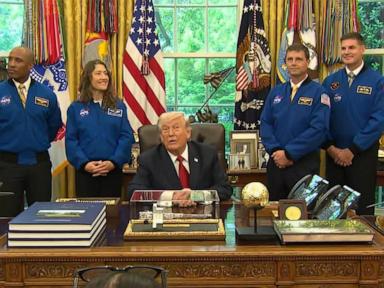
The White House photo op was inevitable. The handshakes were firm. The rhetoric about "leadership in the heavens" was dialed to a deafening eleven. But while the media fawns over the Artemis II crew’s return from their lunar flyby, they are ignoring a glaring, expensive truth. This wasn't a leap forward. It was a $4 billion lap of honor for technology that should have been in a museum two decades ago.
We are watching a victory lap for a system designed to keep legacy defense contractors on life support, not a mission designed to settle the solar system. If you think Artemis II is the dawn of a new era, you haven't been paying attention to the math. Meanwhile, you can explore related stories here: Why Haneda’s Humanoid Baggage Handlers Are a Multimillion Dollar PR Stunt.
The SLS is a Jobs Program with a Rocket Attached
The Space Launch System (SLS) is the backbone of the Artemis program. It is also a Frankenstein’s monster of Space Shuttle components. To build it, NASA didn't innovate; they recycled. They used RS-25 engines that were literally designed in the 1970s.
The problem isn't that the tech doesn't work. Obviously, it does. It got four humans around the Moon and back. The problem is the expendability. Every time an SLS launches, we are throwing $2 billion worth of hardware into the ocean. Imagine flying a Boeing 747 from New York to London and then crashing the plane into the Atlantic upon arrival. You’d be out of business by Tuesday. To see the bigger picture, we recommend the excellent analysis by Wired.
In the private sector, companies like SpaceX have proven that vertical landing and rapid reuse are the only ways to make space economically viable. NASA knows this. Yet, they remain shackled to a cost-plus contract model that rewards delays and punishes efficiency. The SLS is "too big to fail" because its components are manufactured in all 50 states, making it a political shield, not a scientific spear.
The Flyby Fallacy
The "historic" nature of Artemis II is a marketing trick. It was a free-return trajectory. Once the rocket fired, physics did 90% of the work. We did this in 1968 with Apollo 8. Doing it again 58 years later with a higher-resolution camera isn't "history." It's a remake.
The "People Also Ask" sections of the internet are currently flooded with questions like, "Why did it take so long to go back?"
The honest answer is brutal: Because we didn't have a reason to go, and we still haven't built the infrastructure to stay.
A flyby accomplishes nothing for long-term habitation. It tests the Orion capsule’s life support, sure. But we’ve had life support in the ISS for decades. The real challenge isn't surviving a week in a tin can; it's the logistics of the lunar surface. By focusing on these high-visibility, low-utility missions, we are draining the budget that should be spent on orbital fuel depots, lunar power grids, and autonomous mining.
The Orion Capsule is Too Small for the Big Game
Orion is a masterpiece of engineering for 1995. It is cramped, heavy, and limited by its heat shield requirements. While the crew looked heroic at the White House, they were essentially cramped into a space slightly larger than a minivan for the duration of their mission.
Compare this to the planned HLS (Human Landing System) variants. We are trying to dock a tiny capsule to a massive lander because the legacy architecture demands a "command module." This creates unnecessary complexity in the lunar orbit.
Why the Gateway is a Toll Booth in Space
The Lunar Gateway—the planned space station that will orbit the Moon—is another example of bureaucratic bloat. Proponents claim it's a "staging point." Critics, including legendary aerospace engineer Robert Zubrin, correctly identify it as a "toll booth."
If you want to go to the Moon, you go to the Moon. You don't stop at a station in a high-rectilinear halo orbit just to change ships. Every stop you make costs delta-v (velocity change). Every gram of fuel used to stop at the Gateway is fuel that could have been used to land more cargo on the surface. We are building the Gateway because it gives international partners a place to plug in their modules, not because it’s the most efficient way to explore.
The Private Sector Paradox
The most uncomfortable truth for the Artemis cheerleaders is that the government-led portion of the mission is the bottleneck.
- NASA SLS/Orion: $4 billion+ per launch.
- Commercial Lunar Payload Services (CLPS): Millions per mission.
We are seeing a divergence. While NASA handles the "prestige" missions that involve White House dinners, private companies are actually doing the dirty work of figuring out how to land sensors and drills on the lunar south pole. The contrast is staggering. One is a performance; the other is a business.
If we actually wanted to be on the Moon to stay, we would stop building bespoke, expendable rockets. We would buy launches on the open market. But "President Hosts Crew of Heavily Subsidized Government Vehicle" makes for a better headline than "Government Agencies Purchase Freight Capacity from Lowest Bidder."
The Risk of Toxic Positivity
There is a danger in the "Artemis Generation" branding. It creates an environment where questioning the architecture is seen as being "anti-science" or "anti-exploration."
I have seen projects in the aerospace industry burn through billions because no one was allowed to say the design was obsolete. When you are $20 billion deep into a project like SLS, the "sunk cost fallacy" becomes a national policy. We keep going because we've already spent too much to stop, even though we know there are better ways to reach the goal.
The downside to my contrarian view is clear: If we canceled SLS today, there would be a multi-year gap in American heavy-lift capability while we wait for Starship or New Glenn to achieve full operational status. It’s a terrifying prospect for those who view space as a geopolitical scoreboard. But the alternative is worse: spending the next 30 years and $100 billion on a lunar program that can only afford to launch once every two years.
Stop Asking "When?" and Start Asking "How Much?"
The public asks: "When will we be on the Moon?"
The right question is: "What is the cost per kilogram to the lunar surface?"
Until that number drops by two orders of magnitude, we aren't "returning" to the Moon. We are visiting. Artemis II was a high-end tourist excursion paid for by taxpayers. It provided spectacular views and zero sustainable infrastructure.
If we want a base on the Moon, we need to stop celebrating the fact that we can still do what we did in the 60s. We need to demand an architecture that doesn't require a presidential gala every time it successfully fails to explode.
The Actionable Truth for the Space Industry
For those working in the sector, the lesson is simple: don't tie your career to legacy platforms. The gravity of economics is stronger than the gravity of the Moon. The future belongs to those building the "railroad tracks"—the refueling stations, the standardized docking ports, and the reusable tugs.
The SLS and Orion are the last of the Mohicans. They are beautiful, impressive, and utterly doomed by their own balance sheets.
The next time you see a crew standing in the Oval Office, look past the shiny flight suits. Look at the budget. Look at the launch cadence. If we are only going once every two years, we aren't exploring. We’re just posing.
Stop settling for "historic" flybys. Demand a lunar economy that doesn't need a government subsidy to survive the vacuum. The Moon isn't a destination for a flag; it’s a platform for an industry. If we can't treat it like that, we should stay home and save the $4 billion.