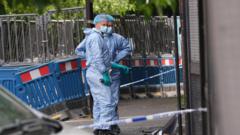
Counter-terrorism detectives have taken the lead in an investigation following a suspected arson attack at a disused synagogue, a move that signals a significant escalation in how authorities are treating threats against religious infrastructure. The transition from a local police inquiry to a specialist anti-terror operation suggests that investigators have identified specific indicators of ideological motivation or a high degree of premeditation. This shift reflects a broader strategy to contain communal tensions before they spiral into wider civil unrest.
While the building in question was no longer an active center for worship, its symbolic value remains potent. In the eyes of an arsonist, a synagogue is never truly "disused." It stands as a landmark of identity. When such a site is targeted, the impact ripples far beyond the immediate neighborhood, affecting the psychological safety of the entire community.
The Shift to Specialist Oversight
The decision to involve counter-terrorism units is rarely a bureaucratic whim. It happens when the nature of the crime suggests something more organized than a simple act of vandalism. Usually, this involves evidence of sophisticated accelerants, specific hateful messaging left at the scene, or a digital trail suggesting the site was selected as part of a wider extremist agenda.
Local police are equipped to handle property damage. They are not necessarily built to map the international networks or radicalization pipelines that often sit behind targeted attacks on religious buildings. By handing the reins to the counter-terrorism command, the state is admitting that this fire was not an isolated incident of local delinquency. It is being treated as a potential strike against the social fabric.
Patterns of Escalation
History shows that attacks on religious sites often follow a predictable trajectory of online escalation. It begins with digital rhetoric. Then comes reconnaissance. Finally, we see the physical act. Investigators are currently scouring closed-circuit television and forensic data to determine if the perpetrators spent weeks monitoring the site or if this was a reactive strike tied to specific global events.
The "disused" status of the building actually makes it a more attractive target for those looking to send a message without the immediate risk of mass casualty intervention. It allows for a high-visibility act of intimidation with a lower chance of immediate interruption. For the intelligence services, the challenge is now to determine if this was a "lone wolf" actor or part of a coordinated effort to test response times and forensic capabilities.
The Vulnerability of Repurposed Religious Spaces
There is a growing crisis regarding the security of former religious buildings. As demographics change and congregations move or shrink, many synagogues, churches, and mosques are left in a state of flux. These buildings often lack the active security presence, high-end surveillance, and daily foot traffic that protect functioning places of worship.
This creates a security vacuum.
A building that is empty is a soft target. However, to the public, the sight of a burning synagogue carries the same weight whether there were ten people inside or none. The symbolic injury is identical. Authorities are now forced to reckon with an inventory of hundreds of these "symbolic targets" that sit across urban centers, often with nothing more than a padlocked gate to protect them from determined extremists.
Intelligence Gathering and Local Impact
The investigation is currently operating on two fronts. The first is the forensic recovery at the scene, where every charred fragment is analyzed for chemical signatures. The second is the human intelligence phase. Detectives are canvassing local extremist watchlists and monitoring encrypted forums where such acts are often celebrated or planned in advance.
The local community is left in a state of high anxiety. For many, the fire is a visceral reminder of historical persecutions. Even if the building was slated for redevelopment or stood dormant, its destruction by fire is a message of erasure. This is why the counter-terrorism mandate includes a heavy focus on "community reassurance"—a technical term for trying to prevent a cycle of retaliatory violence.
The Geopolitical Context
It is impossible to view an attack on a Jewish site in isolation from the current global climate. Domestic extremism is often fueled by overseas conflict. When tensions rise in the Middle East, we historically see a direct correlation in the number of hate crimes and arson attempts at religious sites in the West.
Investigators are looking for links between this specific arson and recent surges in radicalizing content found on social media platforms. The speed at which a global event can trigger a local fire is a modern reality that law enforcement is struggling to manage. We are no longer dealing with purely local grievances; the arsonist in a quiet suburb may be acting on instructions or "inspiration" beamed directly to their phone from half a world away.
Forensic Challenges in Fire Investigations
Arson is a notoriously difficult crime to prosecute. Fire is an effective destroyer of evidence. DNA and fingerprints are often consumed by the heat, leaving investigators to rely on "trace evidence"—the microscopic remains of fuels or the specific way a door was forced open.
Modern counter-terrorism labs use advanced chemical analysis to identify the exact brand of petrol or fire-starter used. This can sometimes lead back to a specific retail outlet or a batch of products sold in a particular region. By tracking these "signatures," the police can build a profile of the attacker’s movements prior to the incident.
The Myth of the Isolated Incident
There is a tendency in early reporting to suggest that such events are "random acts of madness." A veteran analyst knows this is rarely true. In the world of counter-terrorism, there are very few true coincidences. The selection of a synagogue—even a disused one—requires intent. It requires a choice to bypass other buildings to target one specifically linked to a minority faith.
The "disused" label can also be a red herring. Many of these buildings are in the process of being sold or converted into community centers or schools. An attack at this stage can be a tactic to halt the integration of a community into a new area or to drive down property values to prevent a specific group from establishing a foothold. It is economic warfare disguised as religious hatred.
Resource Allocation and Prevention
The fact that this has become a counter-terrorism matter means significant resources are being diverted from other operations. This is a deliberate tactic used by extremist groups: create "noise" and force the state to spend millions investigating small-scale property crimes, thereby thinning out the resources available for monitoring more lethal plots.
Every time a specialist team is deployed to a burnt-out shell of a building, they are not somewhere else.
This creates a dilemma for security services. Ignore these fires, and you risk a total breakdown in community trust and an emboldened extremist fringe. Over-respond, and you play into the hands of those who want to overstretch the police. The current approach suggests the government believes the risk of the former is currently much higher than the risk of the latter.
Digital Footprints and the New Arsonist
The modern arsonist often leaves a trail long before they strike a match. They post "manifestos" in obscure corners of the web or share photos of their target in "reconnaissance" threads. Counter-terrorism units have specialist digital forensic teams currently scraping this data.
They are looking for "pre-incident indicators."
Was there a spike in searches for this specific address? Did someone post a picture of the synagogue’s back entrance on a radical forum three days ago? This digital archaeology is often what separates a successful counter-terrorism conviction from an unsolved arson case. The physical fire is just the final act of a play that began months ago in the digital shadow.
The Role of Public Vigilance
Authorities are now calling for anyone with dashcam footage or doorbell camera recordings from the area to come forward. In an age of total surveillance, the perpetrator's greatest enemy is the passive recording device. A hooded figure walking toward the site at 3:00 AM might seem unremarkable, but when cross-referenced with cellular tower pings and other camera feeds, it becomes a digital breadcrumb trail.
The investigation is expected to be lengthy. The move to involve counter-terrorism suggests they are looking for more than just the person who held the lighter; they are looking for the network that gave them the idea.
A Testing Ground for Civil Order
The fire at the disused synagogue is more than a local news story. It is a stress test for the country's ability to maintain order in a polarized era. If the investigation fails to produce an arrest, it sends a signal that religious sites are "open season." If it succeeds, it demonstrates that the state views an attack on a minority landmark as an attack on the national interest.
The stakes are high because the precedent is dangerous. If a building can be burned because it represents a specific group, then no community space is truly safe. Law enforcement's decision to classify this as a terrorism-related inquiry is a clear attempt to draw a line in the sand. They are signaling that the era of treating "sectarian vandalism" as a minor offense is over.
The investigation now moves into a quiet, intensive phase of surveillance and data analysis. The public may not hear of a breakthrough for weeks or even months. This is the nature of high-stakes counter-terrorism work; it is slow, methodical, and invisible until the moment the doors are kicked in.
Check your own local security measures. If you live near a historical or religious site that appears neglected, do not assume it is ignored by those with darker intentions. Reporting suspicious behavior around these "soft targets" is the only way to provide the intelligence the police need before the smoke starts to rise.

.jpeg?width=1200&auto=webp&trim=0%2C0%2C0%2C0)