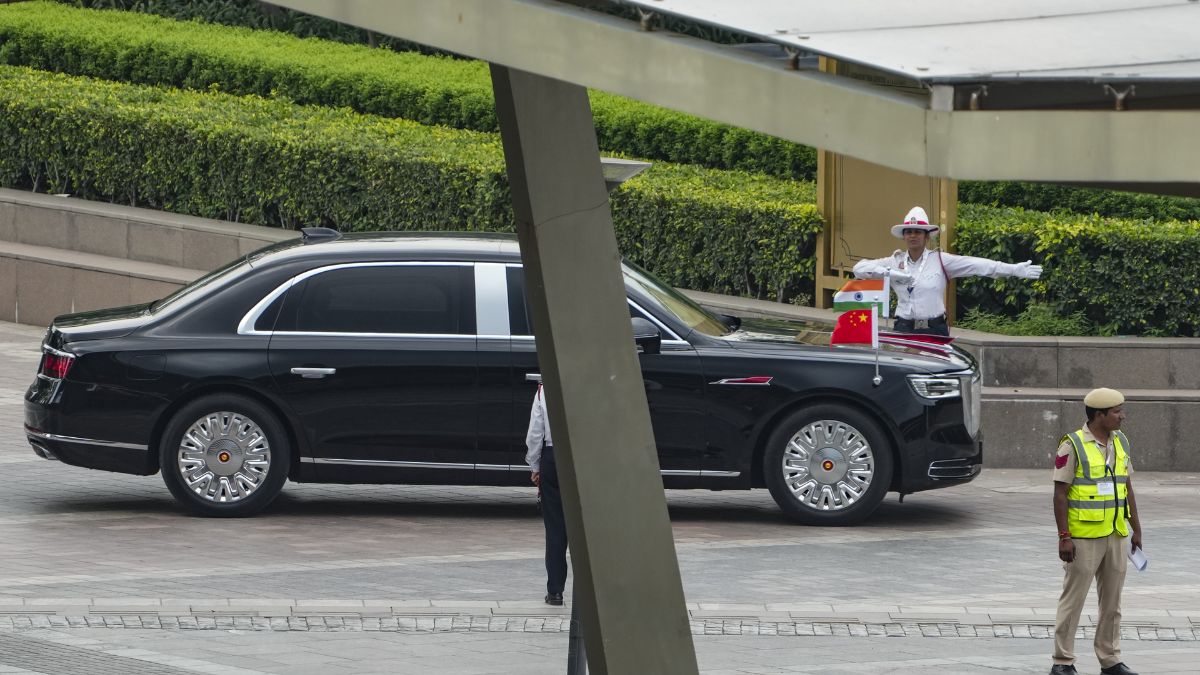
The rain over Kazan did not fall; it hammered. It drove sideways against the black basalt pavement, turning the motorcade route into a slick ribbon of gray reflection.
Standing behind a velvet security rope three hundred yards away, you could smell the wet asphalt and the ozone tang of high-voltage transformers humming beneath the tarmac. But inside the bubble, there was only the smell of aged leather, recycled cabin air, and absolute silence.
To the casual observer watching the BRICS summit footage flash across a morning screen, a presidential limousine is simply a very large, very expensive car. It is a status symbol with a hood ornament. A floating palace of polished chrome meant to ferry men in bespoke suits from tarmac to podium.
They are wrong.
A modern head of state transport is not a vehicle. It is a mobile bunker. It is an architectural statement of survival cast in hardened steel, ceramic composites, and multi-layer ballistic glass thick enough to distort the view of the street outside. When leaders of global superpowers gather, their cars arrive before them as ambassadors of statecraft, whispering secrets about engineering, paranoia, and power long before a door ever swings open.
Consider the physics of paranoia.
Imagine standing next to Vladimir Putin’s Aurus Senat. On paper, the specifications read like a military dossier. It weighs roughly six tons—about the same as a small fully loaded delivery truck. Its body panels are armored against armor-piercing rounds. Its floor is reinforced to shrug off landmines and improvised explosive devices. The cabin is an airtight, NBC-sealed environment, capable of maintaining positive air pressure to keep out chemical or biological agents if the worst should happen.
Yet, when you look at it, the Aurus does not scream military hardware. That is the genius of its design. It borrows the stately, upright grille and stately proportions of classic luxury sedans, deliberately channeling a nostalgic past while hiding a hyper-modern arsenal underneath. It is built in Russia, powered by a heavily engineered V8 developed with international pedigree, and designed to project domestic self-reliance. It tells a story without saying a word: We can build our own shields, and they are unbreakable.
Now shift your gaze down the line to the arrival of Xi Jinping.
The Hongqi N701 rolls to a halt with a solemn, deliberate heaviness. The name itself—Hongqi—translates to Red Flag. Every inch of its bodywork carries the weight of modern Chinese industrial might and political lineage. While the public rarely gets a glimpse of its exact defense specifications, the engineering lineage of these state limousines is a matter of national honor. They are hand-built in limited numbers, rolling fortresses designed to carry the leader of the world's second-largest economy through foreign streets while maintaining an aesthetic of quiet, unyielding authority.
There is a distinct theater to this. Long before a summit's agenda is debated or a joint communique is signed, the automotive choreography sets the psychological baseline.
I remember talking to a veteran diplomatic security attaché years ago, a man whose skin had the permanently weathered look of someone who spent too much time standing near idling diesel engines in foreign capitals. He lit a cigarette, cupping his hands against a Mediterranean wind, and told me something that stuck.
"You don't look at the motorcade to see who is coming," he said, blowing a thin line of gray smoke into the air. "You look at the motorcade to see who is afraid."
Fear dictates weight. Fear dictates glass thickness. When a government ships its leader's primary transport halfway across the world inside a military cargo plane—along with decoy vehicles, backup mechanics, and specialized fuel supplies—it is an exercise in logistical obsession. Nothing is left to chance. Not the local diesel quality. Not the tire pressure. Not the millimeter-precise spacing between the lead car and the presidential capsule.
The modern presidential limousine is also a technological vault.
Inside these rolling command centers, encrypted satellite communication arrays link the occupant directly to strategic nuclear command structures or domestic ministries back home. While the world watches the exterior gloss, the interior functions as an isolated digital fortress. Jammers sweep the surrounding frequencies for remote-detonation signals. Thermal cameras map the heat signatures of the surrounding crowds.
It makes you think about the strange paradox of ultimate power.
The higher you climb in the architecture of human governance, the more isolated you become. To rule millions, you must be encased in inches of ballistic polycarbonate just to cross a city street. You are separated from the crowd by a rolling wall of high-alloy steel. You watch the rain hit the glass, but you never feel it. You hear the muffled roar of the protesters or the cheers of the supporters, but it reaches you through audio filters and sound-dampening insulation.
The Aurus and the Hongqi are monuments to this separation. They are engineering masterpieces, yes, but they are also physical manifestations of distrust. They tell us that even among allies, even at summits dedicated to cooperation and a multipolar future, the first rule of survival remains unchanged: trust no one, and bring your own armor.
As the engines cut and the heavy doors finally click open, the leaders step out into the Kazan rain. The theater concludes. The diplomacy begins.
But down the block, parked in the shadows of a side street, the drivers remain inside their idling titans. The air conditioning hums. The communication lights blink green. The fortresses wait, heavy and dark, guarding the men who guard the world.


