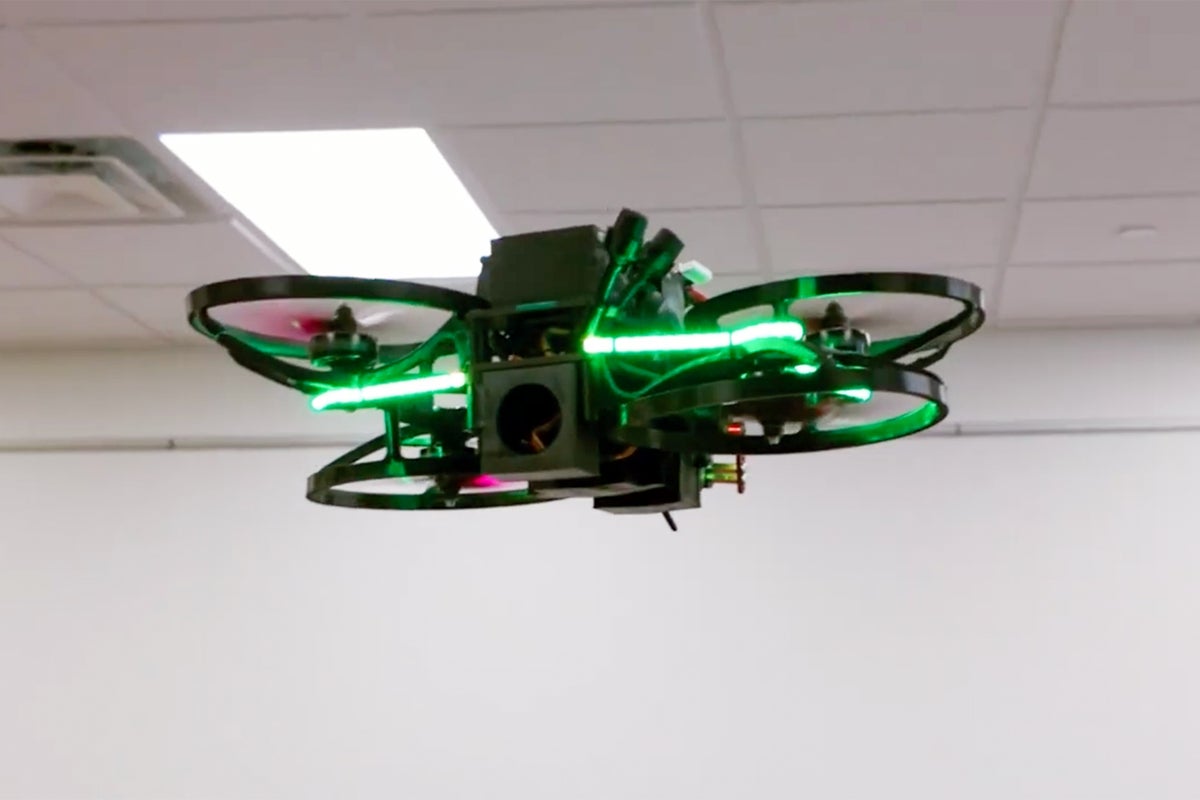
The operational failure profile of traditional school security rests on a single, immutable constraint: latency. Passive protective measures, ranging from reinforced access control points to closed-circuit television monitoring, function primarily as forensic instruments rather than active disruption vectors. When an active assailant breaches an educational facility, the timeline of maximum lethality concentrates within the initial one hundred twenty seconds. Conventional armed response models, predicated on law enforcement dispatch and perimeter arrival, introduce a structural delay that routinely exceeds this critical window.
To compress this response lag, select state legislatures and school districts have initiated pilot programs deploying indoor autonomous and remotely piloted drone infrastructure. Manufactured primarily by firms such as Campus Guardian Angel, these systems station clusters of small, non-lethal aircraft within secure storage enclosures distributed throughout a campus. Triggered via administrative panic applications or automated threat detection feeds, the operational doctrine of these systems relies on a strict temporal progression designed to intercept, disorient, and neutralize attackers before law enforcement personnel physically breach the interior. Recently making news recently: The Beijing Robot Sprint Hoax That Fooled the Internet.
The Three Operational Tiers of Threat Mitigation
Deploying uncrewed aerial systems within confined architectural environments requires a radical departure from standard open-air flight dynamics. Indoor navigation depends on pre-mapped three-dimensional spatial data, localized sensor arrays, and high-frequency telemetry to achieve sub-minute target engagement. The operational architecture functions through three distinct phases: spatial penetration, sensory degradation, and kinetic interception.
The initial phase prioritizes speed over engagement. Upon activation, the deployment protocol targets a five-second launch threshold from distributed ceiling or wall-mounted storage lockers. Remote operators, situated in centralized off-site command facilities, guide or supervise the routing of twenty to sixty specialized aircraft per facility. The mechanical objective is reaching the geographic coordinate of the threat within a fifteen-second window, completely bypassing the horizontal transit barriers that slow human officers navigating multi-story hallways. Further insights on this are explored by The Next Web.
Once the aircraft reaches the target zone, the secondary tier initiates sensory disruption. The goal shifts from transit efficiency to cognitive overload. The drones deploy high-intensity strobe illumination patterns, high-decibel acoustic deterrents, and directional payloads of gel-based pepper spray. This saturation is engineered to impair visual acuity, compromise respiratory function, and disrupt the physiological equilibrium of the assailant, thereby raising the cognitive cost of target acquisition. Concurrently, two-way audio channels permit remote operators or responding police units to issue verbal commands or establish direct communication channels.
If sensory saturation fails to alter the behavioral trajectory of the attacker, the tertiary tier activates kinetic intervention. Designed as a final threshold of non-lethal or less-lethal force, the aircraft can execute controlled high-velocity impacts, effectively ramming the assailant at speed to deflect aim or physically destabilize posture. Furthermore, structural integration allows the chassis to breach interior glass barriers if classroom doors remain locked from the inside, ensuring continuous line-of-sight access.
The Economic and Logistical Cost Function
Implementing an indoor tactical drone ecosystem requires evaluating capital expenditure against institutional risk tolerance. Current pilot deployments in states such as Florida and Georgia operate on state-allocated budgets ranging from $500,000 to over $560,000 per legislative tranche, funding installations across limited high-risk campuses. Scaled across a standard comprehensive high school, the hardware footprint demands dense clustering—frequently thirty to sixty units per building—to ensure that transit distances remain within the required fifteen-second attack window.
The cost structure extends beyond initial procurement. Maintenance cycles for high-frequency indoor flight units, continuous firmware updates for secure spatial mapping, and the operational overhead of 24/7 remote monitoring teams introduce significant recurring expenditure. Institutions must balance these financial vectors against the diminishing marginal returns of adding more conventional passive hardening techniques, which alter physical infrastructure without changing the temporal gap of active response.
Operational Vulnerabilities and Failure Modes
Despite the theoretical advantages of compressing response times, integrating tactical robotics into civilian educational spaces introduces distinct mechanical and operational failure modes.
The primary vulnerability involves identification errors and false positive propagation. Because these systems rely on rapid remote assessment or automated triggers initiated by faculty under extreme duress, the risk of misidentifying responding law enforcement officers as hostile combatants remains a critical operational hazard. In high-stress environments characterized by chaotic audio-visual stimuli, distinguishing between an armed intruder, an undercover resource officer, or a tactical entry team tests the limits of remote operator situational awareness.
Cybersecurity and physical tampering represent secondary failure vectors. Although manufacturers emphasize localized, closed-loop wireless protocols to prevent external signal interception, any connected infrastructure presents a surface for potential unauthorized access or signal jamming. Furthermore, the physical presence of hundreds of pounds of localized explosive or kinetic hardware housed within student-accessible spaces introduces institutional liabilities regarding vandalism, mechanical failure, and accidental discharge during non-emergency conditions.
Strategic Deployment Blueprint
For institutions evaluating the integration of autonomous indoor defense architecture, deployment must follow a strictly governed engineering protocol rather than a reactive security acquisition.
- Baseline Latency Auditing: Quantify the exact transit times of current on-site law enforcement and resource officers from their static locations to the most remote architectural zones of the facility. If the baseline exceeds ninety seconds, evaluate whether auxiliary intervention technology is mathematically justified.
- Environmental Mapping and Signal Hardening: Ensure that interior spaces undergo high-precision three-dimensional spatial digitization that accounts for dynamic acoustic and visual obstacles, eliminating blind spots that compromise autonomous routing algorithms.
- Fail-Safe Authorization Hierarchy: Implement multi-factor verification protocols for system activation. Relying solely on decentralized panic buttons without administrative secondary confirmation drastically increases the probability of false deployment and friendly-fire confusion with law enforcement.
- Integration with Existing Municipal Protocols: Synchronize drone telemetry and video feeds directly with local 911 dispatch and police command software, such as state-mandated mobile alert platforms, to ensure that aerial situational awareness feeds seamlessly into the broader tactical response pipeline prior to officer entry.
Deploying autonomous systems into schools marks a fundamental transition in civil protection philosophy: shifting security infrastructure from passive deterrence toward active, automated threat suppression. Success or failure will be determined entirely by rigorous management of operational latency, strict error-mitigation protocols, and a clear-eyed accounting of the limits of robotics in chaotic human environments.
Fubu Toy review
This video provides visual context on how the automated drone systems operate and are deployed within school facilities during active threat scenarios.
http://googleusercontent.com/youtube_content/1