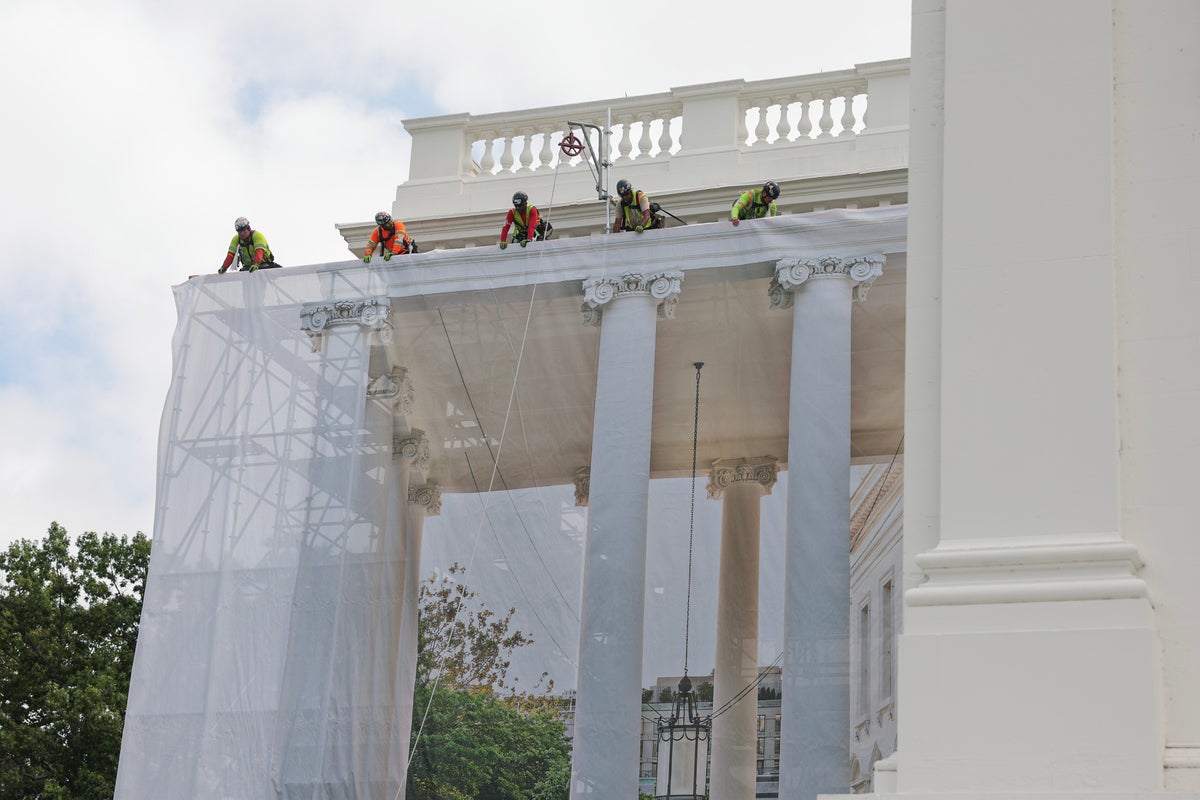
The mainstream media is losing its collective mind over a piece of plastic.
When the Trump administration draped a massive, hyper-realistic trompe-l'œil tarp over the North Portico of the White House to cover up ongoing renovations, the commentary consensus was instant, lazy, and entirely predictable. Critics rushed to brand it as the ultimate metaphor for political superficiality—a literal case of "faking it till you make it." They mocked the faux-stone printing. They scoffed at the visual illusion. Recently making waves in related news: Why the Western Obsession with a US Iran War Misses the Real Threat Completely.
They missed the entire point of modern project management.
What the chattering class views as an embarrassing aesthetic shortcut is actually a masterclass in public-facing infrastructure execution. In any high-stakes development or historic preservation project, managing the psychological impact of construction is just as critical as pouring the concrete. Additional details on this are explored by Associated Press.
The lazy critique assumes that scaffolding and raw construction blight are somehow more "honest." It implies that subjecting millions of tourists and citizens to a skeletal mess of steel and dust is preferable to maintaining visual continuity. That is a fundamentally flawed premise.
The Hidden Cost of Visual Blight
I have spent years advising developers on large-scale urban interventions and historic restorations. I have watched municipal projects blow hundreds of thousands of dollars on public relations campaigns to smooth over the resentment caused by multi-year construction delays. When a landmark goes dark behind ugly green scaffolding, foot traffic drops, local morale plummets, and the public loses faith in the project before it even finishes.
The North Portico tarp is not about deception; it is about mitigating visual pollution.
In architecture, this technique is not new, nor is it a tacky populist invention. European restoration projects have used printed scaffolding wraps for decades. When the Berlin Palace was being rebuilt, massive canvas simulations kept the urban fabric intact during years of heavy lifting. When high-end luxury brands renovate their flagship stores on Fifth Avenue or the Champs-Élysées, they do not leave exposed drywall and wiring for the world to see. They commission beautiful, simulated facades.
Why? Because human beings react poorly to disruption.
- The Broken Window Theory of Infrastructure: Unfinished, messy construction zones breed a sense of neglect and operational chaos.
- The Preservation Paradox: To save a historic structure, you must temporarily destroy its aesthetic value. A simulated wrap bridges that gap.
- The Tourist Economy: Visitors traveling from thousands of miles away to see a global monument do not want a photo of a metal cage. They want the monument.
Draping the White House in a preview of its finished self acknowledges a basic truth: the public's perception of institutional competence is tied directly to visual order.
Dismantling the Faux Aesthetic Outrage
Let us look at the mechanics of historic preservation. The White House is not just an office; it is a living museum subjected to brutal weather, constant security upgrades, and high traffic. Keeping it functional requires heavy, invasive maintenance.
When you strip away the partisan lens, the "People Also Ask" style objections to this tactic fall apart under basic scrutiny.
Is a printed tarp an expensive waste of taxpayer money?
No. The cost of printing a high-resolution vinyl wrap is a rounding error in the budget of a major federal restoration. More importantly, it serves as a highly effective weather barrier. It protects exposed, centuries-old sandstone from moisture and UV damage while the actual work happens underneath. It keeps the workforce shielded from the elements, ensuring fewer weather-related delays. The tarp pays for itself in sheer operational efficiency.
Does it set a bad precedent for architectural integrity?
Only if you lack the capacity for nuance. Nobody looking at the North Portico thinks the columns turned into vinyl permanently. It is a temporary placeholder. Pretending this diminishes the historical value of the building is peak intellectual dishonesty.
The Reality of High-Stakes Project Management
If you want to run a successful large-scale project, you cannot afford to be an aesthetic purist. You have to be a pragmatist. The contrarian truth here is that managing expectations is a design requirement, not an afterthought.
The true failure of modern infrastructure is not that it uses illusions during construction; it is that it usually fails to consider the public experience at all. We tolerate miles of orange barrels, exposed rebar, and shredded scaffolding on our roads and public buildings for years on end, accepting it as an inevitable tax on progress.
The White House tarp disrupts that low standard. It forces a conversation about how we treat public spaces during transitions.
There is a downside to this approach, of course. If the underlying work is delayed indefinitely, the tarp becomes a monument to stagnation. The illusion only works if the delivery is real. The clock is ticking on the actual construction crew to match the perfection of the print.
Stop looking at the tarp as a political statement. It is a blueprint for how to execute disruptive work without degrading the environment around it. The next time you see a major public asset undergoing a facelift, you should pray they have the foresight to wrap it. Otherwise, get ready to stare at a rusted cage for the next three years.
Build the illusion. Then build the reality. Just do not make us look at the mess in between.