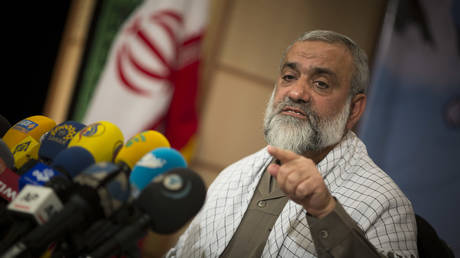
The air inside the concrete bunker smells of stale dust and old oil. Tehran is baking under a merciless July sun, three thousand miles away from the quiet suburban kitchens of Ohio, yet the distance feels entirely theatrical. Down here, beneath meters of reinforced stone, a senior officer of the Islamic Revolutionary Guard Corps adjusts his reading glasses. He is looking at a map that has been redrawn a thousand times.
He does not blink. He does not panic. He calculates. Meanwhile, you can read similar developments here: Why Fidel Castro Still Divides Cuba on His Centenary.
Listen. The ticking clock of sanctions and military posturing sounds loud in Western capitals. In Washington, policy briefs stack high on polished mahogany desks, filled with acronyms, economic indicators, and strategic projections. But inside this room, time is measured differently. Time is measured in decades. Time is measured in blood already spilled and patience cultivated through centuries of political survival.
When a senior IRGC commander publicly declares that Iran can fight on for years to defeat the United States, casual observers hear empty bravado. They mistake the rhetoric for a dying gasp. That is a dangerous mistake. To understand that statement, we must step outside the clean, predictable logic of quarterly economic reports and enter a mindset shaped by a very different historical pulse. To understand the complete picture, check out the excellent article by NPR.
Consider what happens when a nation accepts economic isolation as a permanent climate rather than a temporary storm.
For forty-seven years, ordinary Iranians have navigated a shifting labyrinth of currency devaluation, closed borders, and systemic pressure. I remember standing in a bustling bazaar in Isfahan years ago, watching a shopkeeper calculate the price of saffron against a plummeting rial with the calm detachment of a seasoned meteorologist checking the barometric pressure. There was no screaming. There was no panic. There was only the quiet, grinding motion of adaptation. When the floor drops out from under you year after year, your reflexes mutate. You stop waiting for rescue. You build your own floor out of grey market networks, domestic manufacturing, and sheer stubborn endurance.
This is the invisible reality behind the military communiqués.
Western strategy often suffers from a fundamental illusion. It assumes that pressure has a singular breaking point, a maximum threshold where a society simply yields. Physics teaches us that materials bend before they snap. History teaches us that human societies do something much more complicated: they calcify. They harden into alternative structures.
The commander in his bunker knows this. He is not betting on superior naval firepower or advanced jet fighters. He is betting on friction. He is betting that the United States, with its electoral cycles, its restless public, and its hyper-connected financial markets, has a fundamentally shorter attention span than a civilization that measures its heritage in millennia.
Let us be honest about the mechanics of this standoff. This is not a clash of armies charging across open fields. It is a war of biological and psychological attrition. Every drone assembled in a subterranean workshop, every proxy militia supplied in the Levant or the Gulf, every barrel of oil slipped past tankers through midnight maritime dark—these are not just tactical maneuvers. They are bricks in a fortress of sustained resistance.
To the American taxpayer, a protracted conflict looks like an unending drain on resources and political capital. To the architects of Iran's security apparatus, a protracted conflict is the natural state of being. They have institutionalized endurance. They have built an economy that survives precisely because it is severed from global liquidity.
And that brings us to the core vulnerability of modern superpower diplomacy.
We love clean solutions. We want sanctions to bite so hard that leaders capitulate, or we want precision strikes to rewrite the board overnight. But human behavior refuses to cooperate with spreadsheet logic. When you squeeze a nation from the outside, you do not automatically empower the reformist dreaming of Western liberalism. More often, you validate the hardliner who whispered in the dark that the wolf was always at the door. You create a unified front born of shared misery and defensive nationalism.
The commander’s warning was not an invitation to a duel. It was a statement of psychological geography. He is saying: We live here. You are visiting.
Think about what it takes to sustain that posture. It requires an immense, tragic toll on the civilian population—mothers standing in pharmacy lines, young graduates watching their ambitions shrink to the size of a local rial note, artists painting over murals that get censored by dawn. The human cost is staggering, quiet, and largely invisible to the satellite imagery tracking missile launchers. Yet, within the calculus of the state, that suffering is absorbed, neutralized, and weaponized into moral justification.
We must confront the uncomfortable truth that containment has a half-life, and we are well past it.
When foreign policy is reduced to a game of chicken played across decades, the winner is rarely the one with the fastest car. It is the one who refuses to flinch, even as the tires shred and the engine smokes. The IRGC leadership believes they can outlast the political will of successive American administrations. They have watched presidents come and go, watched strategies pivot from engagement to maximum pressure and back again, while their fundamental objective remained untouched.
The bunker in Tehran is quiet now. The commander closes the map. Above ground, the afternoon traffic snarls beneath billboards bearing stern, bearded faces that watch over every major intersection. The city keeps moving. The tea is poured. The long game continues, indifferent to our deadlines, our elections, and our surprise.