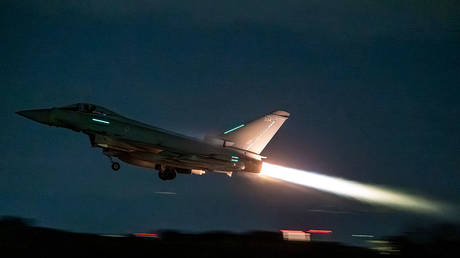
National security commitments are rarely born of pure altruism or sudden diplomatic epiphanies. When the United Kingdom authorized Royal Air Force Typhoon fighter jets to fly defensive air missions over Saudi Arabia to counter escalating Houthi missile and drone strikes, analysts mischaracterized the move as a simple gesture of bilateral solidarity. This interpretation mistakes diplomatic rhetoric for structural reality. The intervention represents a calculated containment strategy designed to protect vital maritime choke points, secure energy supply lines, and prevent asymmetric disruption from cascading through global financial markets.
The Material Drivers of Military Intervention
State power projection operates on strict cost-benefit equations. To understand why London committed combat aviation assets to the Arabian Peninsula, one must analyze the vulnerability profile of Saudi energy infrastructure. Previous Houthi strikes targeted high-value nodes including King Khalid International Airport in Riyadh and critical petroleum facilities operated by Aramco in Dhahran, Yanbu, and the remote Shaybah oil field.
When a regional actor threatens energy processing hubs capable of producing millions of barrels per day, the shockwaves bypass local borders. For the United Kingdom, energy price volatility translates directly into domestic inflation, supply chain degradation, and macroeconomic instability. The military pledge is therefore an insurance policy on domestic economic stability. By deploying defensive air combat patrols, London aims to establish an unyielding intercept barrier that neutralizes low-cost loitering munitions before they breach high-value civilian and industrial perimeters.
Operational Mechanics and Technical Constraints
Deploying RAF Typhoon jets for defensive air missions requires an intricate logistical and tactical framework. Unlike offensive operations, which prioritize deep-strike penetration and suppression of enemy air defenses, defensive counter-air missions operate under severe geographical and legal constraints.
The operational mandate restricts British aircraft to defensive postures: intercepting incoming unmanned aerial vehicles and cruise missiles rather than executing retaliatory strikes inside Yemen. This distinction dictates weapon loadouts, radar modes, and rules of engagement. The Typhoon platforms rely heavily on advanced active electronically scanned array radar systems and Beyond-Visual-Range Air-to-Air Missiles alongside infrared-guided munitions optimized for tracking small, low-radar-cross-section targets.
However, intercepting asymmetric threats creates a severe economic asymmetry. Firing multi-million-dollar air-to-air missiles or investing high-flight-hour airframe maintenance cycles to destroy inexpensive, commercially sourced drone components imposes an unsustainable fiscal ratio over extended campaigns. British defense planners confront a fundamental resource dilemma: how to sustain operational readiness across prolonged deployments without depleting interceptor stockpiles or overextending aircrews.
Regional Alignment and Multilateral Dynamics
Bilateral military commitments do not exist in a vacuum. The UK's deployment coincides with a complex realignment of regional security architectures across the Middle East. Recent diplomatic and defense coordination efforts—including multilateral pacts involving regional powers such as Turkey, Pakistan, and Saudi Arabia—reflect an evolving security landscape where traditional Western security umbrellas are increasingly supplemented by regional mutual defense frameworks.
Within this matrix, the United Kingdom occupies a specific niche. London provides advanced technological expertise, radar integration, and command-and-control interoperability that local militaries integrate into their existing air defense command networks. This integration serves a dual purpose: it enhances the operational effectiveness of Saudi air defense batteries while binding allied defense procurement pipelines to British defense contractors. The strategic alignment reinforces industrial-base ties while projecting a stabilizing presence across critical maritime waterways in the Red Sea and the Gulf of Aden.
Systemic Vulnerabilities and Defense Limitations
Air defense umbrellas, regardless of technological sophistication, possess inherent structural flaws. The physics of missile defense dictate that a defensive network must achieve near-perfect interception rates to prevent catastrophic damage, whereas an adversary launching saturation attacks requires only a single projectile to bypass defenses to achieve a strategic propaganda or economic victory.
Houthi tactical evolution demonstrates a persistent shift toward swarm tactics, utilizing low-altitude flight paths, terrain masking, and commercial satellite navigation spoofing to evade radar detection. Conventional fighter aircraft optimized for high-altitude air superiority face inherent challenges tracking erratic, slow-moving aerial targets operating at tree-top levels.
Furthermore, relying exclusively on tactical air interception addresses symptoms rather than root causes. Without a durable political settlement or diplomatic resolution to the conflict in Yemen, defensive deployments risk becoming open-ended commitments. British forces face the hazard of mission creep, where temporary security guarantees morph into permanent garrison deployments with diminishing strategic returns.
Strategic Forecast for Defense Planners
The operational calculus for the United Kingdom in Saudi Arabia hinges on managing the tension between immediate deterrence and long-term stabilization. As asymmetric aerial threats evolve, military planners must pivot away from high-cost manned interceptors toward directed-energy weapons, electronic jamming systems, and distributed sensor networks capable of neutralizing low-cost drones at scale.
For military commanders and defense strategists operating in the region, the primary objective moving forward must be the rapid transfer of autonomous defensive capabilities to local forces, shifting the burden of airspace sovereignty entirely onto Riyadh while London transitions its role to strategic advisory and intelligence support.
Why the UK is Increasing Military Support for Saudi Arabia
This video provides an expert analysis of the geopolitical and security drivers behind the UK's decision to bolster its military presence in Saudi Arabia.