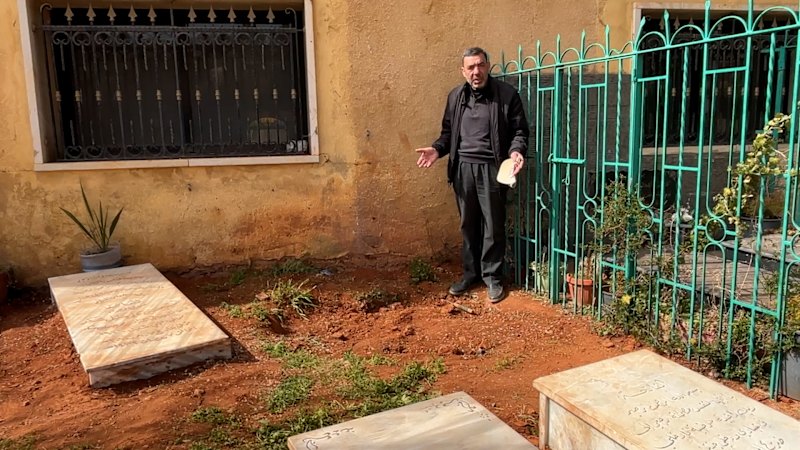
The narrative currently being peddled by the mainstream press regarding the Israeli military’s search for graves in Gaza is a masterclass in missing the point. Most outlets are obsessing over the "sacrilege" of the shovel, framing the desecration of cemeteries as a senseless byproduct of religious fervor or a desperate search for hostages. They call it carnage. I call it a brutal, inevitable clash between 19th-century burial traditions and 21st-century urban warfare.
If you think this is just about "searching for a grave," you’ve already lost the thread. The real story isn't about the dead; it's about how the subterranean geography of modern conflict has turned every square inch of earth into a tactical asset.
The Myth of the Neutral Ground
The "lazy consensus" dictates that cemeteries are off-limits, neutral zones that should remain untouched by the machinery of war. That’s a lovely sentiment for a philosophy classroom, but it’s a lethal delusion on the battlefield. I have watched military planners overlook "soft" sites for decades, only to see those sites used as the primary nodes for insurgent infrastructure.
In Gaza, the cemetery isn't just a place of rest. It is a tactical void. Because international law and public opinion provide a protective "halo" around religious sites, they become the path of least resistance for tunnel networks. When the IDF moves into a cemetery with bulldozers, they aren't looking for a single body as a sentimental trophy. They are dismantling a deliberate exploitation of Western ethics.
You cannot fight a war against an opponent that uses the dead as a shield if you aren't willing to move the dirt.
The Hostage Data Trap
The media frames the search for remains as a "needle in a haystack" failure. They point to the lack of recovered bodies as evidence of a strategic blunder. This ignores the cold reality of forensic intelligence.
In high-stakes recovery operations, "zero results" is still a data point. The objective isn't always the find; it’s the verification of the absence. Military intelligence operates on a different Bayesian logic than a police investigation.
$P(A|B) = \frac{P(B|A)P(A)}{P(B)}$
If the probability of a hostage being at Site A is $P(A)$, and the search $B$ yields nothing, the updated probability doesn't just drop to zero—it reconfigures the entire search grid. The "carnage" people see in the photos is actually the physical manifestation of a massive, violent process of elimination. It’s ugly, it’s expensive, and it’s remarkably inefficient, but it is the only way to close a loop when your intelligence is fragmented.
The Sentimentality Tax
We are witnessing the "Sentimentality Tax" in real-time. This is the cost incurred when a conventional military tries to adhere to traditional norms while fighting an asymmetric enemy.
- Delayed Objectives: Every hour spent trying to "respectfully" excavate a site is an hour the enemy uses to reposition.
- Resource Drain: Engineering units are tied up in soil analysis and DNA tagging instead of clearing active threats.
- Optics Fragility: The moment a headstone is moved, the PR war is lost, regardless of what is found beneath it.
The competitor's piece argues that this search led to "carnage." That’s a lazy use of a charged word. True carnage is what happens when you don't map the tunnels under the graveyard and your soldiers get hit by a flank attack from a tomb.
The Subterranean Arms Race
Let’s get technical about the "why." We are no longer fighting on a 2D plane. We are fighting in a 3D cube.
- Acoustic Sensors: Modern sensors struggle with the density of grave sites. The irregular voids created by burials mimic the signatures of man-made chambers.
- Ground Penetrating Radar (GPR): GPR is notoriously finicky in urban ruins. To be sure there isn’t a reinforced concrete bunker ten meters down, you often have to remove the top three meters of "interference"—which, in this case, happens to be a cemetery.
The outcry over the destruction of graves assumes that the surface and the subsurface are separate entities. In Gaza, they are inextricably linked. You cannot preserve the surface while neutralizing the threats beneath it. To pretend otherwise is to demand a miracle of physics that doesn't exist.
Why the "Desecration" Argument is Flawed
The "desecration" narrative relies on the idea that the sanctity of the site was intact before the bulldozers arrived. I’ve seen enough combat zones to know that "sanctity" is the first casualty of any group that uses a graveyard for military storage.
If a tunnel entrance is located in a crypt, the crypt is no longer a religious site; it’s a military installation. Under the Geneva Conventions—specifically Article 19—the protection afforded to civilian or religious objects disappears the moment they are used for "acts harmful to the enemy."
The media loves the "Israel is digging up graves" headline because it triggers a primal, visceral disgust. It ignores the legal and tactical reality: the moment those cemeteries were militarized by the defending force, their "sacred" status became a legal fiction.
The Cognitive Dissonance of Urban Warfare
People want clean wars. They want surgical strikes and respectful combat.
Imagine a scenario where a military knows with 80% certainty that a captive is being held in a tunnel system that runs directly beneath a historical landmark. If they wait, the captive dies. If they dig, the landmark is destroyed.
The critics suggest there is a third option. There isn't. The "carnage" is the choice. By framing the Israeli search as a failure of morality, the press is actually criticizing the very nature of modern urban siege. They are upset that war is messy, which is the most redundant observation one can make.
Stop Asking if it’s Moral—Ask if it’s Effective
We spend too much time debating the "soul" of the operation and not enough on the mechanics.
- Is it effective for hostage recovery? Rarely. The success rate of digging for remains is abysmal.
- Is it effective for tunnel denial? Extremely. You cannot have a secret tunnel if the ground above it has been churned into a moonscape.
The IDF isn't just looking for people; they are denying the enemy the use of the "sanctity shield." By demonstrating a willingness to bulldoze a cemetery, they signal that no site—no matter how religiously significant—will offer sanctuary. It is a psychological operation as much as a recovery mission.
The Expert Fallacy
The "experts" quoted in these articles are usually human rights lawyers or archaeologists. Where are the combat engineers? Where are the underground warfare specialists from the 777th or the 82nd?
If you ask an archaeologist about a destroyed grave, they will tell you about the loss of history. If you ask a combat engineer, they will tell you about the elimination of a blind spot. Both are right, but only one of them is relevant to winning a war.
We are moving into an era where "non-traditional" targets are the only targets left. As long as we keep applying 1945 rules to 2026 realities, we will keep being "shocked" by things that are mathematically certain to happen.
The Brutal Truth
The search for graves in Gaza isn't a sign of a military losing its way. It's a sign of a military that has accepted the total erosion of the civilian-military divide.
If you find that horrifying, good. It should be. But don't mistake your discomfort for a strategic critique. The "carnage" isn't a mistake; it’s the method.
The next time you see a headline about a "desecrated" site, stop looking at the headstones. Look at the dirt. Look at the depth. Look at the infrastructure.
Stop mourning the symbols and start understanding the geometry.