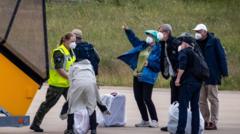
The isolation of the Antarctic wilderness was shattered recently when the MV Hondius, an ice-strengthened expedition vessel, became the center of a public health standoff. While the world's attention has largely drifted away from the heightened sensitivities of the early 2020s, the detection of a positive hantavirus test in an American passenger has reignited a fierce debate over the safety protocols of luxury "frontier" tourism. The French government moved with uncharacteristic speed, publishing a decree to enforce strict isolation measures for returning citizens, a move that signals a deep-seated anxiety about the permeability of international borders to zoonotic diseases.
This is not merely a story about a single sick passenger. It is a revealing look at the logistical nightmare that occurs when high-end tourism meets primitive biological threats in one of the most remote corners of the globe.
The Reality of Zoonotic Risk in Extreme Environments
Hantavirus is not a new name in the medical community, but its appearance on a polar expedition vessel is a jarring anomaly. Typically transmitted through contact with the urine, feces, or saliva of infected rodents, the virus causes a range of illnesses, from mild flu-like symptoms to fatal respiratory failure. The Hantavirus Pulmonary Syndrome (HPS) has a mortality rate that can climb toward 40%. It is a brutal, efficient killer.
The presence of such a pathogen on the MV Hondius raises immediate, uncomfortable questions. How does a rodent-borne virus find its way onto a ship designed for the sterile, frozen reaches of the South Atlantic?
The most likely answer lies in the supply chain. Global shipping and the provisioning of luxury vessels mean that crates of food, equipment, and linens are moved through ports where rodent populations are endemic. A single contaminated surface in a storage hold can turn a multi-million dollar cruise into a floating quarantine ward. For the industry, this is a nightmare scenario because it highlights a vulnerability that no amount of premium champagne or expert-led glacier walks can fully mitigate.
French Intervention and the Legal Precedent
The French government's decision to issue a formal decree for the isolation of its citizens on board is a calculated display of sovereign power. Usually, health incidents at sea are handled by the ship's flag state or the port of arrival under international maritime law. By bypassing these standard channels and codifying the isolation measures in national law, France has signaled that it no longer trusts the self-regulation of the cruise industry.
The decree serves two purposes. First, it provides a legal framework to force compliance from passengers who might otherwise demand to be released upon reaching dry land. Second, it shifts the liability. If a passenger breaks quarantine and causes an outbreak on French soil, the government now has the documented legal basis to prosecute or fine the individual and the operator.
This move has sent a chill through the expedition travel sector. If every nation starts issuing bespoke decrees for every suspected infection, the operational costs of these trips will skyrocket. Ship owners are now looking at a future where they must not only navigate icebergs but also a shifting mosaic of emergency national laws that can be triggered by a single lateral flow test.
The Logistics of a Floating Quarantine
Managing an outbreak on a ship like the MV Hondius is a task of staggering complexity. These vessels are designed for comfort and observation, not clinical isolation.
- Airflow Systems: Most modern ships use recycled air to maintain internal temperatures in freezing climates. Unless a vessel is equipped with medical-grade HEPA filtration and negative pressure rooms, containing an airborne or droplet-based pathogen is nearly impossible.
- Staffing Ratios: Expedition ships carry a limited medical staff, often just one or two doctors and a nurse. They are equipped for broken bones, seasickness, and minor infections. They are not prepared to manage a long-term quarantine for hundreds of people.
- Waste Management: Biohazardous waste on a ship must be stored and processed according to strict environmental laws, especially in protected waters like the Antarctic. An outbreak creates a mountain of contaminated material that the ship may not be legally allowed to dump or even keep on board for long periods.
The American passenger who tested positive became the catalyst for a logistical breakdown. While the individual was isolated, the psychological impact on the rest of the passengers—many of whom paid upwards of $15,000 for the privilege of being there—is profound. The transition from "explorer" to "detainee" happens in the time it takes to read a lab result.
The Conflict Between Profit and Protection
The expedition cruise industry has seen a massive surge in investment over the last five years. More ships are heading south than ever before. This "democratization" of the Antarctic comes at a price. The more humans interact with these environments, and the more frequently ships cycle through international ports to resupply them, the higher the statistical probability of a biological breach.
Industry analysts have noted that the "Hondius Incident" reveals a gap in the insurance market. Standard travel insurance often excludes pandemics or specific zoonotic outbreaks under "act of God" or "force majeure" clauses. Passengers on the MV Hondius may find themselves in a legal vacuum, fighting for refunds for a trip that ended in a cabin lockdown rather than a penguin colony.
The operators are in an equally precarious position. They must weigh the cost of a full-stop quarantine against the reputational damage of being labeled a "plague ship." In the case of the hantavirus scare, the decision was largely taken out of their hands by the French decree, but the precedent remains.
Testing Accuracy and the Burden of Proof
There is also the technical question of the test itself. Rapid diagnostic tests in field conditions are notoriously prone to false positives or cross-reactivity with other, less dangerous viruses. In the rush to contain a potential disaster, the nuances of diagnostic certainty are often sacrificed for the safety of the many.
If the American passenger's test was a false positive, the legal and financial fallout for the ship's operator, Oceanwide Expeditions, could be massive. Conversely, if it was a true positive and the virus had spread, the lack of immediate, aggressive isolation would have been a catastrophic failure of duty of care.
This "no-win" situation is the new reality for high-end travel. Operators are now forced to act as de facto health authorities, making life-altering decisions based on imperfect data in high-pressure environments.
Redefining the Safety Net for Remote Travel
The fallout from the MV Hondius will likely result in a permanent shift in how these voyages are sold and managed. We are moving toward a model where "health clearance" is as important as a passport.
We should expect to see:
- Mandatory Pre-Boarding Quarantines: Similar to the protocols used for oil rig workers or research scientists, passengers may be required to isolate in a port city for several days before stepping onto the ship.
- Enhanced On-Board Labs: The "doctor’s office" on a ship will need to be replaced by a fully functioning diagnostic suite capable of PCR testing for a wide array of rare pathogens.
- Sovereign Indemnity Agreements: Operators may seek formal agreements with nations like France or Argentina to pre-determine how health crises will be handled, avoiding the need for last-minute decrees that disrupt operations.
The allure of the Antarctic has always been its hostility and its distance from civilization. But as the MV Hondius proved, you can never truly leave the grid. The world follows you, and sometimes, it brings its diseases with it. The frontier is no longer a place where you can escape the reach of a government bureaucrat's pen or a microscopic predator.
The luxury of the expedition is a thin veil over the harsh reality of biological vulnerability. When that veil is torn, as it was in the South Atlantic, the result is a chaotic scramble for control that leaves passengers, operators, and governments at odds. The Antarctic remains unchanged, indifferent to the drama unfolding in the steel hulls of the ships that skirt its coast, but for the travel industry, everything has changed.
The next time a siren sounds in the Southern Ocean, it won't just be for a sighting of a Blue Whale; it will be a signal that the borders have closed once again. Ensure your travel insurance covers the cost of a long, lonely look at the sea from behind a sealed cabin door.