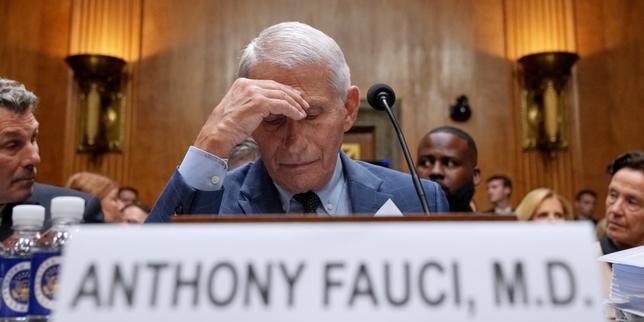
The marble of Capitol Hill absorbs sound differently than a hospital hallway. In a hospital, the quiet is functional; it is a canvas for monitors, low-voiced consultations, and the soft shuffle of rubber-soled shoes on tile. Under the dome, silence is theatrical. It waits. It presses down on the collarbones.
Dr. Anthony Fauci sat at the witness table, a man who had spent over five decades answering to science, now required to answer to performance.
For the public watching through screens, the Senate hearing was a spectacle of friction. To understand why that room felt so heavy, you have to look past the political theater and examine the mechanics of what happens when a scientist is forced onto a political stage. Science deals in probabilities, sliding scales, and evolving data. Politics deals in absolutes, enemies, and final verdicts. When the two collide under television lights, the result is not clarity. It is a collision of languages.
Consider what it means to update a recommendation. In the laboratory, changing your mind when new data arrives is the definition of integrity. In a congressional hearing, changing your mind is treated as a confession of deceit.
"Dr. Fauci, did you or did you not..."
The question arrives like a gavel strike.
Sitting there, the white hair thinned by age, the voice hoarse from hours of back-and-forth, Fauci represented a strange American archetype: the technocrat who became a household name against his will. He was the pediatrician who had to tell the entire country that school was canceled, the epidemiologist who had to explain why the curve needed flattening before the morgues ran out of space.
People forget the spring of 2020. They forget the sheer, suffocating fog of those early weeks. We locked our front doors. We wiped down grocery bags with bleach wipes. We stared out windows at empty streets, listening to sirens wail through cities that never usually slept. In that vacuum of terror, we looked upward. We looked to the men and women in white coats who stood behind podiums bearing the presidential seal, trying to translate a microscopic enemy into plain English.
Fauci was the anchor of that broadcast.
And anchors take the weight of the storm.
Years later, the room had changed. The emergency had receded into the background, replaced by the bitter accounting of post-mortems. Committees were formed. Subpoenas were issued. Emails—thousands of them, pulled from the digital archives of daily communication—were sliced, diced, and weaponized out of context.
When a legislator holds up a piece of paper from March 2020 and asks why a mask policy was what it was before the delta variant, before the vaccines, before the mutations piled up like sediment, they are erasing time. They are freezing a fluid moment in amber and demanding to know why it isn't moving.
Fauci adjusted his microphone. The hum of the sound system filled the brief pause.
"At the time," he began, his voice flat, weary, stripped of any defensive flourish.
He had said those words a thousand times. At the time.
It is a phrase that infuriates people who want someone to blame. Blame requires a straight line from intent to outcome. Blame wants a villain who knew everything from the start and chose malice. But biology does not negotiate with human desire for narrative neatness. A novel virus mutates because that is what organic matter does to survive. It does not care about election cycles, Senate subcommittees, or approval ratings.
The questioning grew sharper. Voices rose. Microphones clipped.
Outside the hearing room, a different kind of reality persisted. Security guards checked badges. Tourists wandered past statues of dead presidents, pausing to take flash photographs. Life had resumed its normal, messy rhythm. But inside, time had stopped at the worst moment of our collective lives, trapped in a loop of recrimination.
What does it cost a person to spend their entire life trying to eradicate disease, only to spend their twilight years defending their honor against accusations of tyranny?
The answer is written in the posture. The slight slump of the shoulders. The measured patience of a man who knows that snapping back will only be clipped into a thirty-second digital loop by the very evening.
There is a profound loneliness in public expertise. When things go right, you are invisible. The vaccine works, the patient walks out of the ICU, the epidemic fades into a footnote, and everyone goes back to their lives. The triumph belongs to the invisible architecture of public health. But when things go wrong—when beds fill up, when businesses shutter, when fear curdles into anger—the architect is dragged into the public square to answer for the weather.
The senators took turns. Some leaned forward, aggressive, hunting for the soundbite that would lead the evening news. Others sat back, weary, asking questions that felt less like inquiries and more like final statements.
Fauci answered them all. He did not raise his voice. He did not roll his eyes. He corrected the record with the meticulous precision of a man who had spent decades reviewing clinical trials. Data point by data point. Context by context.
Yet, logic has a ceiling when the audience is already divided.
We live in an era that demands heroes or villains, as if humanity were a comic book script. We struggle to tolerate the messy middle, where well-meaning people make imperfect decisions with incomplete information under the crushing weight of a ticking clock.
When the hearing finally adjourned, the gavel fell with a dry crack.
The cameras blinked off. The crowd began to file out, rustling papers, whispering assessments to one another. The senators stood, gathering their folders, chatting amicably across party lines now that the performance was over.
Fauci remained seated for a moment longer, gathering his notes, sliding them into a worn leather briefcase. He stood up slowly, walked down the center aisle, and disappeared through a side door, leaving the empty marble room to echo with the ghosts of a crisis we are still trying to forgive ourselves for having survived.