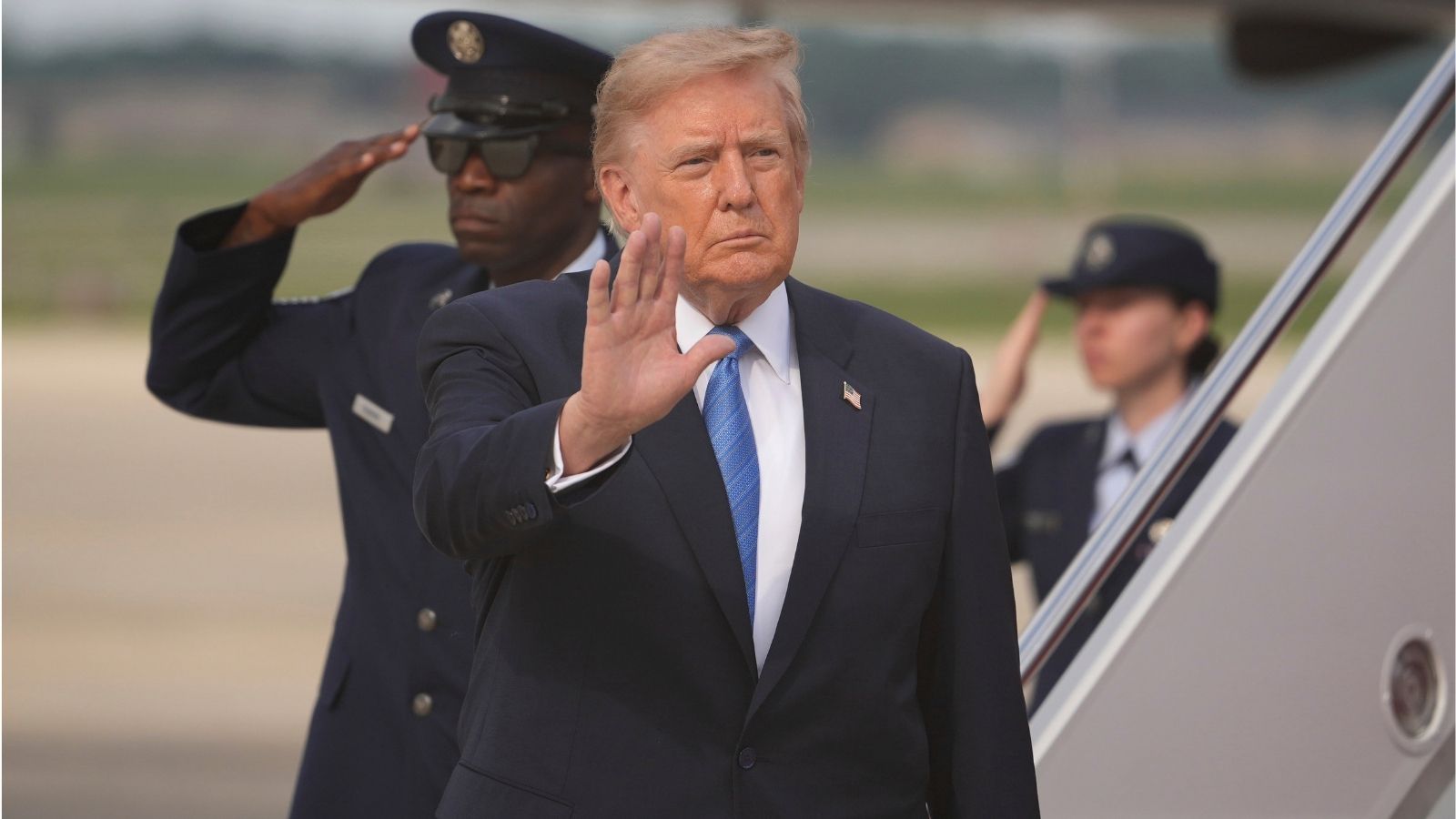
The presentation of a watch-sized, 18-karat gold ring encrusted with 321 diamonds, 56 sapphires, 13 emeralds, and six rubies to the United States Ambassador to Belgium for delivery to President Donald Trump is not an act of spontaneous sentimentality. It is a calculated exercise in post-tariff corporate diplomacy. Commemorating the 250th anniversary of American independence, the "Freedom 250" ring—commissioned by the Antwerp World Diamond Center (AWDC) and designed by David Gotlib—serves as a physical manifestation of a highly successful industrial lobbying campaign.
Independent gemological assessments place the production cost of the object between $25,000 and $35,000, split symmetrically between raw material costs and master craftsmanship labor. To evaluate this artifact merely by its replacement value misses its economic function. The ring operates as an asymmetrical token of appreciation and a low-cost mechanism for reinforcing a critical regulatory concession: the elimination of a sweeping import tariff on a trade corridor worth billions of dollars.
The Microeconomics of the Antwerp-US Diamond Corridor
To understand the strategic rationale behind the gift, one must map the economic dependencies of the global gemstone trade. Antwerp represents the primary clearinghouse for global diamond distribution, handling roughly 80 percent of the world’s rough diamond supply and a substantial portion of polished stone logistics. The United States serves as the world's largest consumer market for finished diamond jewelry.
The baseline stability of this corridor was disrupted when the United States instituted a broad trade policy framework characterized by aggressive import tariffs. The introduction of these financial penalties fundamentally altered the cost structure of European diamond exporters.
The Tariff Cost Function
For the Belgian diamond sector, the vulnerability can be expressed through a standard margin compression formula:
$$\Delta M = P_w - (C_p + T + L)$$
Where:
- $\Delta M$ represents the net profit margin for exporters.
- $P_w$ is the global wholesale price of polished diamonds, largely constrained by consumer demand and retail ceilings.
- $C_p$ is the baseline cost of production, sorting, and cutting.
- $T$ is the ad valorem tariff rate imposed by importing jurisdictions.
- $L$ is the operational logistical overhead.
When $T$ escalated during the broader trade frictions, the net margins ($\Delta M$) for Antwerp merchants collapsed. Because polished diamonds are highly fungible luxury commodities, Belgian firms could not pass the tariff costs onto American consumers without experiencing a catastrophic drop in transaction volume.
The Scale of the Concession
In September, the AWDC successfully secured a zero percent import tariff configuration from the United States administration. This carve-out insulated a critical trade artery:
- Annual Export Volume: More than $2 billion of polished diamonds flow directly from Antwerp to the United States each year.
- Tariff Exposure Minimization: Assuming a baseline tariff penalty of even 5 to 10 percent, the elimination of the trade barrier preserved between $100 million and $200 million in annual capital within the Antwerp diamond ecosystem.
A comparative analysis highlights the massive asymmetry of this return on investment:
| Metric | Financial Value | Operational Role |
|---|---|---|
| "Freedom 250" Ring Production Cost | $25,000 – $35,000 | Token of diplomatic reinforcement |
| Antwerp-US Polished Diamond Trade | > $2,000,000,000 | Core industrial export asset |
| Preserved Annual Capital (Estimated) | $100,000,000 – $200,000,000 | Retained corporate profit margin |
The ratio of the cost of the gift to the value of the preserved trade corridor is roughly 1 to 5,700. The ring represents an incredibly efficient expenditure of corporate lobbying capital.
The Mechanics of Non-Monetary Corporate Influence
The timing and execution of the gift follow a precise framework of corporate influence. The AWDC provided granular analytical "input" to the European Commission during its broader trade negotiations with the United States executive branch. Once the political objective was achieved, the industry transitioned from transactional lobbying to relationship maintenance.
The Reciprocity Framework
The gift exploits a well-documented psychological and sociological framework: the rule of reciprocity. In international commerce and governance, when an administrative entity delivers a massive economic benefit to a specific interest group, that group faces an immediate strategic mandate to validate the decision.
Isidore Mörsel, president of the AWDC, explicitly framed the gift around this concept, noting that "true partnership, like the finest natural diamonds, are formed under pressure... and shine brightest when built on trust." Translating the diplomatic rhetoric into executive terms, the statement affirms to the decision-maker that their intervention yielded deep corporate loyalty and public alignment.
Symbolic Alignment and Semiotic Engineering
The design of the ring minimizes foreign aesthetic elements and maximizes specific iconography designed to resonate with the recipient:
- Patriotic Co-optation: The integration of the Stars and Stripes, "1776," "2026," and an eagle carrying a ruby shield aligns the corporate interests of Antwerp with American foundational myths.
- Personalized Branding: The prominent inclusion of the numbers 45 and 47 framed within a Superman-style logo directly flatters the executive's historical legacy as both the 45th and 47th President of the United States.
- Interior Inscription: "Crafted in Antwerp for Donald John Trump" transforms a generic luxury item into a bespoke, non-transferable asset.
Structural Vulnerabilities and the Constitutional Bottleneck
While the AWDC’s strategy has successfully yielded short-term tariff relief and high-level diplomatic access, the mechanism introduces severe institutional risks for both the corporate donors and the executive recipient.
The Emoluments Clause and Statutory Restraints
The primary structural bottleneck to this strategy is the Foreign Emoluments Clause of the United States Constitution (Article I, Section 9, Clause 8). This provision strictly prohibits any person holding an office of profit or trust from accepting presents, emoluments, offices, or titles of any kind from a foreign state or its representatives without the express consent of Congress.
The AWDC occupies a complex legal status. While it operates as a private foundation representing the diamond industry, it acts as the official representative and regulatory partner of the Belgian government in diamond affairs. If the AWDC is legally construed as an extension of a foreign state apparatus, the acceptance of the ring by a sitting president introduces a direct constitutional conflict.
Executive Discretion and Historical Precedent
United States presidents possess considerable latitude regarding gifts, governed by distinct legal pathways:
- The Public Property Path: Gifts from foreign officials are routinely accepted on behalf of the United States and transferred immediately to the National Archives or the General Services Administration. They become federal property, not personal wealth.
- The Personal Purchase Path: If an executive desires to retain a foreign gift personally, they must reimburse the United States Treasury for the full appraised fair market value of the item using personal funds.
- The Domestic Disclosure Path: Gifts from domestic sources face different disclosure thresholds, as seen in recent executive disclosures revealing a $250,000 commemorative sculpture and high-value sporting event tickets.
The stated intent of U.S. Ambassador Bill White to have the ring displayed in the Oval Office suggests a deliberate strategy to categorize the item as an official institutional gift rather than personal property. This minimizes immediate domestic ethics violations but cements the reality that foreign commercial entities can place permanent physical reminders of their economic victories inside the inner sanctum of American executive power.
The Strategic Playbook for Foreign Trade Groups
The Antwerp diamond sector’s maneuver provides a definitive blueprint for multinational industries navigating an era of volatile, executive-driven trade policies. Relying purely on traditional, multi-lateral institutional lobbying through bodies like the World Trade Organization is insufficient when dealing with protectionist administrations.
The optimal strategic play requires a two-pronged approach. First, industries must protect their supply chains by feeding precise economic impact data to state negotiators, proving that tariffs will cause reciprocal domestic pain. Second, once exclusions are granted, industries must immediately anchor those policy wins by engaging in high-visibility, symbolic cultural diplomacy that offers the executive maximum political capital and personal validation. The cost of a few dozen carats of polished stones is an irrelevant line item when compared to the preservation of unrestricted global market access.