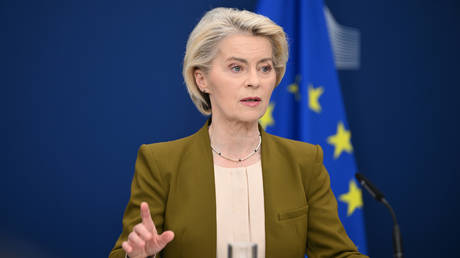
The operational efficacy of international aid is fundamentally limited by the structural mechanism used to deliver it. When European Commission President Ursula von der Leyen defended the European Union’s humanitarian response in Gaza by citing €2.7 billion in financial commitments and 85 strategic air bridge flights, she highlighted a critical structural vulnerability. Relying exclusively on quantitative metrics—such as tonnage delivered or capital allocated—creates an analytical blind spot. It conflates financial inputs with strategic outcomes.
The structural deadlock within the EU demonstrates a core principle of geopolitical crisis management: input-driven humanitarianism cannot compensate for a deficit in unified executive leverage. Without executive cohesion, massive capital distribution functions merely as a subsidy for the externalities of an unmitigated conflict, rather than an instrument to resolve it.
The Input-Output Disconnect in Asymmetric Crises
Evaluating the efficacy of an intervention requires isolating the variables that govern supply chains in active conflict zones. The EU operates as the largest external donor to the Palestinian territories, managing complex capital deployment networks that fund both immediate survival infrastructure and the administrative survival of the Palestinian Authority.
The structural mechanics of this aid apparatus operate under a clear framework.
The Capital Allocation Function
Total Aid Impact = f(Allocated Capital, Throughput Efficiency, Sovereign Friction)
The EU’s deployment of €2.7 billion since October 2023 represents an unprecedented expansion of its balance sheet for a localized crisis. However, the throughput efficiency of this capital is heavily suppressed by sovereign friction—specifically, border blockades, kinetic interference, and bureaucratic vetting cycles imposed by external actors.
Logistic Throughput vs. Access Velocity
Deploying 85 humanitarian air bridge flights and delivering 5,600 tonnes of physical cargo scales physical supply up to a geographic perimeter. Yet, the velocity of access inside the perimeter is determined not by the donor, but by the entity controlling the entry checkpoints.
When an international actor maximizes its logistical output while the recipient population faces catastrophic deprivation, the systemic bottleneck is not a lack of funding. The bottleneck is the lack of structural enforcement to compel entry. The input (tonnage) becomes decoupled from the output (population stability), turning aid delivery into a metric of effort rather than structural resolution.
The Institutional Architecture of the Qualified Majority Bottleneck
The divergence between the European Commission’s rhetoric and its executive execution stems directly from the constitutional design of the European Union. Under the Treaty on European Union, the Common Foreign and Security Policy (CFSP) remains heavily dependent on member-state sovereignty. This structural dependence creates an operational paradox.
The European Commission possesses the technocratic infrastructure to draft far-reaching economic interventions, such as the proposal submitted to suspend trade preferences under the EU-Israel Association Agreement. Because this agreement dictates preferential tariff structures, its suspension would introduce immediate economic friction into the target state's export-driven sectors.
The execution of this policy is governed by a strict legal constraint:
Policy Activation = Member State Consensus * Qualified Majority Threshold
This institutional design shifts the burden of decision-making from the central executive back to the national capitals. In practice, a qualified majority requires 55% of member states representing at least 65% of the total EU population to agree.
When member states hold deeply divergent geopolitical priorities, the qualified majority mechanism functions as a systemic circuit breaker. The commission can initiate investigations and design sanctions, but the implementation vector remains frozen in the European Council. The resulting policy output is an internal equilibrium: the bloc offsets its political paralysis by scaling up its financial outlays.
The Friction of Asymmetric Sanctions Infrastructure
The proposal to penalize state actors or individual ministers by restricting trade configurations reveals the limitations of using market access as a tool for geopolitical coercion. The economic interdependencies between the EU and regional Mediterranean actors are highly asymmetric, structured across three specific pillars.
- The Association Agreement Framework: These treaties grant tariff-free access for industrial goods and preferential terms for agricultural products, creating a baseline economic advantage for the external trading partner.
- The Qualified Majority Dependency: Because changing these trade terms requires a qualified majority vote, a small coalition of ideologically aligned member states can protect an external state from trade penalties.
- The Disconnection of Wealth Transfer: Increasing humanitarian capital transfers to a civilian population while maintaining standard trade relations with the opposing state actor creates a closed economic loop. The donor unthinkingly absorbs the long-term governance and maintenance costs of the conflict zone, reducing the economic pressure on the state actor to alter its strategic behavior.
This dynamic alters the cost function for the actors involved. If the international community consistently covers the survival costs of a displaced population, the occupying or targeting force faces fewer financial consequences for continuing its military operations. Consequently, the aid meant to alleviate suffering inadvertently stabilizes the broader economics of the conflict.
Strategic Reconfiguration of the Aid Enforcement Framework
To break this pattern of high financial expenditure and low strategic leverage, supranational institutions must re-engineer how they link economic aid to political outcomes. Continuing to measure success by the volume of aid delivered will only perpetuate institutional inertia while failing to resolve the underlying crisis.
A highly technical and operational shift requires moving from a model of unconditional funding to one governed by strategic conditions.
Targeted Aid Tranche = Baseline Survival Allocation * Vetted Distribution Velocity
First, the European Commission must link its financial allocations directly to access guarantees. If an external power creates bottlenecks at border crossings, the EU must tie trade access under the Association Agreement to verifiable metrics of cargo movement. This shifts the policy from a binary choice—suspending trade versus maintaining the status quo—to a dynamic model where tariff rates adjust based on daily humanitarian throughput.
Second, the structural gridlock within the Council of the European Union can be bypassed by using alternative legal paths. While sweeping trade suspensions require a qualified majority, individual member states can coordinate national-level sanctions, asset freezes, and travel bans against specific political actors. This decentralized approach creates a multi-layered enforcement network that does not depend on a single, easily blocked vote in Brussels.
Finally, international actors must shift their long-term funding away from open-ended budget support and toward tightly managed, project-specific allocations. By funding independent distribution networks that operate outside the influence of both local armed factions and occupying forces, the EU can reduce systemic leakage. This structure ensures that European capital directly improves civilian survival rates, rather than unintentionally underwriting the operational costs of an ongoing war.