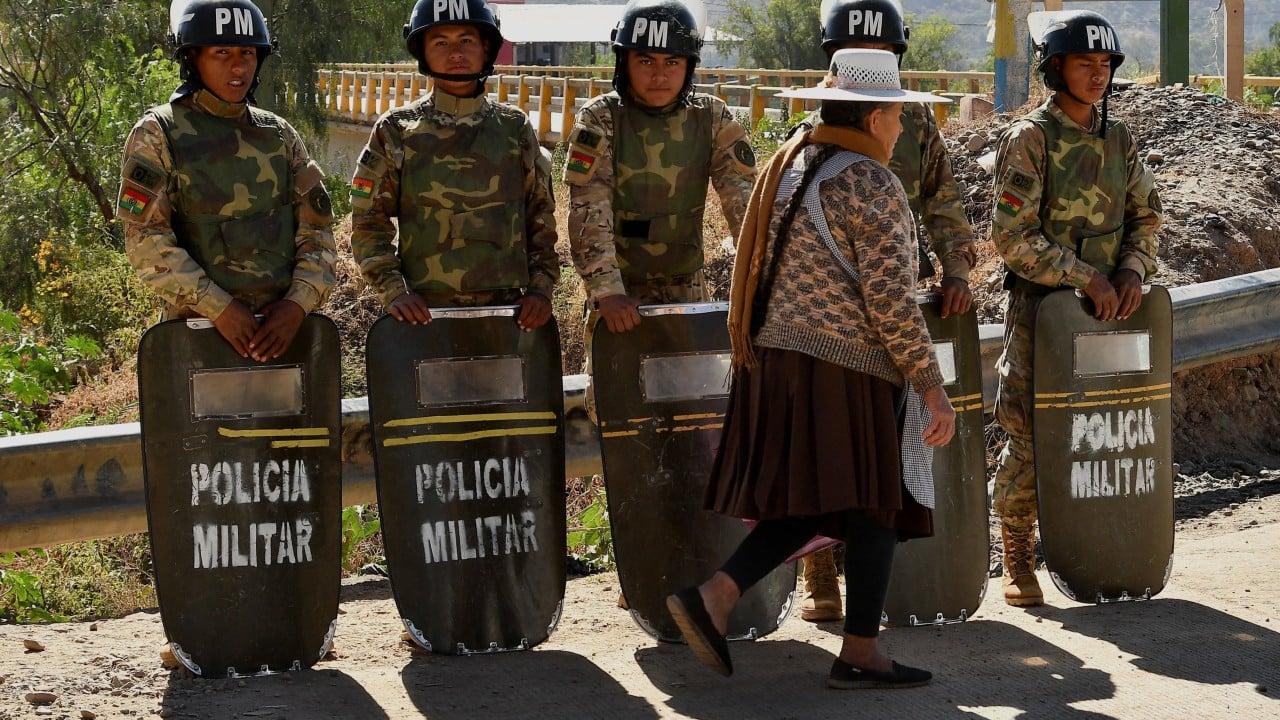
The declaration of a 90-day state of emergency by Bolivian President Rodrigo Paz exposes a critical vulnerability in the geography and macroeconomics of the Andean nation. This is not merely a political standoff; it is a structural strangulation of an economy reliant on a highly centralized transport infrastructure.
When protesting miners, farmers, and labor unions erect over 3,500 physical blockades across 67 major highways, they are exploiting specific nodes in the national logistics network to enforce economic paralysis. Evaluating this crisis requires moving past the political rhetoric of democratic destabilization versus popular rebellion to examine the precise economic mechanisms, structural bottlenecks, and structural limits of state intervention.
The Choke Point Mechanics of Bolivian Logistics
Bolivia’s domestic commerce relies almost exclusively on its highway system to bridge the geographic divide between the agricultural lowlands of the east and the administrative, consumption-heavy highlands of the west. This spatial distribution creates a naturally fragile supply chain.
- The Axis of Vulnerability: The cities of La Paz, El Alto, and Cochabamba function under a de facto state of siege due to their geographic reliance on specific transport corridors. Cochabamba serves as the central transit hub connecting the agrarian engine of Santa Cruz to the western administrative centers.
- The Leverage of the Blockade: By shutting down these specific arteries, rural associations and unionized workers achieve immediate asymmetric leverage. The physical blockade functions as a low-cost, high-impact mechanism that halts the flow of essential goods, transforming localized geographic control into national macroeconomic duress.
- The Per-Day Cost Function: The systemic friction of these blockades manifests in immediate financial bleed. With over 5,000 cargo trucks stranded on highways, the estimated daily loss to the domestic economy exceeds $50 million. This compounding cost curve pressures the state by draining private-sector liquidity and accelerating domestic product scarcity.
The Tri-Factor Fiscal Crisis
The current unrest is the direct consequence of three intersecting structural pressures that severely limit the government's economic maneuverability.
[Dollar Liquidity Crunch] ---> [Removal of Fuel Subsidies] ---> [Supply Chain Blockades]
                                                                      |
[IMF Fiscal Stabilisation] ---> [Land Mortgage Reforms] ----------> [Protest Escalation]
1. The Hydrocarbon Subsidy Reversal
For decades, Bolivia artificially suppressed domestic fuel prices via heavy state subsidies. A worsening shortage of U.S. dollars and declining domestic energy production forced the executive branch to issue a decree ending national fuel subsidies to narrow the expanding fiscal deficit. The removal of these subsidies immediately re-indexed transport costs, causing a cascading spike in the price of consumer goods and triggering immediate resistance from transport unions.
2. The IMF Balance Sheet Mandate
The elimination of fuel subsidies was not an isolated policy choice but a prerequisite for structural adjustment discussions with the International Monetary Fund. Caught in a dollar liquidity trap, the administration required external financing to backstop its dwindling foreign reserves, forcing fiscal consolidation measures that undermined domestic political stability.
3. The Land Capitalization Friction
In an attempt to unlock domestic credit markets, the administration introduced land reforms allowing agricultural property to be utilized as collateral for commercial loans. While designed from a neoliberal perspective to increase capital liquidity for small-scale farmers, the policy was interpreted by indigenous and rural communities as an institutional mechanism facilitating predatory land-grabbing by financial conglomerates, sparking the initial wave of rural resistance.
The Limits of Emergency Power and Military Clearing
The legislative groundwork for the state of emergency was established when Congress passed Law 1732, which abrogated previous restrictions on executive emergency orders. While the decree formally permits the deployment of the armed forces and industrial equipment to dismantle physical roadblocks, the operational execution faces distinct strategic limitations.
First, the clearing of a blockade provides only transient logistical relief. When military forces clear a sector, the underlying structural dissent remains unaddressed. Protesting factions can easily re-establish blockades at adjacent coordinates along the highway network once state forces rotate out to clear other sectors. The state lacks the manpower density to permanently garrison thousands of kilometers of rugged mountain highways.
Second, tactical fragmentation undermines the government's negotiation strategies. While the administration reached a tentative stabilization agreement with the central leadership of the Bolivian Workers' Confederation, the pact failed to pacify rural associations and regional mining syndicates aligned with former President Evo Morales. Because these factions operate via decentralized command structures across regions like Cochabamba, a top-down political settlement cannot effectively clear the roads.
The strategic play for the administration cannot rely exclusively on the deployment of armored bulldozers and military police. Force can clear a specific coordinate, but it cannot fix a broken balance sheet or manufacture missing foreign currency reserves. To prevent complete economic insolvency, the state must pivot from a policy of pure tactical clearance to an aggressive, tiered logistical triage.
This requires prioritizing the security of highly specific economic corridors, such as the Santa Cruz-to-La Paz food pipeline, while establishing localized, conditional rollbacks of land reforms explicitly targeting the most militant rural syndicates to break their tactical alignment. Failing this, the compounding $50 million daily economic burn will deplete remaining private-sector reserves long before the 90-day emergency decree expires.