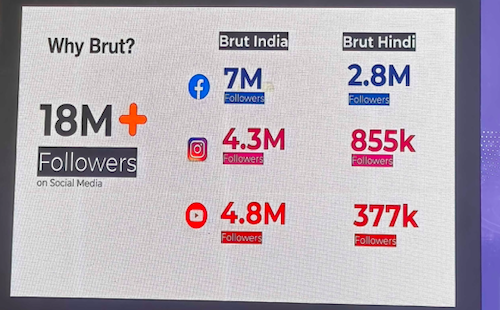
Traditional digital media models operate on a fundamentally flawed conversion funnel. Publishers invest capital into building owned-and-operated infrastructure—websites, mobile applications, and proprietary content management systems—and then deploy paid or organic acquisition strategies to drag users out of native social environments and into their proprietary ecosystems. This friction-heavy architecture creates a severe capital drag. By contrast, a platform-native model eliminates the infrastructure layer entirely, capturing attention where marginal friction is zero and redirecting operational capital directly into narrative optimization.
The economic divergence between these two approaches is stark. Traditional media views social platforms as top-of-funnel discovery networks meant to feed a proprietary destination. A platform-native operator like Brut India treats the platform itself as the destination. This choice transforms the underlying cost function of content distribution and alters the unit economics of audience monetization.
The Structural Mechanics of Platform Native Architecture
Bypassing proprietary applications alters the capital allocation strategy of a modern media firm. In an infrastructure-heavy publishing model, capital expenditure is split across three distinct domains: software engineering, audience acquisition, and content production. The maintenance of iOS and Android applications requires continuous engineering overhead to address API updates, security vulnerabilities, and user interface iterations.
When a media entity strips away the infrastructure layer, the engineering overhead drops asymptotically toward zero. The entire operating budget can then be concentrated on content manufacturing and data-driven editorial iteration. This structural shift can be modeled through three operational dynamics.
The Audience Acquisition Cost Function
In a standard publishing framework, the Customer Acquisition Cost (CAC) includes the paid advertising or search engine optimization spend required to convince a user to download an application or bookmark a website. Because the user must break their immediate browsing habit, cross platform boundaries, and wait for an external page load, the conversion drop-off is severe.
A platform-native strategy utilizes the existing distribution infrastructure of third-party networks, including YouTube Shorts, Instagram Reels, and TikTok. The acquisition cost is effectively subsidized by the host platform's recommendation engine. Instead of buying users, the native publisher creates content that matches the systemic incentives of the host algorithm, reducing the marginal cost of acquiring an impression to the variable cost of content production alone.
Algorithmic Retention Windows
The operational reality of modern media consumption is governed by compressed attention windows. Data indicates that the initial selection window for short-form video content has collapsed to approximately 2.7 seconds. Within this window, the platform user makes a binary decision to stay or swipe.
Platform-native design adapts to this bottleneck by re-engineering the structural format of the media asset. Traditional narrative structures rely on an introduction, context building, and a deferred climax. Native formats invert this framework, placing the most visually arresting or editorially intense asset in the first three seconds to arrest the swipe mechanic. This approach uses high-contrast typography, hard visual cuts, and immediate narrative immersion to satisfy the platform's initial watch-time retention thresholds.
Asset Production Density
A common failure state for digital media companies trying to match platform scale is the overproduction of low-margin volume. Legacy aggregators often publish between 100 and 200 commoditized assets per day to maximize total impression volume across search engines. This strategy dilutes brand equity and raises variable production costs without building audience loyalty.
The alternative playbook prioritizes asset density over pure volume. Publishing a restricted volume—such as a strict cadence of four highly optimized assets per day—allows editorial teams to focus capital on script tight-knitting, fact-verification, and asset-specific packaging. High-quality asset construction achieves higher organic sharing velocity. Because platform recommendation mechanics reward deep completion rates rather than flat publishing volume, a small inventory of high-performing assets frequently out-indexes a large inventory of low-retention assets.
Decoding the Monetization Model
Operating purely within third-party ecosystems introduces specific monetization limits. Native publishers cannot deploy standard programmatic display banners or hard programmatic paywalls, which form the revenue core of traditional journalism. Instead, monetization must shift toward native integrations that align with the platform consumption pattern.
+-------------------------------------------------------------+
|               Platform-Native Revenue Stream                |
+-------------------------------------------------------------+
                               |
        +----------------------+----------------------+
        |                      |                      |
        v                      v                      v
+---------------+      +---------------+      +---------------+
|    Branded    |      | Platform Ad-  |      |    Social     |
|    Content    |      | Revenue Share |      |   Commerce    |
+---------------+      +---------------+      +---------------+
The revenue architecture relies primarily on three independent streams:
- Ethical Branded Content Integration: Brand partnerships are executed as high-fidelity editorial stories rather than disruptive advertisements. To maintain the trust of younger demographics (Gen Z and Millennials), sponsorships are filtered through strict corporate social responsibility benchmarks. Content focuses on sustainability, gender equity, and social justice, matching the exact ideological expectations of the native audience.
- Platform Revenue Sharing: Monetization via YouTube AdSense, Meta overlay ads, and creator fund distributions provides a baseline cash flow directly correlated with total watch hours and geographic audience tier.
- Social Commerce Pipelines: Integrating transactional elements directly into video interfaces allows the publisher to convert passive attention into immediate physical transactions. By embedding affiliate links, custom merchandise drops, or curated storefronts (such as Brut.Shop) into the video interface, the consumption experience transitions into a transactional funnel.
The primary systemic risk of this monetization structure is platform concentration risk. If a primary distribution network alters its sorting algorithm or changes its creator payout structure, the publisher's revenue pipeline faces immediate compression. Mitigating this vulnerability requires systematic multi-platform diversification; assets must be engineered to be platform-agnostic, allowing rapid reallocation of distribution focus if one node experiences traffic degradation.
The Production Engine and Editorial Framework
Maintaining high retention rates across divergent platforms requires a specific internal operating structure. A centralized newsroom model creates localized latency; stories break in one region, but the administrative approvals and asset assembly must clear a single global hub, resulting in lost distribution velocity.
To optimize speed, a hub-and-spoke production matrix distributes creative autonomy across key geographic nodes, including Paris, New York, New Delhi, and Tokyo. The central hub provides standardized asset templates, structural editing frameworks, and unified data dashboards, while the regional nodes function as autonomous production teams capable of identifying, scripting, and publishing local stories in real time.
                +-------------------+
                |    Central Hub    |
                |   (Paris: Tech,   |
                |   Data, Templates)|
                +---------+---------+
                          |
        +-----------------+-----------------+
        |                 |                 |
        v                 v                 v
+---------------+ +---------------+ +---------------+
| Regional Spoke| | Regional Spoke| | Regional Spoke|
| (New Delhi)   | |  (New York)   | |   (Tokyo)     |
+---------------+ +---------------+ +---------------+
The underlying editorial framework ignores the standard objective-neutral pose of legacy broadcasting, shifting instead toward verified narrative perspective. The target demographic does not seek an absence of opinion; they seek an absence of institutional curation. The native script is built using direct language, unembellished primary video footage, and explicit framing around systemic issues like climate mutation and civil rights. The authority of the piece is derived from data transparency and original primary source audio rather than the voice of an artificial studio anchor.
Strategic Asset Allocation Strategy
For media operators looking to deploy capital away from legacy infrastructure and into algorithmic arbitrage models, execution must follow a sequential optimization path.
First, dismantle the legacy engineering development loop. Freeze non-essential mobile app iterations and redirect those engineering salaries toward real-time data analytics and automated video editing pipelines. The technology stack must serve asset optimization, not network hosting.
Second, reconfigure the editorial metric framework. Eliminate raw page views and flat monthly unique visitors from internal performance dashboards. The primary tracking metrics must shift to:
- The Three-Second Retention Rate: The percentage of viewers who stay past the initial algorithmic swipe threshold.
- The Completion Velocity: The ratio of total watch time to overall video duration, which signals the host algorithm to accelerate distribution.
- The Organic Amplification Factor: The volume of user-initiated shares per thousand impressions, indicating true community resonance.
Third, execute strict portfolio diversification. No single social platform should account for more than 40% of total ad-revenue distribution or audience reach. If an app faces a regulatory ban or an algorithm update de-prioritizes news content, the multi-platform framework protects the core enterprise from sudden cash flow collapse.
The ultimate value of a media entity in the current digital landscape is no longer determined by the physical real estate it owns on the web. Value is determined by the speed, precision, and efficiency with which an editorial engine can capture attention inside the dominant social networks of the era. Bypassing the website is not an abdition of publishing scale; it is an admission of where the audience actually lives.