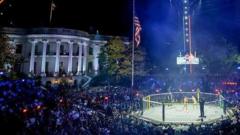
Large-scale public events represent a dense concentration of human, financial, and reputational capital, making them highly attractive targets for coordinated disruptions. The recent conspiracy involving eight individuals targeting a Ultimate Fighting Championship (UFC) event near the White House exposes a critical vulnerability in modern event security architectures: the gap between tactical perimeter defense and decentralized, multi-actor threat vectors. To secure these environments, operational leadership must move past reactive perimeter-checking and adopt a proactive threat-modeling framework that treats security as an integrated, multi-layered system.
The failure to disrupt plots during the planning phase stems from a fundamental misunderstanding of how modern conspiracies operate. Security teams routinely optimize for localized, single-actor incidents—such as an isolated gate-crasher or a lone agitator—while remaining structurally blind to distributed networks that leverage coordinated logistics. Analyzing this threat requires breaking down the operation into three distinct variables: threat vector distribution, operational velocity, and systemic friction. Also making waves lately: The Geopolitical Theater of Iranian Deterrence Why Full-Scale Defense is a Calculated Bluff.
The Triad of Event Vulnerability
Every high-profile gathering operates within a fixed physical and digital envelope. When an adversarial group plans an attack within this space, their success depends on exploiting three systemic vulnerabilities.
1. Vector Distribution
Traditional security models rely on a hard perimeter. This assumes that threats originate outside a defined boundary and must cross a specific checkpoint to cause harm. A coordinated conspiracy involving eight individuals invalidates this assumption by distributing the threat across multiple points of entry, communication channels, and physical locations simultaneously. More details into this topic are explored by NBC News.
If three actors focus on digital disruption, two on diversionary tactics outside the perimeter, and three on penetrating the venue itself, the security apparatus experiences cognitive overload. The network creates a distributed attack surface that forces the command center to divide its attention and resources, diluting the effectiveness of the response.
2. Operational Velocity
The speed at which a threat transitions from coordination to execution is operational velocity. In cases involving multiple co-conspirators, digital communication platforms allow for real-time tactical adjustments. If a security checkpoint hardens, the threat actors can reroute instantly. Standard venue security protocols move at bureaucratic speeds, requiring supervisor approvals and radio escalations. This asymmetry in decision-making speed allows adversaries to out-maneuver traditional security personnel.
3. Systemic Friction
Large public venues are highly complex logistical ecosystems involving third-party vendors, ticketing staff, local law enforcement, federal agencies, and private security contractors. This fragmentation creates systemic friction. Information silos naturally develop. When eight individuals coordinate an attack, they look for these exact communication gaps—the spaces where a private security guard fails to report a minor anomaly to federal handlers because the radio frequencies are unlinked or the chain of command is unclear.
The Threat Lifecycle Framework
To counter distributed conspiracies, security analysts must map the adversarial progression through a strict lifecycle framework. Disruption is most cost-effective and successful when executed during the earliest phases of this cycle.
[Phase 1: Reconnaissance] ──> [Phase 2: Logistics] ──> [Phase 3: Staging] ──> [Phase 4: Execution]
Phase 1: Reconnaissance and Surveillance
Before any physical action occurs, the network gathers intelligence on the venue. For a UFC event near the White House, this involves mapping both the physical architecture of the arena and the broader municipal security footprint. Adversaries analyze camera blind spots, shift-change intervals for security personnel, and the placement of physical barriers.
- The Detection Gap: Traditional security rarely flags reconnaissance because it looks like normal public behavior—individuals taking photos, loitering near exits, or attending minor events at the venue to test entry protocols.
- The Countermeasure: Operational teams must deploy counter-surveillance assets. This involves assigning personnel specifically to monitor the crowd for repetitive, non-standard behaviors rather than looking for overt threats.
Phase 2: Logistical Coordination
A conspiracy involving eight people requires significant logistical synchronization. This includes acquiring materials, securing transportation, establishing off-site staging areas, and setting up encrypted communication channels.
The primary barrier for law enforcement and private intelligence in this phase is data fragmentation. Digital signatures are often buried in massive volumes of benign traffic. Disruption during this phase relies heavily on federal intelligence intervention, cross-agency data sharing, and behavioral pattern analysis across local transit and lodging networks near the venue.
Phase 3: Staging and Perimeter Approach
During the staging phase, the threat transitions from a conceptual risk to an imminent physical danger. The actors position themselves around the asset. In the White House UFC event scenario, the proximity to high-security government zones introduces an extra layer of complexity. The physical footprint of municipal law enforcement overlaps with private venue security, creating a buffer zone that is often poorly managed.
The critical vulnerability here is the "diversion vector." A multi-actor group will frequently sacrifice one or two members to create a loud, non-lethal disturbance at a western checkpoint, drawing quick-reaction forces away from the eastern entrance where the primary breach is planned.
Quantifying the Security Cost Function
Venues cannot deploy infinite resources. Security design is ultimately an optimization problem balancing risk mitigation against operational cost and patron throughput. The efficiency of a security system can be evaluated through a distinct cost function:
$$C_s = (P_f \times L_c) + R_o + F_p$$
Where:
- $C_s$ is the total cost of the security architecture.
- $P_f$ is the probability of a successful security failure.
- $L_c$ is the total cost of a catastrophic breach (financial, human, reputational).
- $R_o$ is the operational cost of running the security apparatus (personnel, technology).
- $F_p$ is the friction introduced to the patron experience (delayed entry, invasive screening).
Many venue operators make the mistake of trying to minimize $R_o$ and $F_p$ without understanding how sharply that increases $P_f$ when facing a sophisticated multi-actor threat. When dealing with eight coordinated conspirators, $P_f$ scales non-linearly if the venue relies solely on basic metal detectors and undertrained event staff.
Structural Bottlenecks in Joint Task Force Operations
When an incident occurs near high-profile locations like the White House, the response involves private security, local police, and federal agencies. While this multi-agency presence offers massive resources, it introduces significant structural bottlenecks.
The first bottleneck is jurisdictional ambiguity. When a threat actor moves from a public sidewalk (municipal or federal jurisdiction) to the interior of a private arena (private security jurisdiction), the rules of engagement and data sharing change instantly. Who owns the threat profile at the moment of transition? If private security spots a suspicious individual tracking perimeter gates but that individual remains on a public sidewalk, the private guard lacks detention authority and often fails to pass that data to federal law enforcement in a structured format.
The second bottleneck is technological incompatibility. Radio networks frequently operate on completely different bands, meaning real-time tactical updates must be funneled through a central dispatch liaison rather than flowing directly between field agents. This delay creates a window of operational latitude that a coordinated group can exploit.
Strategic Reconfiguration of Venue Defense
Defeating a multi-actor conspiracy requires shifting from a static defense mindset to a dynamic intelligence-led framework. Venue operators and security directors must implement three specific structural changes immediately.
Implement Dynamic Perimeter Layering
The single hard perimeter must be replaced with a three-tiered zone system:
- The Outer Intelligence Zone: Extending several blocks outside the venue. This zone relies on visible counter-surveillance, automated license plate readers, and real-time monitoring of local transit data to flag anomalies before individuals reach the venue gates.
- The Tactical Buffer Zone: The immediate exterior of the venue where crowds gather to enter. This area must be monitored by mobile, plainclothes behavior detection teams trained to identify coordinated movements, counter-surveillance tracking, and staging behaviors among multiple individuals.
- The Kinetic Exclusion Zone: The physical turnstiles and interior gates. This layer must be reserved exclusively for rapid, high-throughput technical screening (biometrics, advanced weapons detection systems), freeing up human personnel to focus on behavioral anomalies rather than manual bag checks.
Establish a Unified Command Structure
Prior to any high-profile event, a Joint Operations Center (JOC) must be established with direct, unmediated communication channels between private security leadership, municipal police command, and federal intelligence liaisons. All data feeds—including CCTV, automated alarms, and field reports—must clear through a single analytical unit capable of correlating isolated incidents across different zones of the arena. If Gate A reports a minor distraction and Gate C notes a non-functional camera, the JOC must instantly synthesize these data points as a potential coordinated penetration attempt.
Run Adversarial Red Teaming Simulations
Security plans are often validated through checklist audits rather than realistic testing. To truly prepare for an eight-person conspiracy, venues must employ professional red teams to simulate distributed attacks. These simulations must specifically test the communication links between agencies, the response times of quick-reaction forces during a multi-point breach, and the ability of field staff to identify diversionary tactics. The data gathered from these stress tests should be used to dynamically update the security cost function, ensuring resources are directed toward fixing proven vulnerabilities rather than funding visible but ineffective security theater.