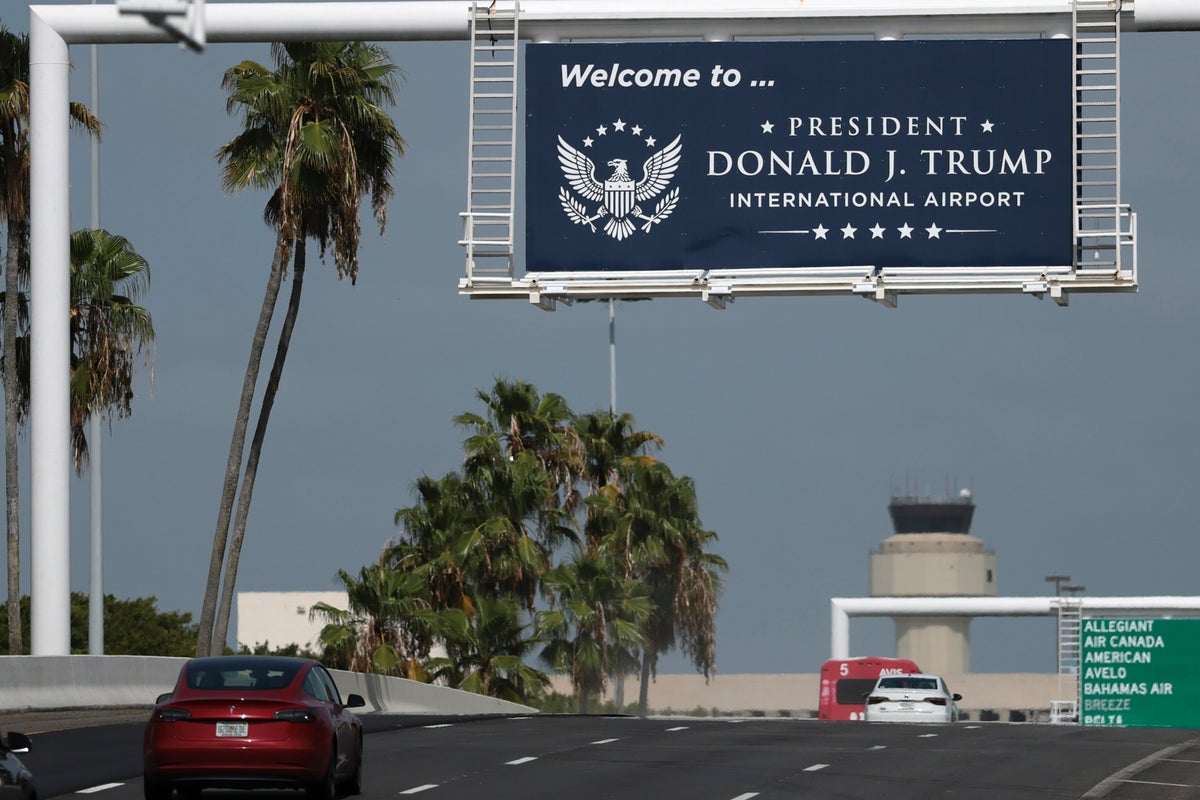
The breakdown in internal communications at United Airlines regarding the renaming of Palm Beach International Airport (PBI) to President Donald J. Trump International Airport (DJT) exposes a structural friction within legacy carrier operations. When a leaked internal memorandum instructed customer reservation agents to exercise "empowerment" to accommodate passengers objecting to the facility's new name, it created an immediate misalignment with the airline's official contract of carriage. This operational friction is not merely an isolated public relations incident; it is a case study in how decentralized employee autonomy can inadvertently disrupt revenue management frameworks and systemic fare structures during highly politicized infrastructure transitions.
The core vulnerability lies at the intersection of brand neutrality, front-line customer service discretion, and algorithmic inventory pricing. By analyzing the structural mechanics of this miscommunication, carriers can better understand the risks inherent in using subjective employee discretion to solve systemic, macro-environmental changes.
The Mechanics of Operational Empowerment Versus Policy Standard
Modern airline service frameworks frequently prioritize customer-facing autonomy to resolve localized friction points. Front-line agents are trained to use a concept known inside legacy carriers as "empowerment guidelines"—pre-approved variances from standard operating procedures designed to de-escalate customer friction without requiring supervisory intervention.
The structural flaw occurs when these localized guidelines are applied to macro-level geopolitical or infrastructural shifts. In the case of the South Florida airport transition, the internal advisory explicitly suggested that if a passenger expressed an objection to landing at the newly renamed facility, agents could process an even exchange to nearby hubs like Fort Lauderdale-Hollywood International Airport (FLL) or Miami International Airport (MIA).
This directive created an immediate logical conflict with the industry-standard contract of carriage. Airlines operate under rigid legal agreements that dictate exactly when a ticket can be modified without a fare difference. These criteria are strictly bounded:
- Involuntary Changes: Triggered by weather anomalies, air traffic control constraints, structural maintenance issues, or carrier-initiated schedule alterations exceeding a specific time threshold (typically 60 to 120 minutes).
- Voluntary Changes: Initiated by the passenger under standard fare rules, which, while increasingly free of flat change fees on standard economy tickets, still mandate the collection of any applicable fare differences between the original itinerary and the new routing.
By instructing agents to treat a subjective political objection as a trigger for an even exchange, the internal memo effectively reclassified a voluntary change as an involuntary one. This structural misstep circumvented the revenue management software designed to protect high-yield inventory at co-terminal airports.
The Economic Cost Function of Multi-Airport Co-Terminal Swaps
The operational suggestion that agents could freely reroute passengers from West Palm Beach to Fort Lauderdale or Miami overlooks the economic asymmetric reality of South Florida's aviation market. Within network planning models, these three airports do not exist as interchangeable nodes; they operate on entirely different cost functions, yield structures, and capacity constraints.
Yield Asymmetry and Inventory Protection
United Airlines operates highly specific schedule frequencies across the South Florida basin. While the carrier maintains roughly a dozen daily direct flights to the newly named facility in Palm Beach County, its footprint expands significantly at Fort Lauderdale, where it operates roughly 30 daily direct frequencies. Miami operates under a separate international-heavy hub dynamic.
When an internal policy permits an unpenalized, even-exchange swap across these distinct hubs, it disrupts the pricing algorithms that dictate network seat valuation. The demand curve for a flight into Miami or Fort Lauderdale is decoupled from the demand curve into Palm Beach. Miami flights frequently command a premium due to international connections, while Fort Lauderdale serves as a high-density, low-yield point-to-point battleground.
Allowing front-line agents to manually override these fare differentials introduces an unquantified risk to the carrier’s passenger mile yields. A customer who purchased a lower-cost ticket to Palm Beach could systematically exploit the name-change controversy to bypass the premium pricing of a Miami or Fort Lauderdale arrival, driving down the carrier’s overall revenue per available seat mile (RASM).
Operational Displacement Costs
Beyond pure ticket revenue, the physical displacement of passengers across co-terminal regions creates secondary operational bottlenecks.
- Baggage Logistics: Passengers routing through alternative hubs disrupt the predicted weight and balance metrics calculated hours before departure, particularly on regional feeder aircraft operating out of secondary stations.
- Ground Infrastructure Strain: Rerouting passengers to FLL or MIA increases the load factor on stations that may already be operating at peak gate capacity during high-demand scheduling blocks.
- Customer Misalignment: South Florida geography dictates significant travel times between these hubs. Fort Lauderdale sits approximately 45 miles south of West Palm Beach, while Miami is over 70 miles south. A customer taking an even exchange out of political protest face severe ground transportation costs, creating a secondary wave of customer dissatisfaction that front-line service teams must eventually resolve.
Systemic Vulnerabilities in GDS and IATA Code Transitions
The operational confusion inside United Airlines was further compounded by the technical reality of updating global distribution systems (GDS) and industry nomenclature. The transition of the airport name from Palm Beach International to President Donald J. Trump International Airport involves a multi-phased technical overhaul that challenges legacy software architectures.
The transition requires updates across major platforms including Sabre, Amadeus, and Travelport. Under state legislation signed by Florida Governor Ron DeSantis, the legal name change took effect on July 9, but the underlying International Air Transport Association (IATA) location code transition is structured as a dual-phase rollout. The historical identifier remains active for existing systems, while the new three-letter code—scheduled to transition to DJT on August 18—must be systematically integrated into reservations, baggage-routing infrastructure, and scheduling databases.
During this multi-week interim window, front-line agents must navigate an environment where internal flight manifests, external customer-facing applications, and Federal Aviation Administration (FAA) navigational charts are temporarily desynchronized.
This technical gap explains the genesis of the poorly worded internal memo. As airlines trained staff to handle passenger confusion regarding the shifting codes on ticketing kiosks and luggage tags, internal communications teams conflated technical clarity with policy leniency. In an attempt to give agents the tools to handle customer confusion over whether a ticket labeled with the old identifier was still valid for the newly named airport, the phrasing inadvertently authorized agents to rewrite the fundamental rules of ticket exchangeability.
Mitigating Geopolitical Risk in Civil Infrastructure Branding
The controversy underscores a growing operational challenge for corporate enterprises: the weaponization of public infrastructure naming conventions by political entities, and the subsequent consumer polarization that follows. When a municipality or state legislature rebrands a major transportation hub after a polarizing figure, the airline operating within that hub is forced into a defensive positioning strategy.
The strategic play for a legacy carrier requires absolute decoupling from the political nature of the infrastructure. The carrier does not control the naming rights of municipal or state-owned facilities. The financial burden of the renaming—estimated at approximately $5.5 million for physical infrastructure, highway exits, and signage updates—is borne by the state and the airport authority, not the airlines.
Consequently, any attempt by an airline to create specific, localized policy exemptions based on the identity of an airport's namesake sets a dangerous operational precedent. If a carrier allows free destination changes due to a political name change in Florida, it logically must extend the same courtesy to travelers objecting to airports named after controversial historical or political figures globally. This would introduce an unmanageable layer of subjectivity into automated reservation systems.
Strategic Realignment Protocols for Internal Policy Distribution
To prevent localized customer service directives from undermining global revenue integrity during sensitive infrastructure transitions, legacy carriers must implement rigid policy governance frameworks. The United Airlines incident demonstrates that corporate communications cannot be detached from revenue management parameters.
The primary solution involves the enforcement of an absolute separation between customer empathy and financial transaction authorization. Front-line staff must be provided with communication scripts that validate user confusion or frustration without offering monetary or structural compensation that violates the contract of carriage.
When navigating future municipal rebrandings, corporate governance teams must route all internal advisories through a tripartite review panel consisting of representatives from legal compliance, network revenue management, and corporate communications. This ensures that any phrase utilizing terms like "agent empowerment" is strictly bounded by pre-existing financial cost functions, preserving both the brand’s neutrality and its bottom-line efficiency. The final operational play is not to restrict employee autonomy, but to ensure that autonomy is governed by automated structural boundaries within the GDS itself, eliminating the risk of human misinterpretation at the reservation desk.



:max_bytes(150000):strip_icc():focal(999x0:1001x2)/taylor-swift-albums-1-93026ca98408417097660e117a10a6a9.jpg)