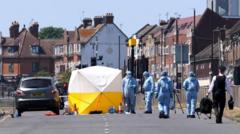
Metropolitan critical incident management relies on a deterministic race between suspect egress velocity and law enforcement containment density. When a weapon-enabled assault occurs within a high-density urban sector, such as West London, the operational objective shifts instantly from preventative policing to a multi-tiered containment protocol. The efficacy of this transition dictates the probability of suspect apprehension and the preservation of perishable forensic material.
The immediate aftermath of a public stabbing exposes the structural vulnerabilities of urban infrastructure. Success is measured in minutes, dictated by three independent operational variables: notification latency, first-responder transit velocity, and cordon initialization mechanics.
The Three Pillars of Real-Time Incident Triage
The operational response to an active homicide investigation demands the immediate synchronization of distinct municipal systems. Failures in any single pillar compounding exponentially over time.
1. Telemetric Ingestion and Dispatch Triangulation
The latency between the initial kinetic event and the arrival of the first emergency chassis on-scene is governed by the efficiency of emergency services routing. In high-density environments, emergency calls provide fragmented data. Dispatch centers utilize automated location identification alongside real-time cellular triangulation to isolate the geolocational coordinates of the event. The deployment architecture relies on a strict priority matrix, ranking active weapon deployment at the absolute peak of resource allocation.
2. Spatial Containment and Perimeter Vectoring
The secondary phase requires the establishment of concentric isolation zones. The inner perimeter seals the immediate locus of the violence to halt the degradation of physical evidence, including biological matter and discarded weaponry. The outer perimeter serves an apprehension function, establishing a dragnet designed to intercept individuals matching suspect profiles based on eyewitness closed-circuit television telemetry.
3. Tactical Asset Saturation
Simultaneously, specialized units—including canine components, armed response vehicles, and air support assets—are deployed to suppress the suspect’s operational freedom. The objective is to deny access to high-velocity transit nodes, such as underground rail networks or major arterial roadways, which would exponentially expand the required search radius.
The Velocity Friction Function in Suspect Egress
Suspect escape dynamics can be modeled as an expanding geographic radius where the total searchable area increases as a function of time squared. Urban topography introduces friction that alters this ideal geometric expansion.
The structural density of West London introduces specific physical bottlenecks. Pedestrianized corridors, complex residential layouts, and public transport access points function as high-probability egress vectors. Law enforcement agencies counter this expansion by utilizing a predictive deployment matrix. By analyzing historical flight paths and immediate spatial barriers, command structures deploy interception assets at predicted intersection points rather than chasing the suspect from the point of origin.
The primary impediment to suspect egress in a heavily monitored urban environment is the saturation of public and private surveillance networks. Modern metropolitan centers feature dense closed-circuit television infrastructure. The operational challenge is not a lack of visual data, but the processing latency inherent in human monitoring. Control rooms must rapidly ingest raw video feeds, apply algorithmic filtering or manual review, and relay actionable descriptions to ground units. A delay of 120 seconds in feed analysis permits a suspect on foot to establish a search radius of approximately 300 meters in any direction, creating a geometric compounding of the asset density required to guarantee interception.
Forensic Triage and Cordon Mechanics
The integrity of a homicide prosecution rests entirely on the execution of forensic isolation within the opening sixty minutes of the incident. This phase is characterized by a conflict between life-saving medical intervention and evidence preservation.
[Incident Occurrence]
       │
       ▼
[Emergency Medical Intervention] ──► Potential Forensic Degradation
       │
       ▼
[Inner Perimeter Cordon Placed] ──► Isolation of Biological Evidence
       │
       ▼
[Systematic Scene Mapping] ──► Digital and Physical Logging
First-responding officers face the immediate necessity of clearing a path for London Ambulance Service or London's Air Ambulance personnel. The physical movement of medical technicians, stretchers, and specialized trauma equipment inherently alters the scene geometry. Footprints are overlaid, biological fluids are displaced, and clothing layers containing vital trace evidence—such as defensive wounds or weapon fiber transfers—are routinely severed and discarded during emergency resuscitation efforts.
To mitigate this systematic degradation, forensic managers enforce strict scene logging protocols the moment life-saving efforts conclude or the victim is pronounced deceased. The protocol demands:
- The establishment of a single point of entry and egress for all authorized personnel to prevent cross-contamination.
- The immediate deployment of physical tents to protect biological material from environmental weathering, particularly precipitation or wind-driven particulate matter.
- The comprehensive digital mapping of the scene using three-dimensional laser scanners to preserve the exact spatial orientation of all evidence prior to physical collection.
The discovery of discarded weaponry requires specific recovery mechanics. Sharp force trauma incidents frequently result in the perpetrator discarding the weapon within a short radius of the assault due to panic or the physical difficulty of concealing a blood-slicked object. These items are treated as high-priority vectors for both touch deoxyribonucleic acid (DNA) and friction ridge analysis. The recovery process utilizes localized chemical stabilization on-site before the object is sealed in specialized secure containers to prevent any friction-induced loss of cellular material during transport to the laboratory.
The Attrition Function of Metropolitan Resource Deployment
Executing a murder arrest following an urban stabbing incurs a massive administrative and operational cost function that strains municipal policing budgets. A single critical incident requires the immediate diversion of dozens of units from proactive policing duties to static containment roles.
The fiscal and labor allocation of a homicide response follows a steep curve. The initial 24 hours demand continuous, non-linear asset utilization.
- Initial Response Units: Up to 30 frontline officers required for immediate cordon maintenance, traffic diversion, and localized door-to-door canvassing.
- Specialist Investigative Teams: Deployment of specialized homicide commands consisting of detective inspectors, family liaison officers, and digital forensic analysts.
- Surveillance Asset Allocation: Continuous operation of remote monitoring suites, involving dedicated personnel cross-referencing feeds across multiple municipal jurisdictions.
This structural redirection of labor creates an operational bottleneck elsewhere in the municipal framework. Low-priority calls are delayed, proactive traffic enforcement ceases, and community-level policing initiatives are suspended. The broader operational impact is a localized spike in response times for non-critical incidents across the adjacent sectors, as assets are drawn into the gravitational pull of the homicide investigation.
The long-term resource drain is governed by the duration of the scene hold. A complex forensic environment in a public space may require a total freeze on local commerce and transit for multiple days. The economic friction imposed on local businesses and residents serves as an externalized cost of the criminal act, compounding the total societal impact of the event.
Systemic Limitations of Modern Urban Containment Architecture
Despite sophisticated tracking systems and dedicated forensic teams, structural vulnerabilities persist within the current municipal defense framework. Understanding these failure modes is essential for developing next-generation response strategies.
The first vulnerability is the data silo existing between disparate surveillance systems. While public transport networks and local council cameras feed into central command hubs, thousands of privately owned commercial and residential security cameras remain completely isolated. Accessing these private data streams requires manual intervention, physical transit by officers to the location, and the voluntary cooperation or legal coercion of the property owners. This creates an unmitigated latency layer during the critical early hours of an investigation when the suspect's trajectory is being calculated.
The second limitation involves the physiological and psychological boundaries of eyewitness testimonies collected under acute stress. Initial descriptions of suspects provided by bystanders are statistically unreliable, frequently exhibiting contradictions regarding clothing coloration, height, and route of flight. When command structures rely on flawed human observations to calibrate their outer perimeters, interception assets are routinely misallocated, allowing the target to bypass containment lines entirely.
Strategic Allocation Shifts in Metropolitan Policing
Optimizing the response framework requires transitioning from a reactive, perimeter-based model to an automated, predictive interception matrix. The integration of high-density sensor networks with automated threat-detection software offers a path toward eliminating human-induced latency.
The immediate integration of audio acoustic sensors capable of identifying the distinct signatures of physical altercations or distress vocalizations could bypass the notification latency of telephone systems. If localized camera arrays were programmed to automatically orient toward the source of acoustic anomalies, central command would receive high-resolution visual telemetry of the suspect prior to the arrival of first responders.
The tactical play for metropolitan forces involves deploying automated drone interception assets stationed on municipal rooftops. Upon a critical incident trigger, these aerial units can achieve overwatch velocity significantly faster than ground vehicles navigating congested urban traffic grids. By maintaining continuous visual tracking of an fleeing suspect from an elevated vector, the requirement for expansive, resource-intensive physical cordons is mitigated, preserving police labor and minimizing the economic disruption imposed on the urban infrastructure.