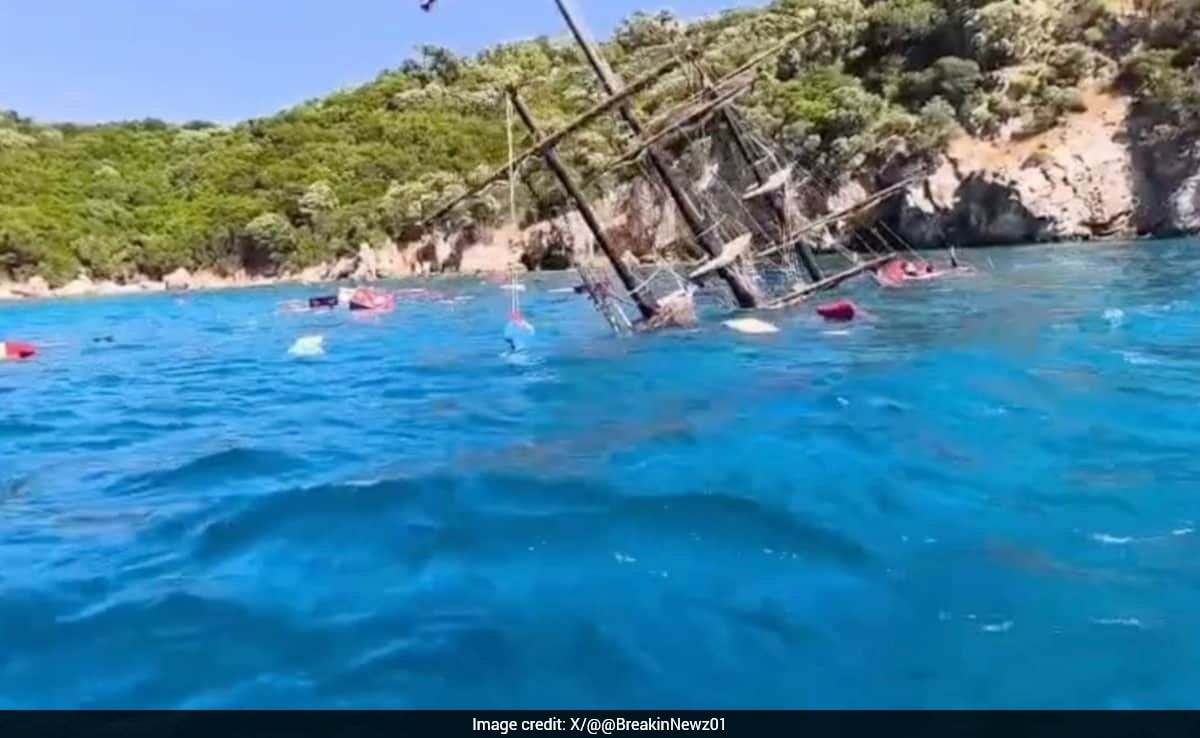
Commercial maritime day-trips operate on thin margins dictated by high fixed capital costs and highly seasonal demand. In competitive tourist hubs like the Turkish Riviera, this economic pressure frequently manifests as a dangerous optimization problem: maximizing passenger throughput while minimizing operational overhead. When a themed excursion vessel carrying 148 passengers sinks near the coastline, public narratives focus on the immediate panic. A structural analysis, however, reveals that such disasters are rarely the result of a isolated freak occurrence. Instead, they are the predictable output of a systemic failure cascade involving vessel stability mechanics, passenger-to-crew ratios, and regulatory enforcement arbitrage.
Understanding the failure mechanics of commercial tourist vessels requires moving past sensationalized reporting and analyzing the operational bottlenecks, physical vectors, and behavioral economics that turn a standard coastal cruise into a mass rescue operation.
The Mechanics of Transverse Instability
The primary physical vector in the sinking of any shallow-draft excursion vessel—often stylized as "pirate ships"—is the rapid compromise of transverse stability. These vessels are frequently modified wooden or fiberglass-sheathed hulls, retrofitted with multi-deck superstructure extensions to maximize passenger capacity per square meter of deck space. This architectural modification fundamentally alters the vessel's vertical center of gravity ($KG$).
To understand why a vessel capsizes or takes on water rapidly, we must examine the relationship between the center of gravity and the metacenter ($M$). The distance between these two points, known as the metacentric height ($GM$), serves as the primary metric of a vessel’s initial stability. The fundamental formula governing the righting lever ($GZ$), which is the horizontal distance between the center of gravity and the center of buoyancy ($B$) as the ship heels, is expressed as:
$$GZ = GM \cdot \sin\theta$$
Where $\theta$ represents the angle of heel. In multi-deck tourist vessels, two variables actively degrade this righting mechanism:
- Elevated Initial KG: Building multiple decorative decks shifts the center of gravity upward. As $KG$ increases, the initial metacentric height ($GM$) shrinks. A smaller $GM$ means the vessel possesses a weaker inherent capacity to return to an upright position when acted upon by external forces like waves or localized weight shifts.
- The Passenger Dynamic Load Factor: Unlike static cargo, 148 human passengers represent a fluid, highly reactive mass. If a vessel experiences an initial list due to a minor mechanical failure, localized flooding, or a sharp turn, passengers instinctively rush to the opposite side or toward the exit points. This collective movement causes a massive, instantaneous shift in the transverse center of gravity ($TCG$), introducing a severe heeling moment that can easily exceed the remaining righting energy of the hull.
When the vessel's deck edge becomes submerged due to this shifting weight, a critical threshold is crossed. The water plane area decreases drastically, causing the metacenter to drop rapidly, resulting in a negative $GM$ and irreversible capsizing.
The Operational Failure Cascade
Vessels operating in high-density tourism zones like Alanya or Antalya face specific operational vulnerabilities that complicate basic maritime safety protocols. A standard sinking event can be broken down into three distinct operational phases, each governed by specific failure points.
Phase 1: The Ingress Trigger
The initial compromise of hull integrity typically stems from two distinct vectors: propulsion mechanical failure or structural impact. In shallow coastal waters, operators frequently navigate close to rock formations or reefs to provide scenic value. A failure in the steering gear or a sudden loss of engine power eliminates the vessel's steerageway—its ability to navigate effectively through water. Without propulsion, the vessel becomes subject to the forces of the current and waves, exposing its vulnerable broadside to the surf zone and risking grounding or hull fracturing against the seabed.
Phase 2: The Crew-to-Passenger Bottleneck
The commercial viability of low-cost day cruises relies on minimizing labor costs. Consequently, these vessels often operate at the absolute minimum legal manning requirement. While a crew of five to eight individuals may suffice for standard navigation, docking, and hospitality duties, that number is mathematically insufficient during an emergency involving 148 untrained, panicked civilians.
The crew-to-passenger ratio creates an immediate information bottleneck. In a crisis, a small crew cannot simultaneously locate the source of water ingress, maintain engine room operations, broadcast distress signals, distribute life jackets, and manage crowd control across multiple decks. The lack of structured command execution leads to a total breakdown in orderly evacuation procedures, forcing passengers to make uncoordinated, high-risk decisions, such as jumping directly into the sea without flotation devices.
Phase 3: The Localized Rescue Network Response
When a vessel sinks near the shore, the official coast guard response time is frequently bypassed by the immediate intervention of nearby civilian craft. Parasailing boats, jet skis, and neighboring excursion vessels form an ad-hoc primary rescue flotilla.
While this localized network prevents immediate mass drowning, it introduces secondary risks. Small pleasure craft lack the freeboard and stability to safely pull dozens of wet, panicked individuals out of the water simultaneously. Overloading rescue craft can easily trigger secondary capsizing events, expanding the scope of the initial incident.
Regulatory Arbitrage and Compliance Gaps
The persistence of maritime incidents in popular coastal tourism regions highlights a systemic gap between statutory international maritime law and localized enforcement realities. Large commercial vessels are strictly bound by the International Convention for the Safety of Life at Sea (SOLAS). Small-scale domestic excursion vessels, however, generally fall under national jurisdictions, which frequently utilize modified, less stringent compliance frameworks.
This regulatory environment creates opportunities for operational arbitrage:
- Intermittent Inspections vs. Continuous Degradation: Hull maintenance on wooden or hybrid vessels requires regular dry-docking to identify structural rot, fastening failures, and marine borer damage. When inspections occur on a predictable, annualized basis, operators can temporarily patch structural deficiencies to pass certification, allowing the vessel to operate in a degraded state during peak revenue months.
- Discrepancy in Capacity Rating Metrics: Passenger capacity limits are calculated based on static weight assumptions that often fail to account for modern realities, such as the increased average weight of passengers or the additional weight of fuel, water, and heavy decorative themes. A vessel certified for 150 passengers may technically float within safe draft lines in calm water, but its safety margins vanish when subjected to dynamic sea states.
- The "Safety Culture" Deficit: In seasonal tourism businesses, crew turnover is exceptionally high. Many deckhands are seasonal workers without formal maritime academy training or long-term career investment in safety protocols. Drills for fire, flooding, and abandonment are frequently treated as administrative checkboxes rather than rigorous operational requirements.
Strategic Mitigations for Coastal Tour Operators
Resolving the structural safety deficits inherent in the coastal excursion industry requires a shift from reactive emergency management to proactive risk mitigation. Operators looking to protect their capital investments and insulate themselves from catastrophic liability must implement rigorous operational protocols.
Implement Continuous Stability Monitoring
Operators should move away from relying solely on static, out-of-date stability booklets. Installing digital inclinometers connected to bridge alert systems provides real-time data on the vessel’s rolling period and permanent list. A lengthening of the vessel’s rolling period indicates a drop in $GM$, serving as an early warning to the captain that bilge water accumulation or passenger distribution has compromised the vessel's stability before visual cues become apparent.
Restructure Crew Training via Scenario-Based Mandates
Crew training must be decoupled from basic compliance and tied to specific operational thresholds. Survival craft management and crowd control training should be conducted on the actual vessel under simulated high-stress conditions, such as total electrical failure or localized deck flooding. Every crew member must have a clearly defined, redundant role in the emergency muster list, ensuring that if one individual is cut off or incapacitated, another automatically assumes responsibility for that evacuation sector.
Establish Hard Red Lines for Environmental and Operational Limits
The decision to sail must be governed by an objective matrix of environmental conditions rather than commercial pressure to fulfill bookings. This matrix should define explicit cut-off points based on:
- Significant wave height relative to the vessel's freeboard.
- Concurrently forecasted wind speeds that could induce a permanent aerodynamic heel.
- Real-time passenger load factors, reducing maximum allowed capacity by fixed percentages when operating in adverse weather conditions.
By formalizing these parameters into standard operating procedures, operators remove subjectivity and commercial duress from the captain's decision-making process, ensuring that safety margins remain intact throughout the charter season.