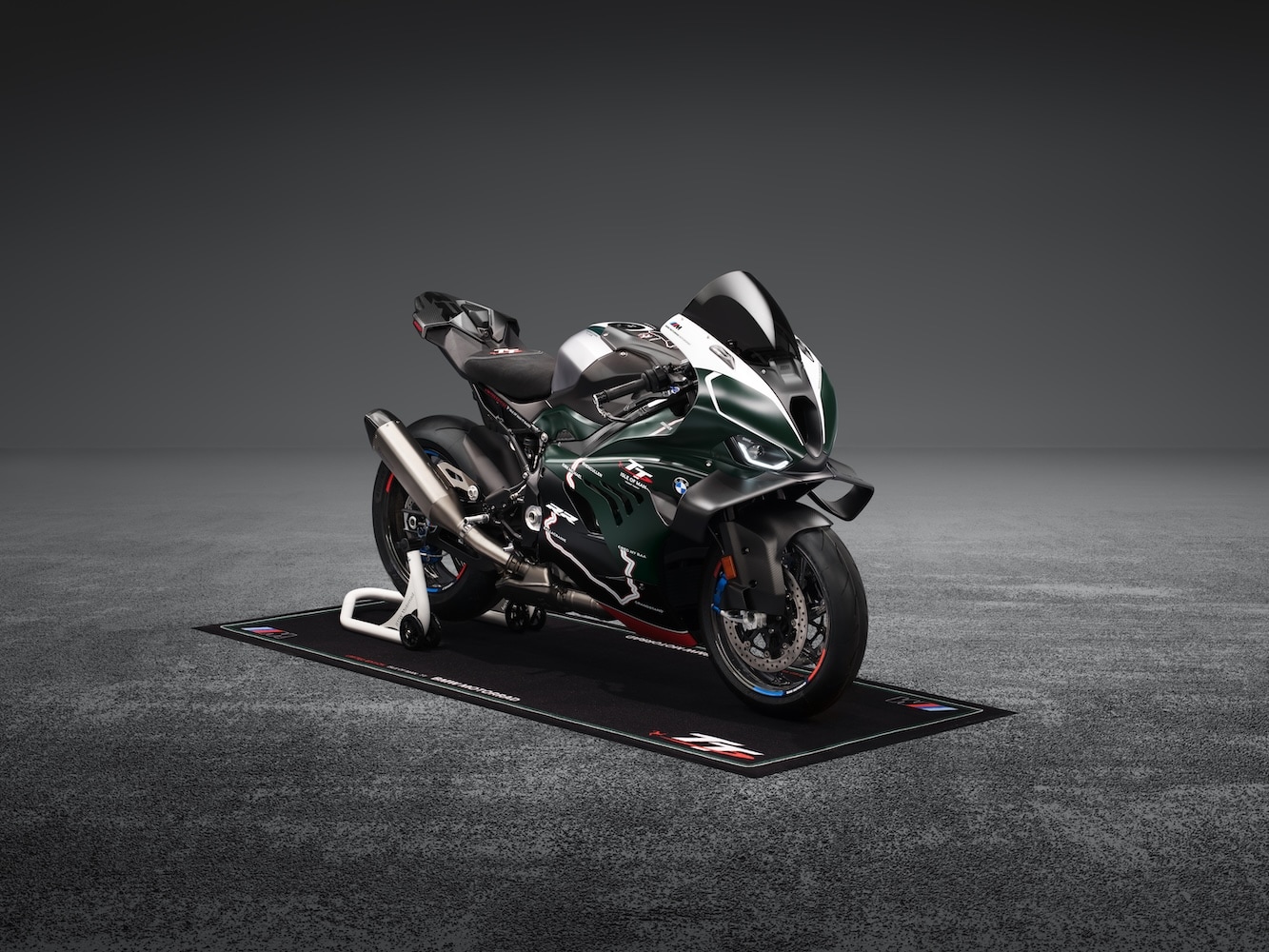
Engineering a motorcycle capable of sustaining a 314 km/h terminal velocity on a closed circuit is a routine exercise in modern aerodynamics. Engineering that same platform to survive the vertical compressions, crown shifts, and literal airborne trajectories of the Isle of Man's 37.73-mile Mountain Course requires an entirely different mathematical calculus.
BMW Motorrad’s release of the M 1000 RR Isle of Man TT Edition—capped at exactly 115 units globally to mirror the 115th anniversary of the historic event—is more than a marketing exercise in scarcity. It represents a strict optimization problem: balancing mechanical thermal limits against aerodynamic drag, and high-frequency chassis damping against predictable tire contact patches. Understanding how this machine operates at its 314 km/h threshold requires deconstructing its powertrain architecture, fluid dynamics, and micro-transaction electronics under extreme mechanical strain.
The Powertrain Equation: ShiftCam Mechanics and Thermal Management
The core propulsion unit of the Isle of Man TT Edition is a heavily revised 999cc liquid- and oil-cooled inline-four engine, a powerplant structurally tied to BMW's World Superbike (WorldSBK) efforts. To extract a peak output of 218 horsepower while maintaining structural integrity over prolonged high-rpm duty cycles, the engine relies on a bifurcated valve actuation architecture known as BMW ShiftCam technology.
The Variable Valve Blueprint
The ShiftCam mechanism utilizes a segment-shifting structural sleeve on the intake camshaft, featuring two distinct cam lobes for each valve: a partial-load cam and a full-load cam.
- Partial-Load Cam Geometry: Optimizes gas velocity, vortex formulation, and fuel atomization at lower engine speeds, maximizing mid-range torque density.
- Full-Load Cam Geometry: Actuates via an electromagnetic actuator shifting the camshaft axially at high RPMs, introducing aggressive valve lift profiles and extended duration to maximize volumetric efficiency up to a 15,100 rpm redline.
Low-RPM:  [Partial-Load Cam Lobe] -> Shorter Lift / High Velocity Fuel Mix
                                 |  (Axial Camshift Transition via Actuator)
High-RPM: [Full-Load Cam Lobe]    -> Maximum Lift / High Volume Intakes
This mechanical variation prevents the historic bottleneck of high-performance engines, where top-end horsepower gains directly compromise low-end driveability. Coming out of slow, tight apexes like the Ramsey Hairpin, the engine delivers immediate, linear torque (113 Nm at 11,100 rpm) before transitioning to peak volumetric flow on the high-speed Sulby Straight.
Reworked Internals and Compression Metrics
Sustaining 218 horsepower from a sub-one-liter displacement architecture requires severe reduction of internal parasitic drag and reciprocating mass. The top end features optimized cylinder head geometries, oval-shaped intake ports, and polished combustion chambers that elevate the compression ratio to a brutal 14.5:1.
The valvetrain uses lightweight titanium valves actuated by slim, DLC-coated (Diamond-Like Carbon) rocker arms. The pistons are forged 2-ring components engineered to withstand immense inertial forces, connected to titanium connecting rods manufactured by Pankl. This reduction in internal mass allows the engine to spin up with minimal rotational inertia, reducing the gyroscopic resistance of the crankshaft during high-speed directional transitions.
Aerodynamic Drag vs. Downforce: The Fluid Dynamics of 314 km/h
At speeds exceeding 300 km/h, atmospheric air ceases to feel like a gas and begins acting like a high-density fluid. The power required to overcome aerodynamic drag increases cubically with velocity ($P \propto v^3$). Therefore, raising the top speed of the M 1000 RR from its historical 306 km/h ceiling to its verified 314 km/h limit required a total re-evaluation of its drag coefficient ($C_d$) paired with an aggressive downforce generation matrix.
The Winglets Evolution 3.0 Framework
The prominent M Carbon Winglets mounted to the front fairing are not stylistic accents; they are highly calculated inverted aerofoils designed to solve a fundamental physics problem: high-speed front-end lift.
Velocity (v) ---> [ Inverted Carbon Winglet ] ---> Generates up to 30 kg Downforce
                               |
            Translates to: Heavy Front-Wheel Load
                           Reduced Anti-Wheelie Electronic Intervention
                           Continuous Power Delivery to Tarmac
As air passes over the winglets, it creates a massive localized pressure differential. At a reference speed of 300 km/h, these surfaces generate up to 30 kg of mechanical downforce directed squarely through the front axle. This payload serves a multi-layered functional purpose:
- Suppression of Dynamic Wheelies: Under hard acceleration, the front tire naturally wants to break contact with the tarmac. The downforce counters this pitch moment mechanically.
- Reduced Electronic Interventions: By utilizing physics rather than electronics to keep the front wheel grounded, the onboard IMU (Inertial Measurement Unit) does not need to pull ignition timing or cut fuel to maintain chassis stability. Full power reaches the rear tire for longer durations.
- High-Speed Cornering Stability: Unlike standard aerodynamic configurations that lose efficiency during lateral roll, the Winglets Evolution 3.0 are contoured to maintain downforce even at steep lean angles, anchoring the front contact patch when tracking through sweeping bends.
Wind Management and Thermal Extraction
The front fairing support is a monolithic carbon fiber structure designed to support a tall, optically corrected windscreen. This high profile creates an expansive aerodynamic bubble for the rider, reducing high-frequency helmet buffeting and lowering the rider's physical fatigue metrics during sustained high-speed operations.
Integrated directly below the nose are specialized M Brake Ducts. These channels capture high-pressure ambient air at the front boundary layer and route it over the blue-anodized M four-piston radial calipers. This continuous fluid-cooling circuit drops internal brake pad and fluid temperatures under heavy deceleration, preventing the hydraulic lever fade that occurs when transitioning rapidly from 314 km/h down to double-digit cornering speeds.
Kinematics and Micro-Transaction Electronics: The Chassis Infrastructure
A rigid frame at low speed becomes a dangerous resonance transmitter at high speed. The M 1000 RR Isle of Man TT Edition employs a cast aluminum bridge frame architecture that uses the engine as a stressed load-bearing member. This design is engineered for optimized lateral flexibility alongside immense longitudinal stiffness.
Variable Geometry and Mass Reduction
Unladen, fully fueled, and road-ready, the motorcycle weighs 194 kg. Minimizing unsprung and rotational mass is achieved through standard-fit M Carbon wheels. By moving mass away from the perimeter of the wheel assembly, the rotational inertia is deeply mitigated. This creates two distinct performance advantages:
- Accelerated Velocity Change: The engine requires less torque to break the rotational inertia of the wheel, resulting in sharper throttle response and faster deceleration metrics under braking.
- Minimized Gyroscopic Precession: A spinning wheel acts as a gyroscope, resisting directional changes. The lightweight carbon construction lowers this resistance, allowing the rider to flick the bike into a corner with significantly less physical input at the handlebars.
The Micro-Transaction Electronic Suite
Managing 218 horsepower on public-road topography requires a high-frequency sensor ecosystem running calculations in milliseconds. At the center of this infrastructure is a 6-axis IMU working alongside a newly integrated steering angle sensor. This hardware layer powers two critical vehicle dynamic systems:
- Brake Slide Assist: When entering a corner on the brakes, the system monitors front and rear wheel speeds alongside the steering angle. It allows a precisely calculated amount of rear-wheel drift (lateral slip) before modulating the ABS intervention, allowing professional racers to back the machine into corners safely.
- Slip-Slide Control: Operating within the Dynamic Traction Control (DTC) architecture, this system differentiates between pure wheel-spin and lateral chassis slide. If the rear tire steps out while accelerating out of a bend, the computer calculates the exact slide angle relative to speed and lean angle, allowing the rider to maintain a controlled slide without provoking a violent high-side crash.
To ensure immediate access to this power band, the traditional throttle assembly has been replaced by a 58-degree M Quick-Action Throttle. By compressing the rotational path from 72 degrees down to 58, the physical wrist rotation required to hit wide-open throttle is drastically reduced, ensuring instantaneous access to the full-load cam profile on corner exit.
Limited Production Economics: Scarcity as an Engineering Valuator
The decision to limit production of this specific variant to 115 units operates at the intersection of brand equity and high-tier collectibility economics. In the premium automotive and motorcycle sectors, ultra-limited editions perform an essential dual function: they serve as technology showcases while operating as appreciating assets for collectors.
Collector Package Packaging Architecture
| Exclusive Asset | Functional Utility |
|---|---|
| British Racing Green Uni Matte Paint | Unique visual indicator distinguishing the model from standard production units. |
| Satin Chrome Fuel Tank Finish | Highly specialized treatment reducing surface glare while adding distinct physical aesthetics. |
| Mountain Course Topography Graphics | Historical and physical link directly honoring the Isle of Man course geography. |
| Individually Serialized Certification | Verifiable origin documentation validating long-term asset value in the secondary market. |
| M Track Equipment Pack | Includes a dedicated race cover kit, custom paddock mats, and rear wheelstands. |
This collection of physical additions, combined with the mechanical upgrades carried over from the standard M 1000 RR platform, positions the vehicle outside standard depreciation curves. Because production is restricted to 115 worldwide, the target demographic is divided cleanly between elite track day practitioners demanding turn-key performance and high-net-worth preservation collectors who view the machine as an alternative asset class.
Strategic Play: Evaluating the Acquisition Profile
For riders and collectors assessing the acquisition of an M 1000 RR Isle of Man TT Edition, the purchasing decision must be evaluated through a clear dual-use framework. This machine is not a multi-purpose tool; it is a highly specialized instrument designed for a narrow operating window.
                    [ INVESTOR ARCHETYPE EVALUATION ]
                                    |
            -------------------------------------------------
            |                                               |
[ Track Day Practitioner ]                      [ Asset Preservation Collector ]
            |                                               |
- Requires 218 hp limits.                        - Requires immediate climate control.
- Utilizes 30 kg downforce.                      - Capitalizes on 115-unit scarcity.
- Capitalizes on sub-200kg agility.             - Avoids mileage accumulation to preserve value.
If the primary objective is pure track day performance without an interest in historical curation, the standard production M 1000 RR offers a more pragmatic financial path. The baseline model provides the identical 218 hp engine architecture, advanced aerodynamics, and high-frequency electronic suite without the premium associated with historical exclusivity.
Conversely, if the objective is asset appreciation backed by legitimate mechanical pedigree, the Isle of Man TT Edition represents a highly defensible allocation of capital. The 115-unit threshold ensures long-term insulation from market saturation. To preserve the vehicle's underlying value, the asset must be maintained in a climate-controlled environment with zero fluid degradation or mileage accumulation, effectively transitioning from an instrument of extreme sports technology into a preserved monument of internal combustion engineering.