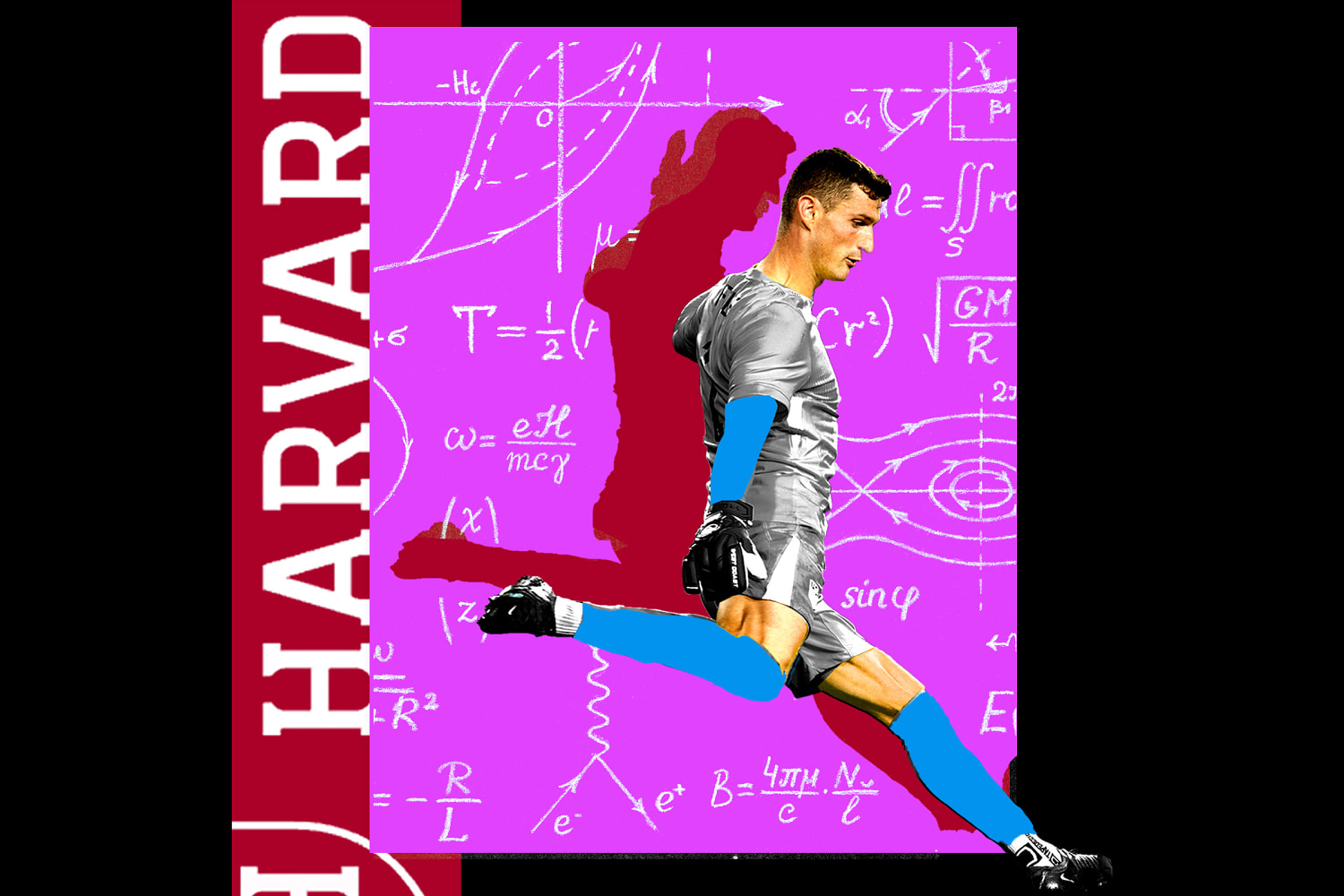
The romanticized narrative of the scholar-athlete finding sudden, inexplicable glory on the global sports stage is an artifact of lazy journalism. When media outlets profile United States Men’s National Team (USMNT) goalkeeper Matt Freese ahead of the 2026 FIFA World Cup, they frame his status as a Harvard economics graduate as an eccentric anomaly—a charming juxtaposition between elite academia and elite athletic performance. This superficial treatment obscures the structural optimization occurring beneath the surface of American soccer infrastructure.
Freese is not a triumph of intellect over system. He is the product of a highly calculated dual-track developmental framework that solves a fundamental flaw in the traditional European academy model: the complete correlation between athletic failure and socioeconomic ruin. Analyzing the mechanics of this collegiate-to-professional pathway reveals exactly why an Ivy League foundation yields specific, measurable competitive advantages at the highest levels of international football.
The Strategic Framework of Dual-Track Development
The traditional global soccer apparatus forces a binary choice at age 16. Elite prospects enter club academies full-time, effectively abandoning comprehensive formal education. While this maximizes immediate technical training hours, it introduces catastrophic downside risk. Statistical baselines indicate that fewer than 1% of academy players secure long-term professional contracts. The European model operates on an extractive labor strategy, leaving the remaining 99% with depreciated human capital and limited economic mobility.
In contrast, the American model utilizes the university system to manage this risk profile through a distinct portfolio strategy. By distributing the institutional risk across both professional club academies (such as the Philadelphia Union academy, where Freese trained) and NCAA institutions, the player's personal cost function shifts.
The Career Risk Mitigation Equation
The structural stability of this model can be mathematically conceptualized by comparing the lifetime expected utility ($EU$) of an asset (the player) under both systems:
$$EU_{Academy} = P(S) \cdot U(W_{Elite}) + [1 - P(S)] \cdot U(W_{Unskilled})$$
$$EU_{Collegiate} = P(S) \cdot U(W_{Elite}) + [1 - P(S)] \cdot U(W_{Skilled})$$
Where:
- $P(S)$ represents the razor-thin probability of achieving an elite, sustainable professional career.
- $W_{Elite}$ is the financial compensation at the top professional tier.
- $W_{Unskilled}$ represents the depressed wage floor for an individual exiting an academy without alternative qualifications.
- $W_{Skilled}$ represents the high-indexed earning potential of an Ivy League economics degree.
By significantly increasing the value of the downside outcome ($W_{Skilled} \gg W_{Unskilled}$), the collegiate model eliminates the psychological desperation that frequently stifles player development. Freese completed his degree at Harvard while simultaneously maintaining status on the roster of Major League Soccer (MLS) side Philadelphia Union. This did not divide his focus; it established an absolute psychological baseline. A player who does not rely on soccer for basic economic survival is structurally insulated from the performance anxiety that paralyzes young athletes during high-stakes competitive transitions.
The Tactical Allocation of Goalkeeping Assets
The specific position of goalkeeper demands a cognitive load that aligns precisely with analytical academic training. Unlike outfield players whose performance metrics are heavily weighted toward raw physiological outputs—VO2 max, linear acceleration, and muscular endurance—the modern goalkeeper operates primarily as an in-game data processor.
Cognitive Load and Spatial Data Processing
Under national team head coach Mauricio Pochettino, the USMNT utilizes a tactical system dependent on building possession out from the defensive third. This requires the goalkeeper to execute complex distribution sequences under intense opposing press structures. The goalkeeper is no longer merely a shot-stopper; they are the deep-lying playmaker of the first phase of build-up.
- Spatial Assessment: The goalkeeper must calculate real-time vectors of oncoming attackers, measuring the velocity of the press against the passing lanes of descending midfielders.
- Risk Appraisal: Every pass out from the back carries an inherent turnover risk. An analytically trained mind is uniquely suited to process these probability matrices under intense time constraints.
- Defensive Organization: High-level goalkeeping requires dictating the positioning of the defensive line. Translating complex tactical instructions into clear, authoritative commands requires an advanced command of structural logic.
Freese’s 2024 MVP season with New York City FC and his subsequent performance in the 2025 Gold Cup—where he recorded 16 saves across six matches to lead the team to a second-place finish—demonstrate this cognitive efficiency. His profile reflects a player who manages the penalty area through predictive positioning rather than relying solely on reactive athleticism.
Structural Bottlenecks of the NCAA Pathway
It is analytically dishonest to present the Ivy League or broader collegiate pathway as a flawless system for elite soccer development. The model possesses fundamental structural limitations that prevent it from becoming the default pipeline for international talent.
The Training Hour Deficit
The primary limitation of the collegiate model is the severe restriction on deliberate practice hours imposed by governing bodies. NCAA regulations strictly limit organized team training outside of the brief autumn competitive season.
| Metric | European/MLS Academy Model | NCAA / Ivy League Model |
|---|---|---|
| Annual Competitive Matches | 40 – 50 matches | 15 – 20 matches |
| Weekly Training Hours | 20 – 25 hours | 20 hours (capped during season) |
| Off-Season Continuity | High (Structured year-round) | Low (Severe instructional limits) |
| Age of Professional Debut | 17 – 19 years old | 21 – 23 years old |
This discrepancy creates an acute development bottleneck. Outfield players who require maximum micro-technical refinement during their peak developmental windows (ages 18 to 21) cannot afford this deficit. The missing developmental hours explain why the vast majority of elite international outfield assets bypass university altogether.
The goalkeeping position, however, scales differently across time. Goalkeepers typically hit their competitive primes much later than outfield players—often between the ages of 27 and 32. The immediate loss of training hours at age 19 is less damaging because the career arc is prolonged. Freese's trajectory, moving from an All-Ivy selection in 2018 to a primary USMNT squad inclusion for the 2026 World Cup at age 27, tracks perfectly along this extended development curve.
The Financial Underpinnings of the National Program
The ascension of an Ivy League graduate to the upper echelon of the national team coincides with a massive capital restructuring within U.S. Soccer. The federation’s ability to recruit top-tier technical staff, headlined by the appointment of Pochettino, is directly tied to private philanthropic underwriting.
Pochettino’s reported $6 million salary is funded significantly by high-net-worth donors. This capital injection alters the selection criteria of the national program. It detaches the coaching staff from the historical, inward-looking biases of the domestic soccer apparatus. A manager with elite European experience evaluates a roster strictly through the lens of tactical utility and psychological resilience.
Within this cold evaluation framework, a player with Freese's profile becomes highly attractive. The selection of a disciplined, intellectually rigorous goalkeeper to stabilize a backline is a deliberate tactical choice, not a sentimental narrative.
The Strategic Projection for 2026
The USMNT's World Cup campaign in Los Angeles and across North America will serve as the ultimate stress test for this dual-track developmental thesis. The tournament demands unprecedented psychological durability due to the compounding pressure of playing on home soil.
The strategic deployment of Freese within the squad offers a distinct competitive advantage in tournament play. In knockout football, matches are decided by the minimization of catastrophic errors rather than the maximization of creative flair. Goalkeepers who over-index on athletic instinct are prone to positioning errors when fatigue or anxiety degrades their physical output. Conversely, an analytically insulated player relying on structured positional geometry maintains a highly stable performance floor.
The long-term play for American soccer infrastructure requires formalizing this hybrid pathway. Rather than treating collegiate success as a historical curiosity, MLS clubs and U.S. Soccer must actively integrate academic institutions into their academy webs. By building formalized pipelines that allow elite prospects to maintain high-level academic enrollment while training within professional club environments, the domestic game can systematically manufacture assets who possess both elite technical competencies and superior cognitive capabilities. This systematic integration is the only viable mechanism to consistently scale talent capable of challenging the entrenched soccer monopolies of Western Europe and South America.