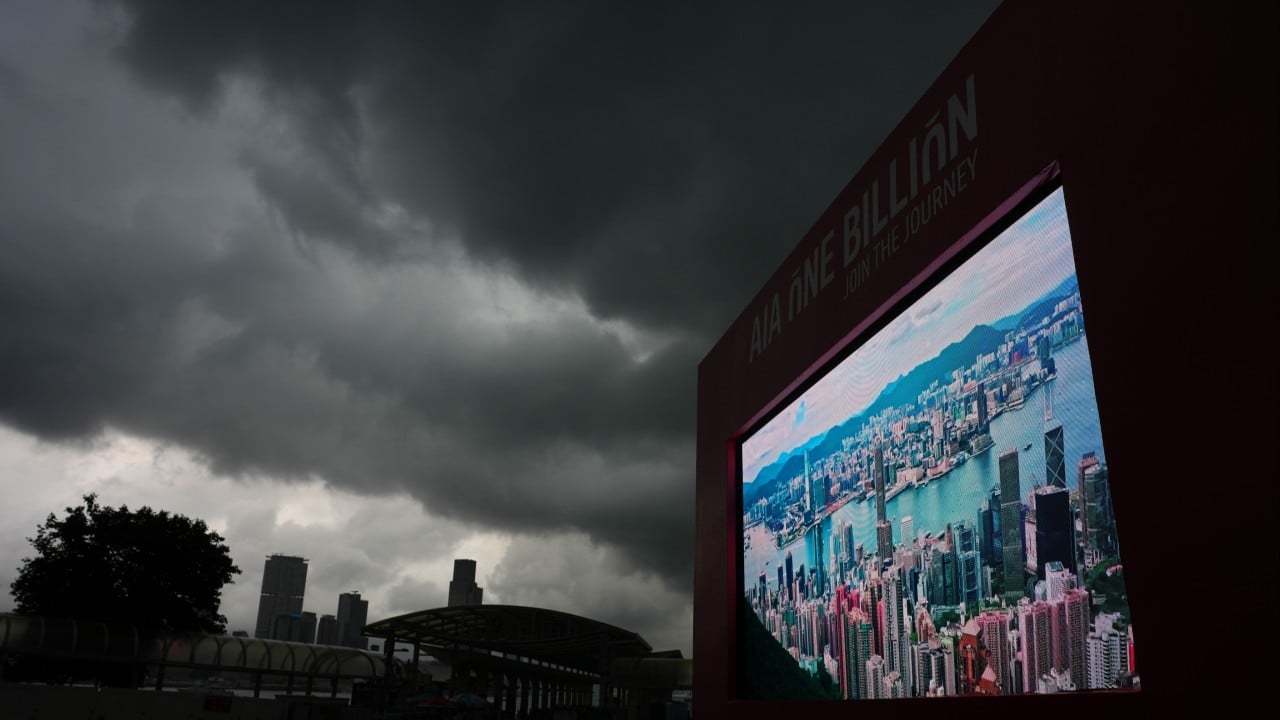
An Amber Rainstorm Warning Signal issued by the Hong Kong Observatory is not merely a weather advisory; it is a trigger for a highly coordinated, deterministic sequence of civil engineering and municipal risk management protocols. While public perception often treats the lowest tier of the three-level rainstorm system as a minor inconvenience, the operational reality dictates otherwise. The issuance of an Amber alert signifies that heavy rain has fallen or is expected to fall generally over Hong Kong, exceeding 30 millimeters in an hour, with the distinct probability of escalating into a systemic threat to urban infrastructure.
Understanding the mechanics of this system requires moving past simple meteorological metrics and examining the specific thresholds, systemic feedback loops, and economic mitigation strategies that govern Hong Kong’s response to extreme precipitation events.
The Tri-Threshold Precipitation Matrix
The Hong Kong Observatory (HKO) utilizes a color-coded hierarchy—Amber, Red, and Black—to communicate quantitative precipitation thresholds to the public and relevant government bureaus. This system functions as a progressive risk matrix based on localized rainfall intensity and the capacity of the city's drainage architecture.
- Amber Signal (Threshold: >30 mm/hour): This initial tier indicates that heavy rain is widespread or imminent. The critical operational variable here is the saturation level of the soil and the baseline capacity of stormwater systems. A 30 mm/hour downpour on dry terrain presents a different risk profile than the same volume falling on a fully saturated catchment area.
- Red Signal (Threshold: >50 mm/hour): At this level, rainfall intensity begins to outpace the natural and engineered drainage capacities of standard urban zones, leading to localized flooding in low-lying areas and traffic disruption.
- Black Signal (Threshold: >70 mm/hour): This represents a severe threat level where macroscopic urban failure occurs, necessitating the suspension of schools, stock market trading, and non-essential public services to prevent loss of life.
The primary limitation of this tri-threshold system lies in its reliance on area-wide averages versus hyper-local bursts. A convective cloud cell can stall over a specific micro-topography—such as the steep slopes of Hong Kong Island or the low-lying plains of Yuen Long—dropping 60 mm of rain within a confined watershed while the regional average remains below the 30 mm Amber threshold. Consequently, the HKO must balance empirical radar data with predictive modeling to issue warnings before localized flash flooding occurs.
The Hydrological Cost Function of Urban Density
Hong Kong’s geography presents a compounding risk structure. The combination of steep, mountainous terrain and high-density, concrete-paved urban coastal strips creates a highly efficient system for generating rapid surface runoff. When an Amber warning is active, the hydrological cost function of the city escalates along three distinct axes.
Slope Stability and Geotechnical Friction
The territory contains over 60,000 registered man-made slopes. Heavy rainfall rapidly increases pore water pressure within the soil matrix, reducing the effective shear strength of the slope. Under an Amber warning, the Geotechnical Engineering Office (GEO) initiates monitoring because the first 30 mm of hourly rainfall acts as a lubricating agent. If antecedent rainfall over the preceding days has already saturated the terrain, even a brief Amber-level event can serve as the tipping point for a catastrophic landslide.
Drainage Inflow vs. Tidal Backwater Effects
Hong Kong's urban drainage network relies on a combination of stormwater interception tunnels, underground storage tanks, and gravity-fed outfalls discharging into Victoria Harbour or the sea. During an Amber rainstorm, if the peak rainfall coincides with a high astronomical tide or a storm surge, a hydraulic bottleneck occurs. The high sea level creates a backwater effect, preventing gravity outfalls from discharging efficiently. The stormwater network then experiences pressurized pipe flow, leading to manhole push-outs and urban street flooding long before the 50 mm Red threshold is achieved.
Transport Network Throughput Degradation
The immediate casualty of an Amber rainstorm is the operational efficiency of the surface transit network. Reduced visibility and surface water accumulation alter the friction coefficient of road surfaces. This forces a systemic reduction in vehicular velocity, causing cascading gridlock across critical bottlenecks like the Cross-Harbour Tunnels. The economic cost of these delays accrues exponentially for every 15 minutes the rainstorm coincides with peak commuting hours.
Institutional Mitigation Protocols
The transition to an Amber status forces immediate, scripted operational shifts across multiple government departments and utility providers. These actions are governed by pre-established internal codes of practice designed to prevent localized issues from scaling into regional crises.
[HKO Issues Amber Warning]
       │
       ├──> Drainage Services Dept (DSD) ───> Deploys Emergency Clearance Teams
       ├──> Highways Department          ───> Monitors High-Risk Structural Assets
       └──> Home Affairs Department      ───> Activates Emergency Coordination Centers
The Drainage Services Department (DSD) activates its emergency control center and dispatches specialized clearance teams to known flooding blackspots. The primary objective is the immediate removal of debris, litter, and fallen leaves from gully gratings and intake structures. A blocked intake can reduce a storm drain's capacity by up to 80%, transforming an easily manageable Amber event into an artificial localized flood zone.
The Highways Department initiates targeted inspections of structural assets, focusing on underpasses and low-lying arterial roads equipped with mechanical pumping systems. These pumps must operate at peak efficiency to clear water from sub-surface roadways where gravity drainage is impossible.
The Home Affairs Department monitors the situation to determine if temporary shelters need to be readied, particularly for residents living in squatter huts or sub-standard rural housing in the New Territories, where structures are highly vulnerable to both rising waters and minor mudslides.
The Failure Modes of Predictive Meteorology
The HKO relies on a dense network of automatic weather stations, rain gauges, and dual-polarization Doppler weather radars to formulate its nowcasting models. Despite this advanced infrastructure, predicting the exact onset and spatial distribution of Amber-level rainstorms remains subject to significant epistemic uncertainty.
The first challenge is the rapid development of mesoscale convective systems. In the sub-tropical environment of the South China Sea, a localized convective cell can form, intensify, and drop 40 mm of rain within a 45-minute window. The time required to collect radar data, run predictive algorithms, verify the trend, and disseminate the warning to the public can sometimes exceed the lifecycle of the initial downpour. This latency results in "belated warnings," where the public receives the Amber notice after the heaviest downpour has already impacted the area.
The second limitation involves false-positive management. If the HKO issues warnings too conservatively based on marginal model outputs, it risks inducing warning fatigue among the population and local businesses. Conversely, under-calling an event leads to unmitigated damage and exposure to safety hazards. The operational mandate, therefore, prioritizes a risk-aversive approach based on real-time rainfall accumulation rates rather than purely predictive long-range models.
Strategic Operational Directives for Enterprise and Asset Management
For corporate entities, asset managers, and logistical operators in Hong Kong, an Amber Rainstorm Warning must not be viewed as a passive weather update, but rather as an operational signal to execute specific risk-mitigation plays.
Facilities managers must immediately verify the operational readiness of all sub-grade sump pumps and ensure that temporary flood barriers are staged near basement garage entrances and electrical switchrooms. Power distribution infrastructure located below sea level represents a single point of failure that can cripple an commercial asset for weeks if breached by muddy runoff.
Logistics and supply chain directors must implement dynamic rerouting. Given the predictable degradation of surface transport throughput during an Amber event, freight movements should be diverted away from known low-lying corridors in the New Territories and optimized around the mass transit rail network where infrastructure is largely insulated from surface weather dynamics.
The final strategic imperative involves managing human capital. Enterprises should utilize the window provided by an Amber warning to transition non-essential site personnel to remote work protocols or staggered dismissal schedules. Waiting for a formal escalation to a Red or Black signal ensures that staff will be caught in the systemic transport bottlenecks that invariably follow, destroying productivity and escalating corporate liability.