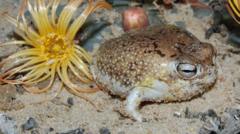
The conversion of viral internet visibility into quantifiable ecological preservation is an unproven mechanism. The case of the desert rain frog (Breviceps macrops), an endemic amphibian of the West Coast of South Africa and Namibia, illustrates a stark divergence between digital awareness and habitat equilibrium. Following a structural reassessment by the International Union for Conservation of Nature (IUCN) Red List, Breviceps macrops transitioned from Near Threatened to Vulnerable. This classification update is driven by measurable habitat destruction, infrastructural projects, and the downstream feedback loops of commercial exploitation.
The survival blueprint of Breviceps macrops relies entirely on a highly narrow, hyper-specific geographic band that makes it uniquely sensitive to industrial disturbance.
The Macro-Ecological Constraint Matrix
Breviceps macrops operates within an exceptionally tight spatial budget. The species is restricted to a narrow strip of coastal sand dunes within the Strandveld Succulent Karoo biome, extending no further than 10 kilometers inland from the high-water mark. This habitat is defined by a low surface-area-to-volume ratio adaptation, a vital physiological requirement for a fossorial amphibian surviving in an arid zone with less than 60 millimeters of annual precipitation.
The species bypasses the structural requirement for open standing water through two primary physiological mechanisms:
- Atmospheric Moisture Capture: The coastal fog belt of the Atlantic Ocean deposits fine condensation across the dune systems at night. This moisture penetrates the upper sand layers, establishing a subsurface equilibrium zone.
- Subsurface Hydration Access: Breviceps macrops utilizes specialized, paddle-like feet equipped with thick webbing to execute vertical burrowing. The frog descends between 10 and 27 centimeters below the dune surface to settle in a specific micro-environment where the sand retains enough moisture to be compressed by hand.
This localized distribution means that any physical disturbance to the topsoil profile completely breaks the hydric regulation loop that the species relies on to prevent lethal desiccation during daylight hours.
Industrial Interruption: The Three Vectors of Range Degradation
The primary driver of the population decline is the physical fragmentation of its 2,000-square-kilometer maximum range. This destruction operates via three distinct economic vectors.
+-----------------------------------------------------------------+
|               Vectors of Range Degradation                     |
+-----------------------------------------------------------------+
|  1. Open-Cast Strip Mining (Topsoil stripping & structural collapse)|
|  2. Green Energy Infrastructure (Spatial footprint of green H2) |
|  3. Linear Corridors & Tourism (Compaction via roads and ORVs)  |
+-----------------------------------------------------------------+
1. Open-Cast Strip Mining
The Namaqualand coast holds some of the world's highest-grade alluvial diamond deposits. Extraction requires the complete removal of the overburden, which clears out the native succulent shrub vegetation and disrupts the underlying stratigraphy of the sand dunes. When mining operations strip these layers, they destroy the underground moisture reservoirs. Even when companies attempt post-mining terrain contouring, the original soil density and moisture-retaining layers are altered, rendering the restored land unusable for fossorial burrowing.
2. Green Energy Infrastructure
Large-scale decarbonization projects introduce a new spatial conflict. Emerging green hydrogen production facilities and supporting coastal energy developments are projected to directly impact up to one-third of the frog's remaining range in South Africa, and up to two-thirds of its range in Namibia over the next two decades. The physical footprint of these facilities—clearing land for foundations, heavy equipment staging, and building desalination infrastructure—creates permanent geographic barriers across the species' historic range.
3. Linear Corridors and Recreational Compaction
The construction of access roads and the unregulated use of off-road vehicles (ORVs) across coastal dunes introduce a mechanical failure mode: soil compaction. Heavy vehicle traffic increases the bulk density of the sand, which blocks Breviceps macrops from burrowing effectively. Furthermore, these corridors break the continuity of the habitat, separating populations into smaller groups and stopping the genetic exchange needed to maintain long-term population health.
The Asymmetric Impact of Digital Exposure
The digital footprint of Breviceps macrops acts as an environmental stressor rather than a conservation catalyst. Viral videos showcasing the frog's high-pitched defensive vocalization—a sound produced by rapid air expulsion from its globose body during perceived predatory threats—have inadvertently driven market demand within the illicit exotic pet trade.
This dynamic introduces a distinct collection bottleneck. Because Breviceps macrops is highly localized, poachers can target specific, easily accessible coastal entry points like McDougall's Bay. This targeted collection pulls adult, breeding-age individuals from the wild, directly undermining the species' reproductive capacity.
Compounding the problem, the species has a highly sensitive reproductive cycle. It bypasses the free-swimming tadpole stage entirely, with eggs developing directly into fully formed froglets inside underground chambers. This biological trait means that any local drop in adult density cannot be quickly offset by massive larval survival spikes, making populations highly vulnerable to focused collection pressures.
Strategic Conservation Interventions
Reversing the current population decline requires moving away from broad, non-binding ecological goals and shifting toward legally enforceable, highly localized spatial protections.
The immediate priority must be the formal proclamation of the Orange River mouth at Alexander Bay as a strictly managed nature reserve. Establishing a protected geographic sanctuary that completely bans open-cast mining, heavy infrastructure development, and off-road vehicle access is the only reliable way to preserve the subsurface moisture profiles the species needs to survive.
Furthermore, mining companies operating within historic concession zones must shift their environmental rehabilitation metrics from basic surface greening to functional subsurface restoration. True habitat restoration requires verifying that rehabilitated dune sands match the original density, grain size distribution, and moisture retention capabilities of undisturbed soil profiles. Without these specific physical properties, surface-level replanting creates an ecological trap—appearing viable from above, but remaining completely uninhabitable for the specialized burrowing species below.