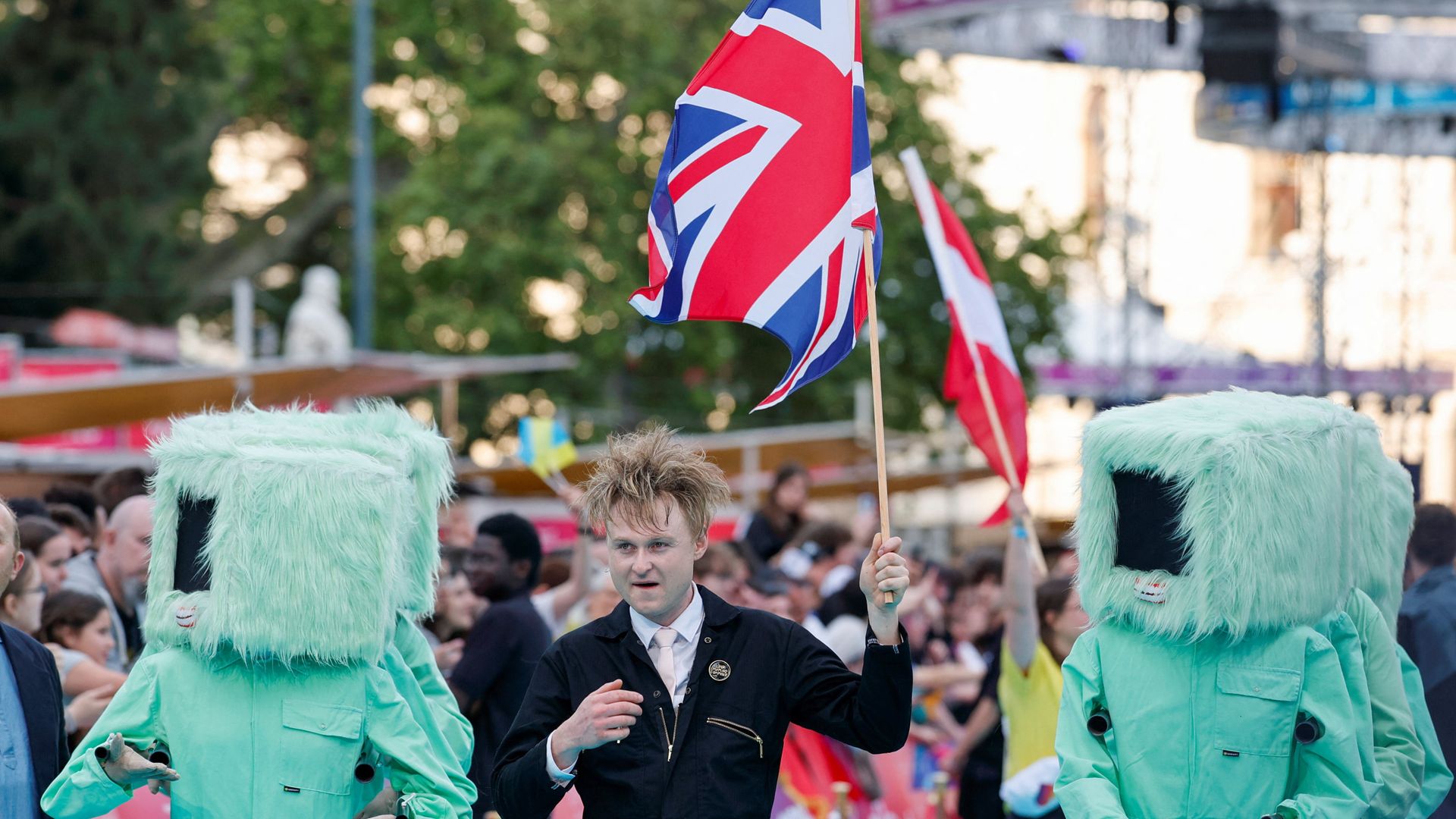
The United Kingdom’s selection of Sam Battle, performing under the moniker Look Mum No Computer, for the 2026 Eurovision Song Contest marks a deliberate structural shift from conventional pop orthodoxy to high-variance novelty branding. For a nation operating under a 29-year championship drought, the deployment of the synth-pop track Eins, Zwei, Drei represents an attempt to bypass traditional pop valuation metrics in favor of viral arbitrage and extreme tonal differentiation.
To analyze whether this operational pivot can succeed where standard industry formulas have repeatedly generated bottom-tier placement, the entry must be evaluated through a framework of cultural risk mitigation, production economics, and voter psychology.
The Strategic Failure of Low-Variance Pop
The UK’s historic underperformance across the last decade stems from a structural misallocation of creative capital. Broadcasters have historically favored low-variance, Radio 1-friendly pop tracks. The systemic flaw in this approach lies in the mechanics of the Eurovision voting model, which aggregates points from both professional national juries and the general public (televoting).
A competitive pop entry requires high-tier execution across three primary variables:
- Vocal Precision: Flawless live execution of demanding melodic runs.
- Production Sophistication: Contemporary studio tracking that translates to a massive arena sound system without sounding generic.
- Staging Narrative: Visual curation that looks premium and cinematic within a three-minute broadcast window.
When the UK deployed standard pop formulas—such as Mae Muller in 2023 or Olly Alexander in 2024—the entries suffered from a differentiation deficit. They competed directly in the same sonic category as highly optimized pop powerhouses from Sweden, Italy, and France, yet frequently lacked the staging budgets or the baseline live vocal execution to win direct comparisons. The result was a recurring position in the lower third of the leaderboard, culminating in the public voting public awarding zero points to Remember Monday in 2025.
The outlier to this trend was Sam Ryder’s second-place finish in 2022 with Space Man. That success was achieved by maximizing a specific cultural asset: high-register rock vocals built on classic British rock pastiche (reminiscent of Queen and Elton John). Instead of building on this high-vocal-capability framework, the selection of Look Mum No Computer moves the strategy toward an entirely different quadrant: the novelty/alternative axis.
The Mechanics of Leftfield Differentiation
By sending an experimental electronic artist who builds custom analog instruments out of obsolete hardware, the UK is executing a classic market differentiation strategy. Eins, Zwei, Drei abandons the traditional pop value proposition to target specific vectors:
The Novelty Arbitrage Vector
Eurovision televoting rewards immediate memorability over sustained artistic merit. In a field of 26 grand final performances, a track that rhymes "pepperoni" with "feeling okey-dokey" and layers a glam-rock glitter-beat over a modular synthesizer creates an intentional cognitive disruption. The track does not aim for broad-based consensus; it aims for intense pockets of high-volume voting from niche demographics.
The Authenticity Premium
A frequent point of friction for UK entries has been the perception of corporate manufacturing—the sense that a song was engineered by a committee to satisfy a broad European demographic. Battle’s established digital footprint—comprising 1.4 million subscribers and 85 million views built on genuine engineering eccentricities—functions as built-in proof of authenticity. This subverts the "manufactured pop" penalty often levied against the Big Five nations (the UK, Germany, France, Italy, and Spain), who bypass the semi-final elimination rounds through financial contribution.
Systemic Risks of the High-Variance Model
While a high-variance strategy creates a pathway to a high televote ceiling, it introduces severe structural downside risks, particularly regarding jury adjudication. The professional jury evaluation matrix weighs vocal capacity, composition quality, and overall international market viability.
Eins, Zwei, Drei presents clear vulnerabilities across these metrics:
- Vocal Ceiling: The track relies on spoken-word delivery, shouted hooks, and a post-punk vocal style modeled after Damon Albarn. This structural design offers minimal opportunities to showcase technical vocal range, meaning the entry is highly likely to face a severe points penalty from jury panels that prize traditional vocal capability.
- Compositional Simplicity: The song traded a traditional melodic hook for a rhythmic coda and a heavy synth hook. Juries evaluating the harmonic complexity of the composition are structurally inclined to score this low.
- Staging Overload: The presentation relies on a custom-built, highly complex "mega synth" aluminum circuit board rig. In live television production, increasing the technical complexity of staging hardware exponentially raises the probability of execution failure. If the audio mix fails to balance the live analog synthesizers with the backing tracks, or if the visual irony fails to translate to international audiences, the entry risks collapsing into uncoordinated noise.
The Mathematics of the Leaderboard
Betting markets and historical data structures suggest that the UK's strategy is a high-risk gamble with a low mathematical probability of an outright win. Bookmakers pricing the UK at odds as wide as 150/1 are calculating the entry’s structural inability to appeal to the jury side of the ledger.
To win the contest, an entry typically requires a balanced profile: a top-five finish in the jury vote combined with a top-five finish in the televote. A track optimized purely for eccentric televote appeal faces a hard mathematical ceiling. Even if the public vote delivers a surge of points from viewers charmed by the distinctly English eccentricity and retro-techno aesthetic, a near-zero return from the juries will anchor the entry to a mid-table finish.
The strategic pivot to Look Mum No Computer should therefore not be viewed as a precision-engineered bid for first place. Instead, it is a defensive repositioning designed to pull the UK out of the low-performing cycle of generic pop entries. By intentionally choosing a polarizing, avant-garde act, the broadcaster shifts the narrative from a failure of execution within mainstream pop to a deliberate, avant-garde artistic statement.
The ultimate metric of success for this entry will not be whether it breaks the 29-year championship drought, but whether its structural eccentricity can secure a reliable baseline of public televotes to insulate the nation from another bottom-of-the-board finish. If the technical execution holds under the pressures of live broadcast, the entry will provide a definitive test case for whether raw authenticity and aggressive differentiation can overcome the structural headwinds that face the United Kingdom on the modern Eurovision stage.