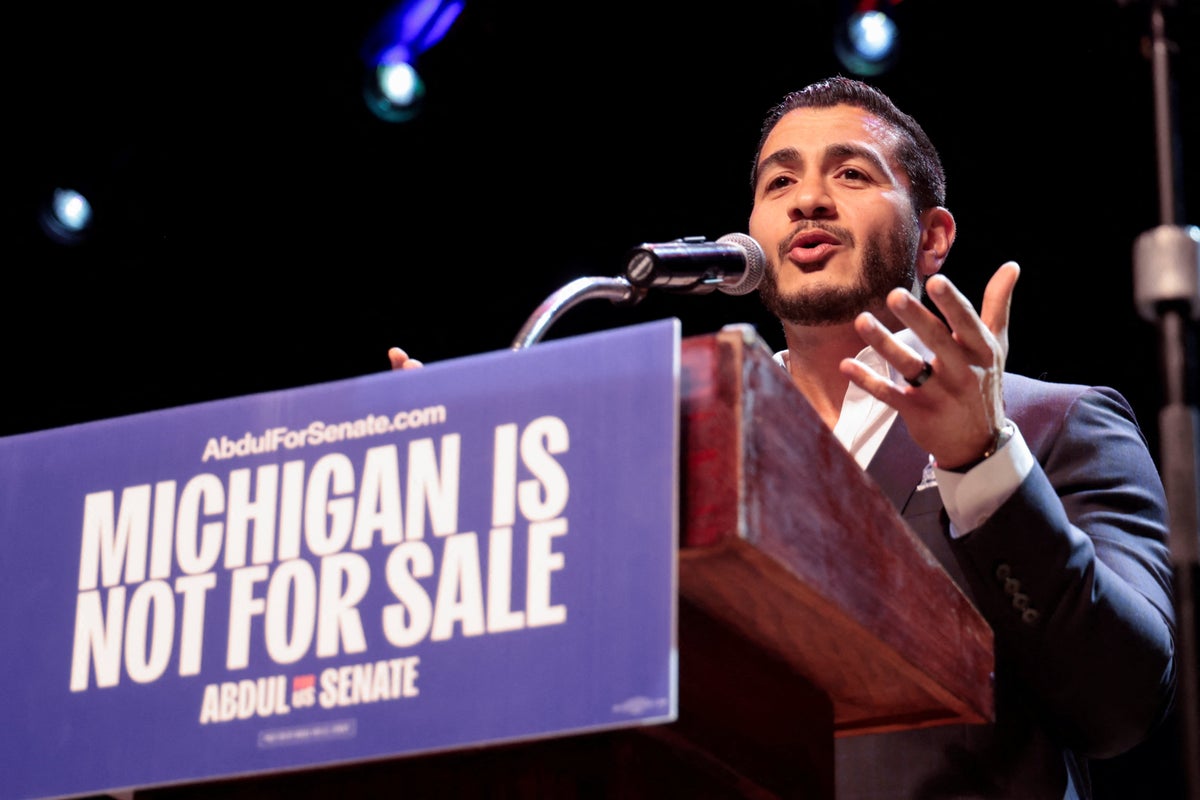
Political insurgents rarely scale competitive primaries without exploiting a structural misalignment between institutional party preferences and base-level economic anxiety. The 2026 Democratic United States Senate primary in Michigan serves as an empirical case study in this phenomenon. The contest pits Abdul El-Sayed, an epidemiologist and progressive public health administrator, against Haley Stevens, a four-term incumbent member of Congress backed by the institutional apparatus of the Democratic Party. Deconstructing this primary requires analyzing the mechanics of outsider campaigns, the role of asymmetric capital allocation, and the shifting fault lines of ideological alignment in the industrial Midwest.
The Cost Function of Institutional Entrenchment
Incumbent primary strategies rely on name recognition, institutional endorsements, and massive financial backing from aligned political action committees. In the Michigan primary, outside spending reached historic proportions, totaling tens of millions of dollars. The vast majority of this external capital favored the institutional candidate through coordinated media buys and broadcast saturation. Also making headlines recently: Inside the English Channel Migrant Boat Fire That Left Over 150 People Rescued.
This dynamic creates a specific cost function for the challenger. When an insurgent cannot match television ad impressions dollar-for-dollar, they must substitute paid media with earned media, ideological polarization, and grassroots network activation. El-Sayed bypassed traditional donor networks by framing institutional funding as evidence of regulatory capture. By rejecting corporate political action committee donations and challenging the financing models of establishment figures during high-profile debates, the campaign converted financial disadvantage into a populist asset.
The Public Health Framework of Political Economy
El-Sayed’s background as an epidemiologist and former executive director of both the Detroit Health Department and Wayne County's Department of Health, Human, and Veterans Services informs his core argument: macroeconomic precarity is a downstream effect of broken political systems. Rather than treating healthcare, housing, and labor rights as isolated legislative items, his platform organizes these issues into a single epidemiological variable. Additional insights on this are detailed by The Washington Post.
This model traces chronic illness and economic stagnation back to structural policy choices, such as corporate consolidation in healthcare markets and lax antitrust enforcement. By proposing systemic interventions like Medicare for All and wealth taxation on top earners, the campaign addresses a specific voter hypothesis: that incremental policy adjustments are insufficient to resolve structural inflation and declining purchasing power.
Asymmetric Fault Lines in the Industrial Electorate
Michigan represents a complex political geography where working-class voters swing across party lines based on economic protectionism and cultural positioning. The primary exposed deep fractures regarding foreign policy, corporate influence, and labor alignment.
The contest intensified divisions over U.S. foreign policy in the Middle East, particularly concerning Gaza. El-Sayed’s vocal criticism of current foreign assistance frameworks and alignment with progressive movement leaders galvanized a coalition of young voters, Arab-American constituents, and left-leaning urban factions. Conversely, institutional defenders emphasized traditional foreign policy alliances and pragmatic governance to secure moderate voter segments.
At the same time, institutional labor endorsements, such as support from the United Auto Workers, provided the insurgent campaign with essential operational credibility. This union backing neutralized the traditional establishment argument that progressive candidates cannot secure blue-collar industrial support.
The Mechanics of Primary Volatility
Polling volatility throughout the primary cycle demonstrated the friction between institutional safety and populist disruption. While moderate voters favored candidates perceived as safe general election options against Republican opponents, insurgent momentum capitalized on deep-seated frustration with the status quo.
The primary mechanics hinged on turnout distribution across key counties. High turnout in dense, progressive-leaning university towns and diverse urban centers counterbalanced suburban strongholds loyal to the congressional incumbent. When external spending attempts to overwhelm a localized insurgency, the survival of the challenger depends entirely on the intensity of ideological loyalty rather than passive brand awareness.
Target precincts must maximize ground-game mobilization to offset broadcast disadvantages. Operational resources should prioritize peer-to-peer digital organizing and direct voter contact in high-density sympathetic wards to neutralize television saturation by opposing political action committees.