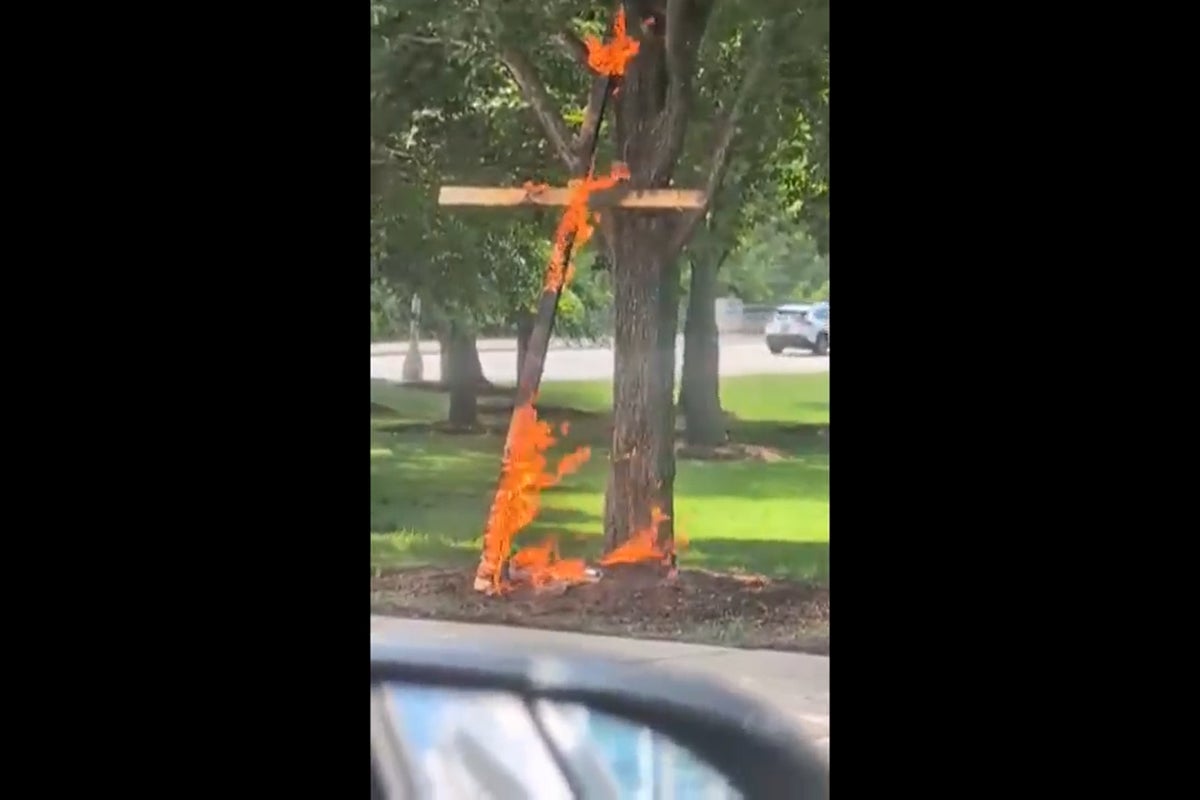
The friction between subjective intent and systemic visual impact forms the core bottleneck in modern speech adjudication. When a 21-year-old college student ignited a six-foot wooden cross in Chicago's Grant Park on June 9, 2026, the act triggered an immediate municipal crisis. It also exposed a profound analytical gap between individual ideological literacy and the legal architecture governing public intimidation. The suspect, captured on security footage and subsequently taken into custody by the Chicago Police Department, publically disclaimed racial animus. The individual asserted that the installation—topped with a red Make America Great Again (MAGA) hat—was an anti-establishment protest targeting Christian nationalists and corporate elites rather than an effort to threaten Black Americans.
This dynamic reveals an analytical breakdown where a perpetrator attempts to decouple a historically saturated instrument of terror from its foundational context. In public square security, the legal, sociological, and operational realities of such incidents must be evaluated through objective frameworks rather than the stated intent of the actor.
The Dual-Axiom Framework of Semiochemical Terrorism
To understand why the municipal response to this incident was swift and severe, the act must be analyzed through two distinct operational frameworks: spatial symbolism and semantic capture.
Spatial Symbolism
The choice of geography shifts an act from a localized disturbance to a broad public threat. Grant Park is not a neutral coordinate. It serves as the physical site where Barack Obama delivered his 2008 presidential acceptance speech as the first Black president of the United States.
Deploying an instrument of racial terror at this exact geographic location establishes a compounding effect. The space amplifies the symbol, and the symbol targets the historical significance of the space. The psychological impact on a community is calculated as a function of the historical weight of the venue multiplied by the severity of the icon utilized.
Semantic Capture
The Ku Klux Klan spent over a century establishing the burning cross as an explicit declaration of impending violence and racial supremacy. This long-term branding creates a monopoly on meaning. Legally and sociologically, a burning cross cannot be repurposed by an individual actor to signify a completely separate political grievance. The historical signal density of the object overrides any contemporary modifications, such as the addition of political headwear.
The disconnect between these variables can be mapped to evaluate how an act is processed by the public and by law enforcement:
- The Intent Vector: Private ideology governed by the actor's personal knowledge base, localized political motives, and a self-reported absence of racial animus.
- The Transmission Vector: The physical properties of the act, including a six-foot wooden structure, combustible accelerants, high-visibility public placement, and deliberate cross-assembly.
- The Impact Vector: Collective trauma, historical memory trigger, municipal deployment costs, and widespread public insecurity.
The student’s defense relies on an asymmetric assumption: that the Intent Vector dictates the legality of the Impact Vector. In constitutional law and criminal sociology, the Transmission Vector almost entirely supersedes private intent when the symbol used carries an objective history of physical intimidation.
The Legal Threshold of True Threats
A primary question emerges regarding how prosecutors handle an individual who confesses to an act of terror while denying the underlying bias required for a hate crime designation. US jurisprudence addresses this challenge through the "True Threats" doctrine, refined by the Supreme Court to establish clear boundaries for unprotected speech.
                  [ ACT OF PUBLIC GRAPHIC EXPRESSION ]
                                   │
                     Is it a "True Threat"?
                     (Virginia v. Black, 2003)
                                   │
                ┌──────────────────┴──────────────────┐
                ▼                                     ▼
     [ OBJECTIVE STANDARD ]                [ SUBJECTIVE STANDARD ]
    Would a reasonable person              Did the actor intend to
   view the burning cross as an             intimidate, or reckon with
    expression of a serious                 the risk that their act
      intent to do harm?                    would cause terror?
In Virginia v. Black (2003), the Supreme Court ruled that cross burning carried a unique history of violence, meaning a state could legally ban the act when performed with the intent to intimidate. However, the court noted that cross burning is not prima facie evidence of intent to intimidate on its own; the state must prove the mental state, or mens rea, of the actor.
The legal bottleneck for prosecutors in this case relies on navigating two distinct standards of proof:
- The Objective Reasonable Person Standard: Would an ordinary citizen observing a six-foot burning cross in a historic Black landmark feel threatened? The answer is consistently affirmative. The historical context establishes an immediate expectation of violence.
- The Subjective Mental State Standard: Did the actor consciously intend to intimidate, or did they act with a reckless disregard for how their actions would be interpreted?
The student’s public statements to media outlets present a paradox. He admitted knowing the historical relevance of cross burning prior to the act but claimed he failed to anticipate the severity of the racial interpretation. This admission provides a critical data point for prosecutors. Under modern legal standards, proving recklessness—showing the actor knew a risk existed and consciously chose to disregard it—is sufficient to meet the criminal threshold, even if direct racial malice is absent.
Socio-Educational Decoupling and the Information Deficit
The occurrence of this incident highlights a growing systemic vulnerability: the decoupling of historical literacy from modern political activism. The University of Chicago’s Center for the Study of Race, Politics and Culture observed that while the actor’s ignorance of the symbol's full impact appeared authentic, it demonstrated a dangerous level of historical illiteracy regarding domestic terror symbols.
This educational gap creates a specific operational risk for municipal security forces. If modern political actors feel entitled to use historical terror iconography as a blank canvas for unrelated grievances, the volume of high-priority municipal alerts will increase.
[Historical Illiteracy] ──> [Misappropriation of Terror Symbols] ──> [False-Intent Public Traumas] ──> [Municipal Resource Strain]
This dynamic introduces a distinct set of operational challenges:
- Resource Allocation Strain: Law enforcement agencies must deploy hate crime units and counter-terrorism protocols for every incident, regardless of whether the root cause is structural malice or historical ignorance.
- Social Cohesion Degradation: The public impact of a burning cross is identical whether ignited by a white supremacist or an misinformed student. The trauma occurs upon sight, accelerating polarization before the underlying facts can be investigated.
- Precedent Exploitation: If courts accept historical ignorance as a valid defense against hate expression charges, it creates a loophole. True bad actors could adopt a defense of ignorance to evade prosecution.
Strategic Allocation of Municipal Enforcement Resources
To manage the rising risk of high-visibility public provocations, municipal leaders and law enforcement executives cannot rely solely on reactive criminal prosecution. Cities must treat the weaponization of public spaces as a infrastructure security challenge requiring structured containment.
First, municipal authorities should implement spatial risk zoning. Urban parks must be monitored based on their symbolic value and historical resonance. Grant Park requires higher tiers of automated visual surveillance and rapid-response physical security than parks lacking explicit historical markers. This approach optimizes the deployment of city resources toward high-value ideological targets.
Second, the prosecution strategy must prioritize the tangible economic and operational damages of the act over the complex process of proving ideological alignment. While investigating hate crime enhancements, the primary charges should leverage strict liability public safety violations. These include arson, reckless endangerment, domestic terrorism frameworks, and criminal trespass.
By penalizing the physical act of destruction and the resulting public disruption, the state creates an immediate deterrent. This legal strategy minimizes the defense's ability to derail the case by debating the nuances of the perpetrator's political intent, ensuring swift accountability for the public harm caused.