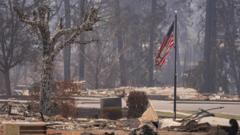
The containment failure of Washington state's recent wildfire outbreak stems from an intersection of high-density fuel loads, severe regional drought, and human-induced ignition vectors. On August 3, 2026, the Spokane County Sheriff's Office arrested 37-year-old Aaron F. Farinacci on suspicion of first-degree arson regarding the Old Trails Fire, the largest of three concurrent blazes threatening Washington's second-largest city. While the arrest provides a legal accountability mechanism for a single point of origin, the broader systemic crisis reveals fundamental vulnerabilities in wildland-urban interface management.
The Ignition Vector and Law Enforcement Response
The operational sequence leading to the arrest of Farinacci highlights the friction points between initial field encounters and rigorous forensic investigation. The Old Trails Fire initiated on Saturday, August 1, amidst extreme environmental stress factors. A civilian witness observed a suspect kneeling near grass where the ignition sequence subsequently began. For a closer look into similar topics, we suggest: this related article.
Initial field deputies made contact with Farinacci shortly after the fire was reported, detaining and questioning him before releasing him due to an incomplete aggregation of real-time evidence. The turning point in the evidentiary chain occurred when major crimes detectives reviewed body-worn camera footage alongside citizen tips. Authorities established spatial and temporal alignment between Farinacci’s presence and the origin point of the fire. Upon secondary detention, law enforcement recovered waterproof matches and a butane lighter.
Holding the suspect on a $1 million bond reflects the severe public safety risk and the catastrophic capital loss associated with the blaze. Farinacci possesses a prior felony manslaughter conviction from Arizona, adding a significant risk variable to his pretrial release assessment. To get more information on this topic, in-depth reporting can be read at The Washington Post.
Environmental Preconditions and Fuel Dynamics
An arson event does not scale into a regional disaster without structural environmental enablement. The Spokane-area blazes expanded rapidly due to three core systemic variables:
- Paultry seasonal snowpack reducing subsoil moisture reserves.
- Prolonged regional drought creating desiccated fine fuels, such as dry grasses and dead brush.
- High ambient temperatures combined with variable wind vectors capable of driving spotting behavior across natural firebreaks like the Spokane River.
These variables combined to produce over 700 destroyed structures and forced the evacuation of approximately 67,000 residents. The total footprint of the three primary Spokane-area fires expanded to roughly 16 square miles by early Tuesday. Across Washington state, more than 390 square miles have burned during a fire season tracking among the worst in three decades.
The Wildland-Urban Interface Bottleneck
The destruction footprint underscores the vulnerability of the wildland-urban interface. When residential housing developments overlap directly with unmanaged or drought-stressed wildland vegetation, municipal protection assets face an immediate capacity constraint.
During the initial hours of the Spokane outbreak, firefighting units attempted door-to-door defensive operations but were rapidly overwhelmed by the velocity of the spread. Over 1,000 firefighters, including out-of-state reinforcements, were deployed by Monday, with logistical projections indicating that resource totals would double. Despite these deployments, the fires remained entirely uncontained through the early days of the emergency.
Resource competition further degrades containment efficacy. The Pacific Northwest outbreak coincides with major active fires across Utah and Idaho, stretching federal, state, and local aerial and ground assets thin. Furthermore, civilian interference—specifically the operation of unauthorized drones near active fire zones—forced temporary groundings of aerial suppression units, creating operational delays in fire line establishment.
Resource Allocation and Strategic Municipal Defense
Municipalities facing high-density wildfire threats must shift from reactive suppression frameworks to predictive asset positioning. Because human-caused ignitions like arson bypass natural fire cycle predictability, regional emergency management systems require hardened surveillance networks within high-risk wildland-urban interface corridors. Prioritizing automated thermal detection and citizen-reporting integration bridges the latency gap between initial ignition and tactical response, minimizing the window in which an isolated spark can transition into a multi-structure catastrophe.

.png?itok=1mb05mKJ)

